The ruble passed the test: markets held, but the price of adaptation is high
What was confirmed in the 2025 forecast and which assessments require revision
Russian oil retained major buyers, agricultural exports returned to growth in 2026, and the ruble finished 2025 considerably stronger than the forecast presented by Ramil Akhtyamov, Candidate of Economic Sciences and digital economist, in “Real Time” in July 2025. As was stated, the economy's ability to adapt to sanctions was confirmed, while the estimates on the exchange rate and timing did not withstand scrutiny by the data. In his next authorial column for our publication, the expert sorts out what in the forecast held up and what did not, and why stability turned out to be arranged more complexly than he described last summer.
On July 30, 2025, I wrote for “Real Time” the column “The Ruble Under Protection.” At that time the threat of American tariffs against buyers of Russian oil was being discussed. I considered that trade ties and own resources leave Russia space for maneuver. Today I can say: the grounds for this conclusion were there. Now it is important to separate the confirmed conclusions from the specific estimates that were not confirmed.
The pressure did not remain rhetoric. Already on August 6 the USA announced an additional 25% tariff on imports from India because of purchases of Russian oil, with introduction on August 27. In October “Rosneft” and “Lukoil” fell under American sanctions. The test of trade ties was quite real.
India retained its economic interest
The most substantive confirmation of the ability to retain markets is the Indian direction. I assumed purchases at the level of 1.2—1.5 million barrels per day. According to OPEC's estimate in the February 2026 review, in December 2025 the deliveries amounted to about 1.3 million barrels per day against 1.9 million in November. Russia remained the largest supplier. The December estimate fell into my range, but one month does not confirm the whole base scenario.
According to a later OPEC estimate published in August, in June 2026 India purchased about 2.2 million barrels of Russian oil per day. The market was already affected by interruptions of supplies from the Middle East. This volume cannot be entirely credited to the former forecast: the conjuncture changed. But it confirms that Russian oil retained practical value for Indian refiners.
It is precisely the economic interest that I consider the main argument. A refinery evaluates the cost of the raw material, its quality, delivery and the possibility of making a profit. Political pressure changes this calculation, sometimes very sharply. However for the cessation of trade it has to outweigh the real commercial advantages.

China retained its significance under the new conjuncture
With China the result is more complex. According to Chinese customs data cited by “Interfax," over 2025 the deliveries of Russian oil declined by 7.1%, to 100.72 million tons. This does not support the thesis of growth over the whole year. But for the +15% laid into the scenario I did not set a clear base and period of comparison; the annual statistics include almost seven months before the publication. There is no strict verification of precisely this number here.
For January — September 2026 the picture changed: according to Chinese customs data in the publication of InfoTEK, deliveries grew by 18.3% year on year, to 87.58 million tons. Their value increased by 36.5%, to $51.54 billion. Here there is both physical growth and an increase in the sum of purchases. Russia remained the largest supplier on the Chinese market.
The growth occurred already against the background of the crisis in the Persian Gulf. According to the EIA estimate, the total oil import of China in the second quarter of 2026 declined by 32% to the first; sea deliveries from Russia also declined — by approximately 640 thousand barrels per day. The crisis was not an unambiguous gain for Russian exporters. By September Russia and Brazil together provided more than 40% of China's oil import against the backdrop of persisting interruptions from the Middle East.
The Chinese direction confirmed its potential. But the growth of 2026 reflects the new conjuncture. This is testimony to the ability to retain the market, and not the precise fulfillment of the quantitative forecast of July 2025.

Agricultural exports added again
According to FCS data, over eight months of 2026 the export of food and agricultural raw materials, except textile, grew by 20.1%, to $28.6 billion. This supports my thesis about the significance of the agrarian sector as an additional source of external revenues. But there was no continuous growth: in the same statistics for 2025 a decline of exports by 4.1% was recorded, to $40.9 billion.
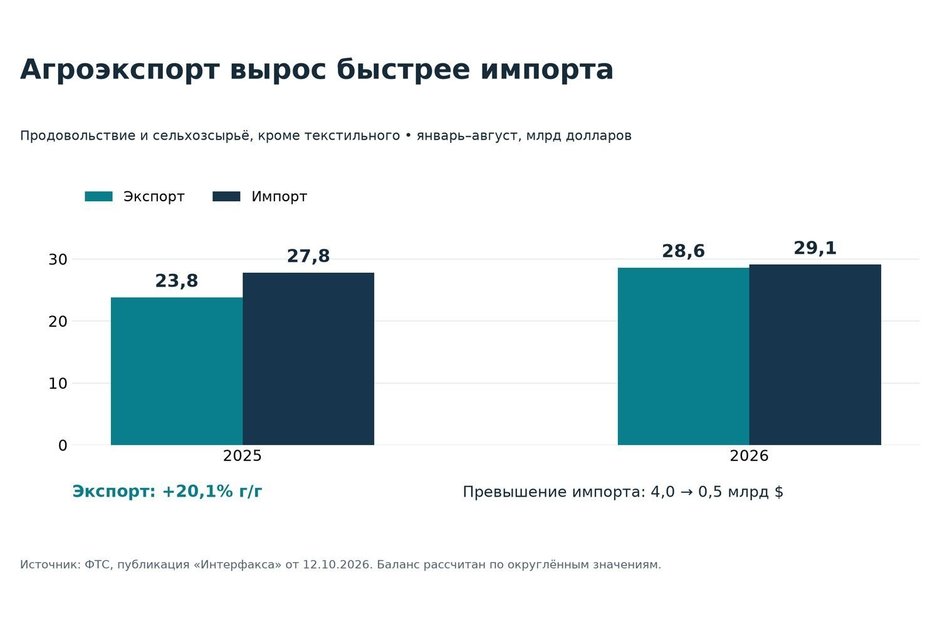
The import of this commodity group for January — August 2026 amounted to $29.1 billion. According to rounded data, the excess of imports over exports decreased from $4 billion to $0.5 billion. This is a noticeable improvement of the trade balance. It is, however, insufficient to calculate the contribution of the industry to the ruble exchange rate: for this information about the currency and terms of settlements is needed.
The ruble turned out stronger than my forecast
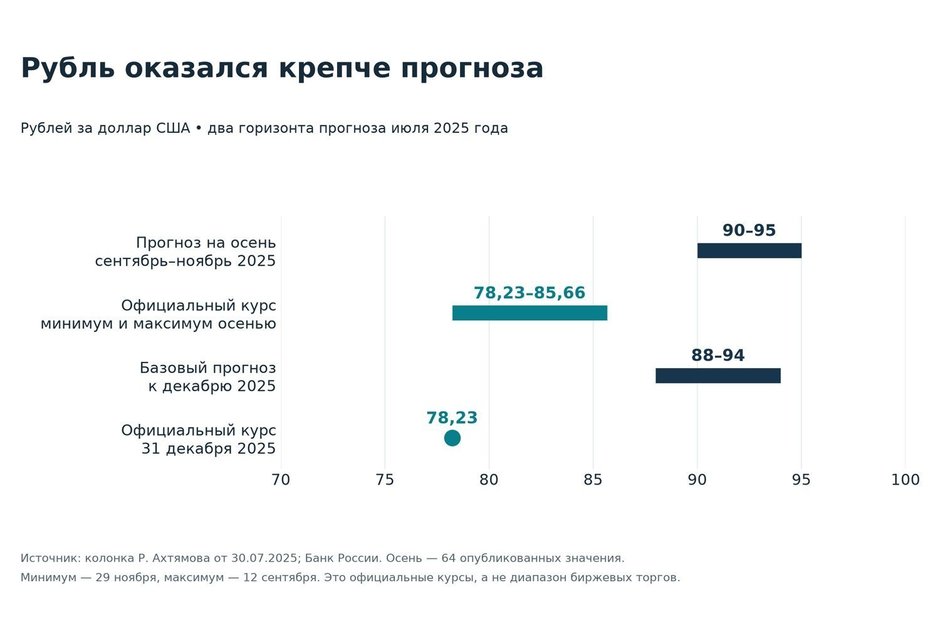
Here the result is unambiguous. I expected 90—95 rubles per dollar in the autumn of 2025. For September — November the published official rates of the Central Bank were in the range of 78.2284—85.6647 rubles — entirely below the forecast. By December I expected 88—94 rubles; on December 31 the official rate was 78.2267. Both forecasts were not confirmed: the ruble turned out stronger. This requires a revision of the weight of factors in the initial assessment.
In the initial argumentation I paid the main attention to the supply of currency through exports. Meanwhile the market has another side — the demand for currency. Already in the summary of August 6, 2025, the Bank of Russia linked the dynamics of the rate to a significant degree with the tight monetary-credit policy, which restrained imports and the need for currency for their payment. This factor requires more weight in the assessment of the ruble's stability.
A high rate makes ruble savings more attractive and credit purchases more expensive. A company postpones the acquisition of imported equipment; the consumer approaches large expenses more cautiously. As a result even under pressure on export revenues the demand for foreign currency may remain restrained.
Therefore one explanation “resource protection worked better than expected” is insufficient. Part of the stability was ensured by expensive money and limited demand. These mechanisms have a price for investments and business activity.
In my work about the timing of the return of inflation to the target I compared dated versions of forecasts. To my own column the same principle is applicable: we preserve the initial deadline and check the result on it. To shift the check from December 2025 to November 2026 would be wrong.
What changed in the work of the currency market
Over the past year there appeared the possibility to check the very mechanism of the state's influence on the rate. In my October study I collected 32 announcements of the Ministry of Finance for 2024—2026. For the assessment of the unexpected part of the announcement 31 events are suitable: 23 for 2024—2025 and eight for 2026. The rate of the yuan to the ruble is measured around the moment of publication.
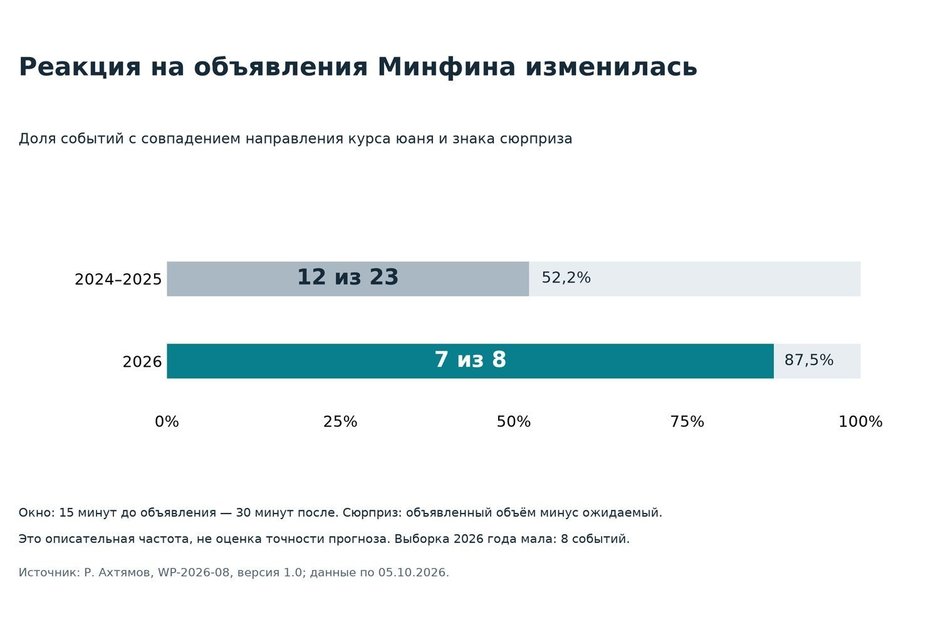
In 2024—2025 no stable reaction to the unexpected part of the announced volume was detected. In 2026 the connection became noticeable: the direction of the rate coincided with the sign of the surprise in seven cases out of eight. This is an observed frequency in a small sample, and not the accuracy of a trading strategy.
The change coincided with a reduction of the parallel currency operations of the Bank of Russia. But on eight observations it is impossible to separate this factor from other changes of the regime. All the more so such a study does not explain the whole annual rate. It shows a concrete short-term reaction of the market to new information.
For the former forecast this is an important clarification. It is insufficient to list oil, gold and the budget rule as sources of protection. One needs to understand what volume of currency will really come onto the market, when this will happen and what the participants already expected. The same resource under different rules of sale and different awareness of the market can give a different result.
It is precisely here that the boundary between a successful general thesis and a qualitative explanation passes. The preservation of exports confirms the possibility of adaptation. To assert by how many rubles it changed the rate, a separate assessment is required. To substitute it with the very fact of a strong ruble I would not do today.
The budget shows the price of adaptation
A stable rate does not yet mean that exports bring as much revenue as before. Over nine months of 2026 the oil and gas revenues of the federal budget declined by 17.2% year on year. Simultaneously the non-oil and gas receipts grew. This supported the total revenues, but the expenses increased more strongly in absolute terms, and the deficit widened.
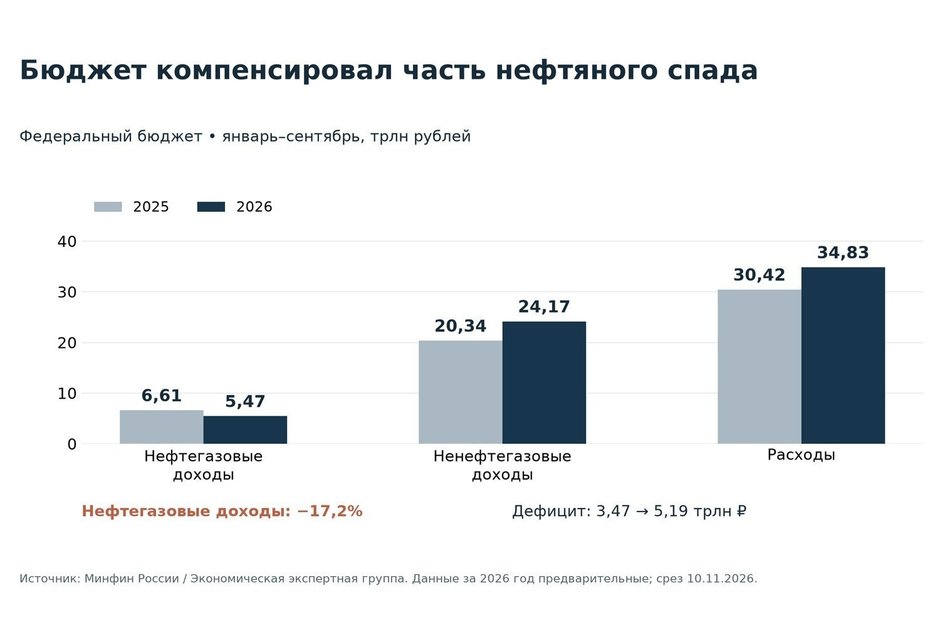
Table 1. Federal budget for January — September, trillion rubles
| Indicator | 2025 | 2026* | Change |
| All revenues | 26.95 | 29.64 | +10.0% |
| All expenses | 30.42 | 34.83 | +14.5% |
| Deficit | 3.47 | 5.19 | +1.72 trillion |
* Preliminary data. Calculations by unrounded values of the Ministry of Finance / EEG.
From these figures follows an important clarification for me. The economy has possibilities to compensate for the losses of individual sources of income, but such compensation is not automatic or free. The growth of non-oil and gas collections in itself also does not prove an acceleration of production — receipts are influenced by prices and tax conditions.
And export tons cannot be considered the final measure of success. After the sale of oil there remain expenses for transportation, insurance, intermediaries and financing. Analytical estimates of 2026 showed that the discount in the Russian port and the price at the Indian buyer could differ greatly because of transport costs. Therefore the discount to Saudi oil and the discount of Urals to Brent cannot be compared without identical delivery conditions.
Expectations for the BRICS stablecoin have not yet been confirmed
A separate revision is required by the forecast of the spread of the BRICS stablecoin. In the former column I described a possible construction and the expected timeframes of its development. These expectations have so far not been confirmed by realization. The proposed architecture was not equivalent to an agreed inter-state plan.
In the BRICS declaration adopted in New Delhi on September 12, 2026, the emphasis is placed on settlements in national currencies and the compatibility of cross-border payment mechanisms. The document does not announce the launch of a common stablecoin. There is no confirmation of the scale of its use I declared by the date of this column.
At the same time the general meaning of the task is preserved. Business needs payments with clear terms, a predictable commission and a lower risk of blocking. This can be achieved in various ways. The practical result is determined by whether the settlements go through; the name of the payment instrument is secondary.
The assessment of the timeframes must take into account the complexity of inter-state coordination. For a common digital settlement unit it is insufficient to write a program. One must agree on who issues the instrument, what it is backed by, who is responsible for redemption and what rules apply in a disputed situation. The countries have different currency regimes and priorities.
I already set this practical task in the column “The Russian Economy Is Ready for a Reload," published in “Real Time” on February 6, 2026. In the section about the digital corridor I considered a contract linking customs clearance, an electronic waybill and cargo tracking into a single system. Its meaning is to reduce costs and make the execution of the deal more transparent.
Then I developed this approach in a report about digital transport corridors at the XV International Forum “Russia and Greater Eurasia in the 21st Century” at the CEMI RAS on June 9—10, 2026. In the calculation model of the digital contract the effect is evaluated through the delivery time, transaction costs and the number of disputes. This is a model estimate, and not the result of a completed pilot. The next step is to check the expected effect on real deliveries along a specific route. Thus the idea receives measurable criteria of success.
The assessment should be formulated precisely: the proposed digital architecture has so far not been confirmed as an operating mechanism of ruble protection. But in November it is still early to draw the final conclusion on all possible pilots of 2026, and the reference points for 2027 are to be checked separately.
Resources need working mechanisms
Here there was a methodological error: in the initial text I did not clearly enough separate the already existing resources — gold and reserves — and the mechanisms of their use proposed by me.
The stock of gold does not turn into an export payment by itself. For settlements one needs the consent of the counterparty, infrastructure and an acceptable cost of the operation. Similarly a change of the parameter of the budget rule in itself does not create new money: it changes the rules of handling revenues and reserves.
Therefore the proposed gold auctions, currency swaps and new settlement schemes cannot be recorded as realized results without confirmed operations. They must be evaluated as proposals. Confidence in the resource potential must be accompanied by the same exactingness to the mechanism of its use.

Table 2. Results of the check as of November 10, 2026
| Thesis | Observed result | Assessment |
| Indian market | About 1.3 million bpd in December 2025 | The December estimate fell into the range; the whole scenario is not confirmed by this |
| Chinese direction | -7.1% over 2025; +18.3% over 9 months of 2026 | The potential was preserved; strict verification of the +15% forecast requires a set base |
| Agricultural exports | -4.1% in 2025; +20.1% over 8 months of 2026 | Return to growth after a decline |
| Ruble exchange rate | 78.23—85.66 /$ in autumn; 78.23 on December 31, 2025 | Both forecasts — 90—95 and 88—94 /$ — were not confirmed |
| Common BRICS stablecoin | Launch not announced in the 2026 declaration | Expectations ran ahead of confirmed decisions |
| Gold and currency instruments | Proposals require verification of realization | Cannot be considered fulfilled by the single fact of rate stability |
The main conclusion of July 2025 I preserve: large export industries and the economic interests of partners give Russia real possibilities to adapt to sanctions pressure. The preservation of the Indian market and the growth of Chinese purchases in 2026 are concrete confirmations of this ability. The return of agricultural exports to growth adds another source of revenue.
Part of the forecast estimates were not confirmed. The ruble turned out stronger than both expected ranges, and the common digital infrastructure has so far not reached the presumed readiness. For the Chinese direction the initial quantitative estimate should be checked only after clarifying the base and the period of comparison. The influence of the monetary-credit policy on the demand for currency requires more weight in further calculations.
Now I would follow three measurable values: the exporter's revenue after delivery and settlement costs; the term from shipment to receipt of available funds; the net volume of state purchases and sales of currency taking into account the operations of the Bank of Russia. This is a proposed set for monitoring, and not an already calculated stability index. Together with the demand for imports and the cost of credit it will help check by what path export resources reach the currency market.
The ruble turned out stronger than my forecast. The ability to retain markets was confirmed, but the influence of each protective mechanism still needs to be measured. The next step is to show what part of the export income remains with business and turns into investments. It is precisely thus that the resource potential becomes economic stability that can be checked.