Prehistoric picture gallery, dark matter map, dinosaur blood
Interesting science news of the week
At Peking University a toothbrush with piezoelectric bristles has been developed. In a Spanish cave a gallery of prehistoric rock art has been found, half a hundred images — of animals. Gene therapy was used to treat epilepsy, which enhances the effect of taking a medication; such an approach is called chemogenetics. In the bones of a dinosaur remains of hemoglobin were found — until now it was considered that blood could not have been preserved since the Cretaceous period. Based on data from the James Webb telescope the deepest map of the dark matter of the Universe to date has been compiled.
Scientists have developed a toothbrush that kills bacteria with electric current
Scientists from Peking University have created a toothbrush with piezoelectric bristles that generate an electric charge during tooth brushing. This launches the formation of reactive oxygen species that damage the membranes of the cell wall of pathogenic bacteria. The technology allows fighting harmful bacteria and increasing the relative share of beneficial microorganisms.
The basis of the development became polyvinylidene fluoride (PVDF). Under mechanical action it generates an electric charge. During brushing the bristles bend, and the arising electrical activity launches reactions with the formation of reactive oxygen species. They oxidize the bacterial membranes and damage them. The pathogenic microbes die. Thus, in laboratory experiments the miracle bristles suppressed the growth of Streptococcus mutans (which causes caries) by 52.8% and of Porphyromonas gingivalis (which participates in the development of periodontitis) by 78.21%.
The development was tested in a clinical study with the participation of 115 volunteers; it lasted 3 months. In the participants who brushed their teeth with brushes with piezoelectric bristles the indicators of dental plaque, gum inflammation and bleeding decreased. And there became fewer pathogenic bacteria in the mouth. But the content of some non-pathogenic microorganisms grew.
The authors note that the development combines mechanical cleaning of the teeth with antibacterial action, and such a brush does not even need batteries. True, the advantages of the technology over electric, ultrasonic and other modern brushes are still to be checked.

Tens of thousands of years in plain sight: a gallery of prehistoric art has been found in a Spanish cave
In Spanish Catalonia one of the largest collections of Paleolithic rock art on the Mediterranean coast of the Iberian Peninsula has been discovered. In the Cova de la Font Major cave scientists from the Catalan Institute of Human Paleoecology and Social Evolution (Spain) counted 280 graphic images, including 55 figures of animals. Among them — horses, deer, bulls, mountain goats and a bear image rare for Paleolithic art.
It is noteworthy that the drawings were in plain sight for dozens of years, and no one noticed them. The cave was accessible to visitors from 1957, and the section with the engravings was part of the tourist route from 1993. During this time thousands of people passed by the ancient images. Some left names and dates on the walls, not suspecting that they were spoiling a monument of prehistoric art.
The discovery was made by chance on October 30, 2019, during archaeological work, but a detailed article about it came out only now. One of the researchers drew attention to several images that differed from the numerous later inscriptions and petroglyphs by features characteristic of Paleolithic art. These images were very easy not to notice. The archaeologists explained that if one directs light straight at the engravings, they are practically invisible; to make out the hollows one needs to change the direction of the lighting. In the end a whole complex of prehistoric images was discovered, and now the Cova de la Font Major cave occupies third place by the number of animal images on the whole coast of the Iberian Peninsula. More figures have been found only in the caves of Ardales and La Pileta in the south of Spain.
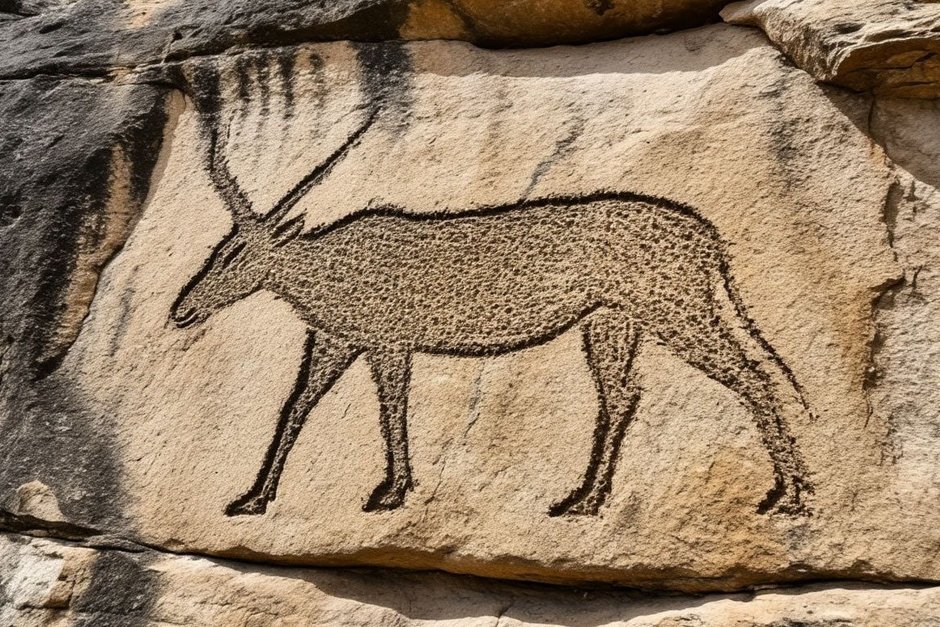
Most of the images are made by engraving: the ancient artists scratched the soft marl. The length of the drawings — from 15 to 45 centimeters. Besides the animals, numerous geometric images have survived on the walls: straight parallel lines, groups of intersecting strokes, circles, semicircles and quadrangular figures. Especially unusual is one composition consisting of hundreds of loops connected into horizontal sequences. So far the scientists have not been able to confidently determine either its age or its meaning.
Among the animals — horses, deer, mountain goats and aurochs. A special find — a bear with drawn ears and a half-open mouth. About 30% of the figures could not be precisely identified by species: the ancient artists often distorted the proportions of the head, neck, body and limbs, and almost did not draw out anatomical details.
The precise dating of the whole complex so far remains a task for further research. The scientists compared the images with archaeological finds and the peculiarities of the artistic manner. For now they suppose that the engravings appeared in the early Upper Paleolithic — not earlier than 26 thousand years ago.
Gene therapy helps against epilepsy
Experimental gene therapy helped three patients with epilepsy reduce the frequency of seizures by 90%. This result was obtained by Chinese scientists from the Capital Medical University in Beijing in the course of a clinical study. It was participated in by three adult patients aged 10—25 suffering from epilepsy caused by hippocampal sclerosis. They had already developed resistance to several anticonvulsant preparations. Their epileptic seizure occurred at least twice a month.
They were offered gene therapy: into a small section of brain tissue “responsible” for the seizures an adeno-associated virus was introduced. This virus was supposed to deliver a certain gene into the nerve cells of the affected area of the brain. In turn, the gene was modified so as to make the neurons sensitive to a certain preparation — clozapine. And clozapine acts as a “switch” and arrests the abnormal electrical discharges between neurons because of which the seizures occur.
The result is a three-stage system. The genetically modified virus is used as transport: it is introduced into the brain and delivers the needed gene into it. The gene increases the sensitivity of the cells to clozapine. Clozapine, in turn, “switches off” the provokers of epilepsy.

Clozapine began to be given to the patients two weeks after the gene therapy, and already two months later the average number of seizures decreased: in two participants of the experiment — from 4.5 to 0.5, and in the third — from 4 to 0.
The combination of gene therapy with the taking of a medication — an approach that is called chemogenetics. The approach is innovative; it is less traumatic than other methods of surgical treatment of epilepsy (for example, the removal of the section of the brain provoking the seizures, or the destruction of brain tissue with the help of a laser).
The research will continue, since the sample cannot yet be called representative. Three participants of the experiment — this is too few.
Dinosaur blood survived 115 million years
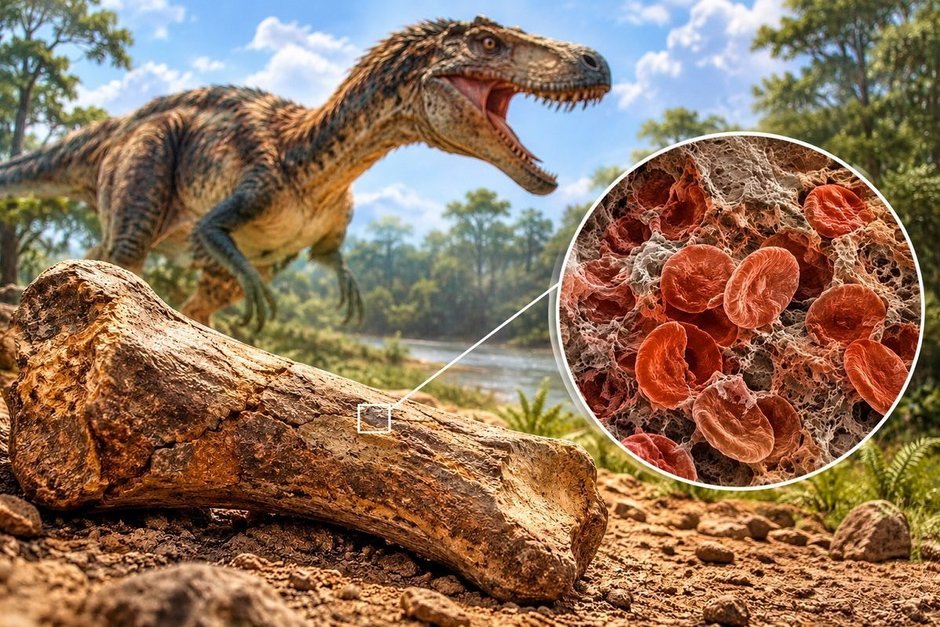
Molecular traces of blood were found in the fossilized bones of a dinosaur that lived about 115 million years ago. The find belongs to Aratasaurus museunacionali — a predatory theropod whose remains were discovered in the northeast of Brazil. Inside the bones of its legs the researchers revealed microscopic structures resembling erythrocytes, and the chemical analysis confirmed the presence of heme — the iron-containing component of hemoglobin responsible for carrying oxygen.
The chemical proof that before the scientists really turned out to be the remains of dinosaur blood — a big event for paleontology. After all, soft tissues and the molecules entering their composition usually break down much faster than the bones petrify. Therefore the discovery of organic compounds connected with blood after dozens of millions of years is considered a real miracle. Besides, such finds are hard to distinguish from the products of chemical reactions occurring in the bones during fossilization, or from traces of the vital activity of microorganisms that participated in the decomposition of the remains.
To check the origin of the discovered structures the researchers applied several independent methods of analysis. With the help of high-performance liquid chromatography and mass spectrometry they discovered in the bone tissue heme B and the products of its chemical change.
Then the scientists investigated the microscopic structures directly inside the bone. On the spectroscope they saw signals of porphyrins connected with heme, and transmission electron microscopy discovered iron, carbon and nitrogen in the same structures. The combination of chemical data with the location and form of the microstructures strengthened the hypothesis of their biological origin. The researchers interpret them as mineralized erythrocytes that were in the channels of the blood vessels of the bone.
Special attention the team paid to the mineral hausmannite — manganese oxide discovered inside these structures. According to the scientists' supposition, it served as a time capsule: it stabilized the cellular structures and protected part of the organic molecules from destruction.
The authors of the work consider that such finds open new possibilities for studying the physiology of extinct animals. If it becomes possible to reveal and compare molecular traces in other fossils, scientists will be able to investigate not only the anatomy of ancient organisms but also the peculiarities of their blood circulation, oxygen transport and metabolism.
The study does not mean that the scientists discovered untouched blood or whole hemoglobin molecules 115 million years old. It is a question of fossilized structures and chemically transformed derivatives of heme. But even such traces are capable of substantially expanding the idea of what information fossils can store and how far into the past it will be possible to look with the help of molecular paleontology.
To see the invisible Universe: one of the most detailed three-dimensional maps of dark matter has been created
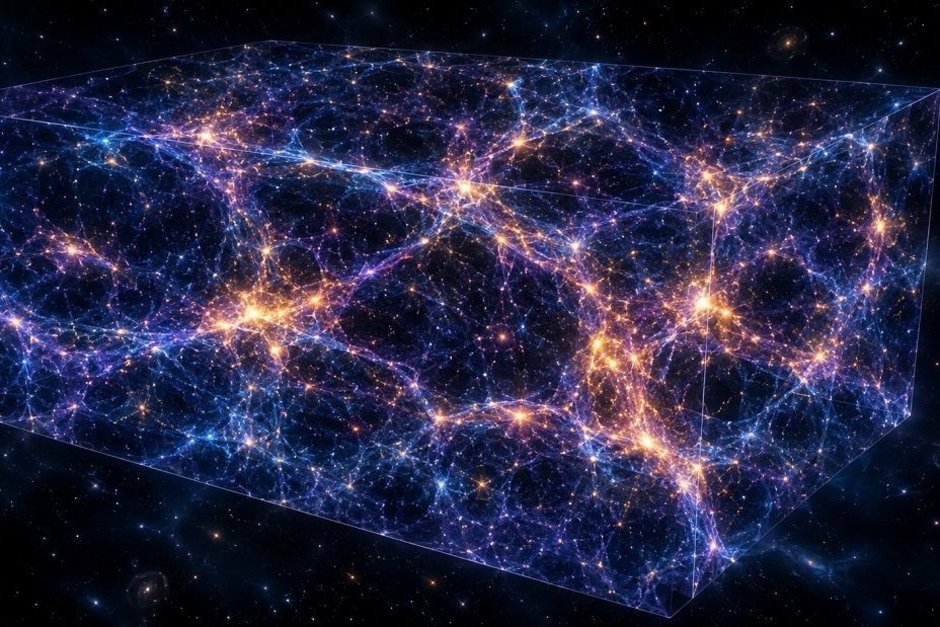
Dark matter, which cannot be seen directly, forms a kind of framework of the Universe. Its gravity helps galaxies gather into clusters and builds a gigantic cosmic web.
Now astronomers have managed to build one of the most detailed three-dimensional maps of this invisible substance and look 10 billion years into the past of our cosmos. For this an international group of researchers used data from the James Webb telescope and artificial intelligence. The study included information about 235,911 galaxies in one of the sections of the sky.
But how to see what does not emit light? Dark matter cannot be detected directly, but one can notice its influence on the light of distant galaxies. Under the action of gravity massive clusters of matter curve space-time and slightly deform the images of objects located behind them. By these distortions astronomers determine where the invisible mass is. This effect is called gravitational lensing.
Earlier such observations allowed mainly obtaining flat maps on which structures located at different distances and at different times from the Earth were superimposed on each other. To separate them the scientists combined the data of the James Webb telescope with a neural network preliminarily trained on thousands of computer models of the Universe. As a result it was possible to reconstruct the distribution of matter on 20 conventional layers covering distances right up to the era of about 10 billion years ago. This is twice as far as the previous three-dimensional maps built from the data of the Hubble telescope allowed.
The new reconstruction helped separate clusters of matter that on the former maps looked like single structures. Besides, the scientists discovered several regions of increased density connected with distant clusters of galaxies not distinguishable on the previous map compiled on the basis of the data of the Hubble telescope.
The authors of the study count on this method being applied to far larger volumes of cosmic observations. In the future it can be used for the analysis of data from the Euclid and Nancy Grace Roman telescopes. This will help trace how over billions of years the distribution of dark matter changed and the cosmic web formed that determined the appearance of the observable Universe.