Olya Gulchak: “There are very many comedians — the quality of comedy at open mics has fallen”
The headliner of the “Text” festival — about philological humor, Murmansk and chak-chak
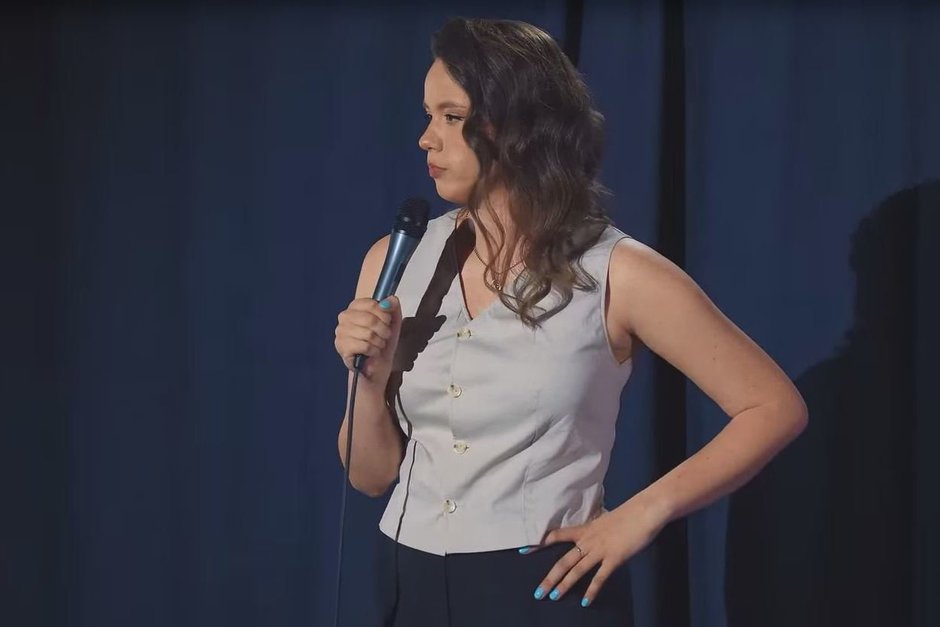
At the “Text” festival in the National Library of Tatarstan there will be stand-up — Olya Gulchak will perform here with a solo concert — a finalist of the show “Comedy Battle," a member of the KVN team “Bez bab," of the projects “Improvisation. The Team," “Battle for Time," “StandUp Roulette," the host of the travel shows “Labels on the Map” and “One of Our Own in India.” In an interview with “Real Time” the native of Transnistria tells about the difficulties of the work and about which language she would like to study in old age.
“In ordinary bars I each time simply performed it to silence”
— Olya, if one watches your monologues and concerts in a row, one could in principle already write your biography — here are the philological quirks, and there the stories about a train compartment. It seems to me that you briskly move away from the first images by which you were remembered on television. Which material was easiest and hardest for you?
— Probably it was precisely the material about philology in my first performances that was the hardest, because it was quite hard to write it; for this one had to dig through various articles, that is, conduct a whole scientific, research work. And as a bonus to everything — this material did not work. In ordinary bars I each time simply performed it to silence. It was very hard morally, and it worked only once. But how, in the very “Comedy Battle”! It was hardest to write it. The easiest, probably, is to write material on general, some everyday, recognizable themes. For example, those very stories about a train compartment, about snoring people, what is close to people, what they come into contact with every day.
— For me your concert “Descendant of the Atlanteans," where you speak about Transnistria, was very interesting. It came out, as I think, the most relaxed, but at the same time sharp. If you were filming it now, what would you add to it?
— Well, I sometimes still tell some blocks of jokes that were in that concert at various performances, and the jokes acquire new branches, that is, some new circumstances are a little grafted onto them, maybe some improvisation with the audience. On the whole globally I would not add anything to that concert in terms of thoughts. Unless some contextual jokes could be added. It seems to me that my last year's work, that solo show, is on the whole completed. I would not add anything.
— I followed a little how your travel show filming went. About which cities would you yourself film a TV show? And, of course, what would you tell about Kazan?
— I would definitely film a show about Murmansk; I visited there recently. We had a press tour with journalists timed to the birthday of Murmansk. I very much liked Teriberka, I very much liked the Barents Sea, I very much liked the northern cuisine — everything is very beautiful. I would definitely film some travel show about this city. On the whole I did that too — simply in a small format. On my page in all social networks you can watch mini-vlogs from Murmansk.
Unquestionably I would like to film some show about Kazan, because Kazan has a very interesting history, very interesting beautiful architecture, very tasty national cuisine. Therefore about Kazan, probably, there would be a program about the capital of hospitality — I filmed a small vlog from Kazan; I think I called it that. Because here it is always very pleasant, everyone meets me, both the organizers and the comedians are always very friendly, everything is very cozy, in a kind way. Therefore, probably, I would reveal Kazan from the point of view of the people who live in it, and chak-chak.
“A small crisis of the genre”
— Stand-up is also about networking, tech checks, and run-throughs. And I read that you do not particularly watch other comedians. Where do you go to test material? Do you have a “comedy buddy," how friendly or, on the contrary, toxic is this environment?
— Now I more often test material at solo concerts in various cities, because it has become far simpler than testing anything in Moscow. In Moscow there is a certain decline of stand-up as a genre, a small crisis of the genre. Therefore I test material more often in the regions, and I like this very much, because people are not yet spoiled by comedy, they react sharply and vividly to everything. It is very interesting to communicate with the residents of various cities, to learn the problems that worry them, to tell them that in Moscow some problems simply do not exist, and to hear the feedback. This is always interesting. As for the “comedy buddy," several times we wrote with Borya Zeliger. He is my great friend, also a comedian, who is commonly considered an intelligent comedian. I have long been used to intellectual humor with Borya, I have become attached, therefore we came together in some opinions, for some time we together accelerate material for each other.
How friendly or, on the contrary, toxic this environment is, I cannot judge, because the environment is very large and, of course, in it, as in any society, there are more friendly people and more unfriendly ones. I am not greatly friends with comedians; I have a certain number of comedian friends, and I selected them by my own internal criteria, with whom it is comfortable for me to be friends. I do not consider them toxic, correspondingly, but, without question, there are people worse than my friends. In general the whole crowd of comedians is more cheerful. But this too depends on the place and the number of people and their experience in comedy.
— Do you teach stand-up, do you see now problems in Russian stand-up that prevent it from moving forward?
— Now I do not teach stand-up. Earlier I worked on various stand-up courses as an editor and lecturer; now I have moved away from this a little. Honestly, lately there is neither strength nor time. I want to devote more attention to my own material, although on the whole the editorial practice was a very good warm-up for the brain.
Do I see problems in Russian stand-up that prevent it from moving forward? Probably now there is a large influx of people who are interested in this genre. Because of the fact that very many comedians have appeared, the quality of comedy at open mics has fallen; there are more and more beginners. And this is the case when quantity, unfortunately, beats quality. But I think this is temporary. I think that now there is demand for stand-up, since it is a very personal, frank conversational genre. Now people have something to say, and they want to speak, therefore now there is a boom, but it, without question, influences the quality of the events that are held. Now the genre is a bit hard, it seems to me.
— Does any other language besides Russian and French enchant you, and with what?
— Sanskrit interests me madly. I am interested in the fact that the first sacred scriptures were written in it. It is very complex. A minimal number of people in the world know it and teach it. Therefore it, probably, attracts me most of all. And when I have enough time, focus and desire, I would take up the study of Sanskrit and the translation, perhaps, of some books in it. This is what I will leave for old age.