Russian auto industry — 2026: production is growing, but the market is going to competitors
Decline in Lada's share and expansion of Chinese brands — key barriers for domestic automakers
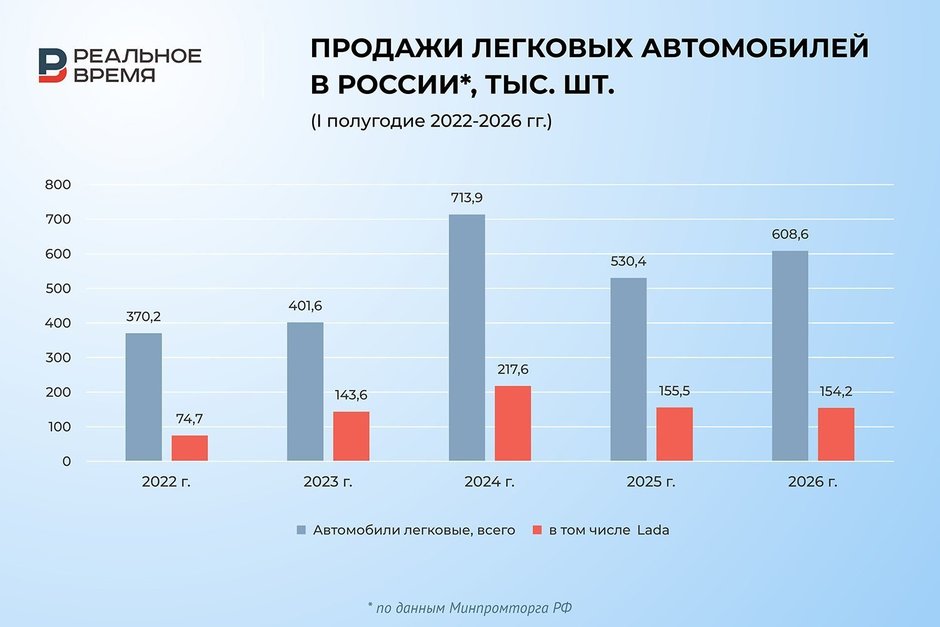
Passenger car production in Russia in the first half of 2026 increased by 16%, with the largest growth occurring in June — 73.2% more than a year earlier, according to Rosstat data. According to the results of six months, according to the Russian Ministry of Industry and Trade, over 608 thousand new passenger cars were sold (+16%). In the truck and bus segment, on the contrary, the trend of previous years continued — a reduction in production and sales volumes. How production and the automotive market in the country are changing, why, according to experts, AvtoVAZ is losing the competitive battle to the Chinese, and what measures could change the trend of the domestic vehicle market “collapsing” — in the material by Realnoe Vremya.
Production is growing, Lada's sales share is falling
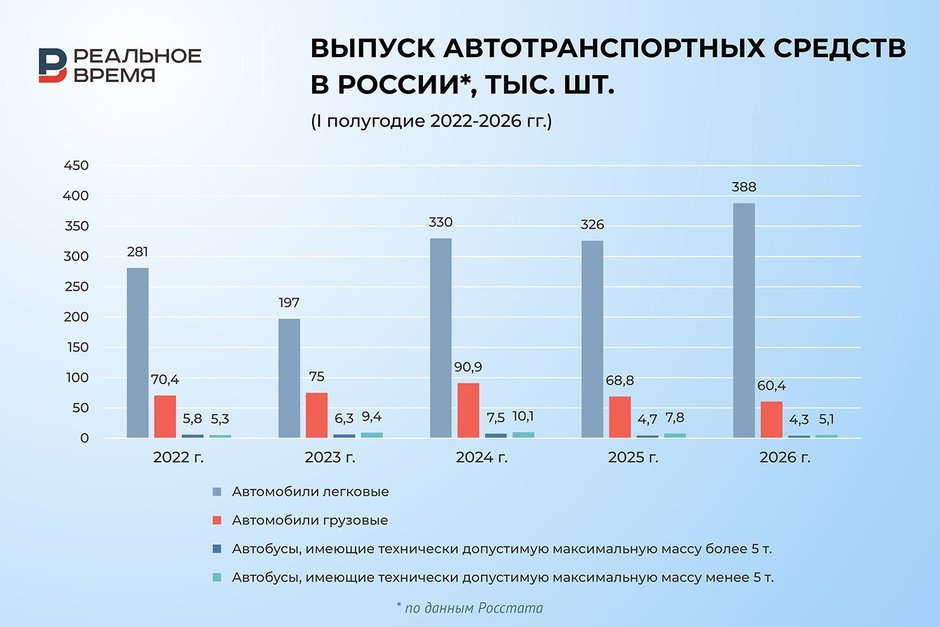
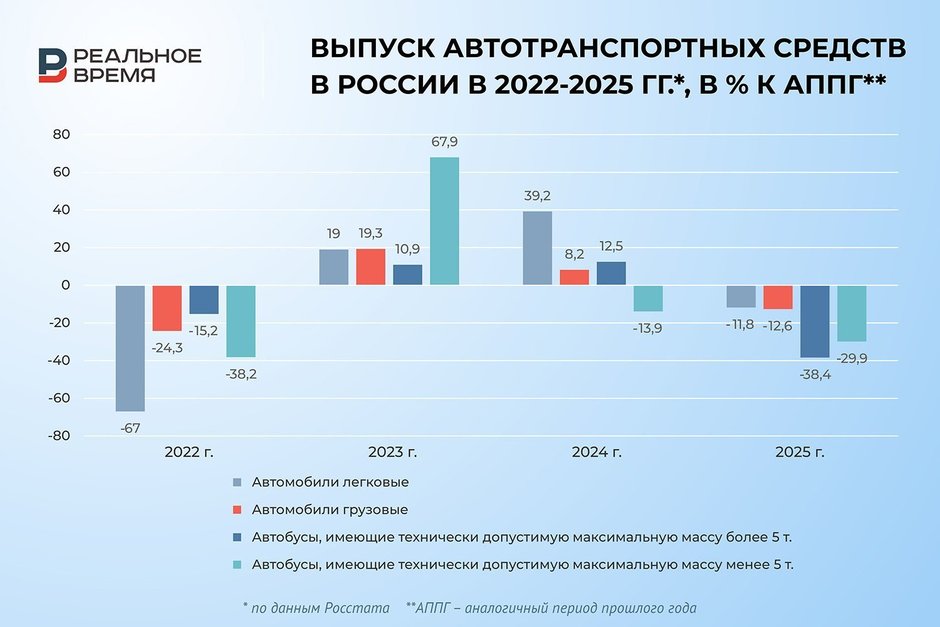
In the first half of 2026, 388 thousand new passenger cars, 60.4 thousand trucks, and 9.4 thousand buses were produced in Russia, Rosstat reported. Passenger car production exceeded the figures for the first half of 2025 by 62 thousand, while production of other types of vehicles continued to decline.
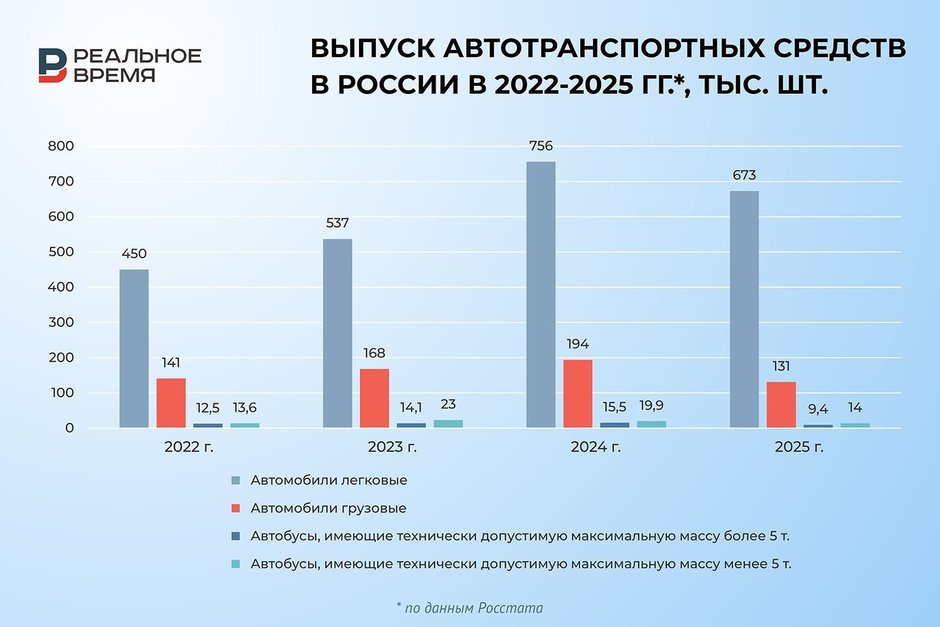
Statistics from the previous four years showed a trend toward growth in passenger car production starting in 2024, but the figures indicate that the “drop” recorded in 2022 was overcome in 2024, while in 2025, the domestic auto industry lost ground again.
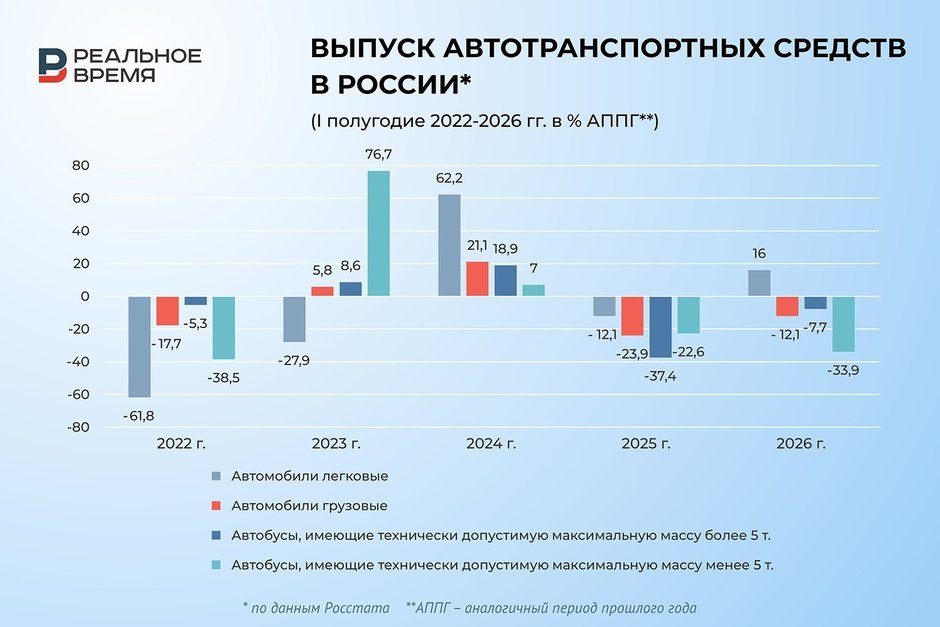
Truck production in 2025 fell below the 2022 level and continued its downward trend in the first half of 2026. Bus production also has not yet returned to the level of five years ago.
Sales of new passenger cars in Russia in the first half of 2026, according to the Russian Ministry of Industry and Trade, exceeded the level of the same period in 2025 by almost 80 thousand units, but turned out to be lower than the 2024 level by more than 100 thousand.
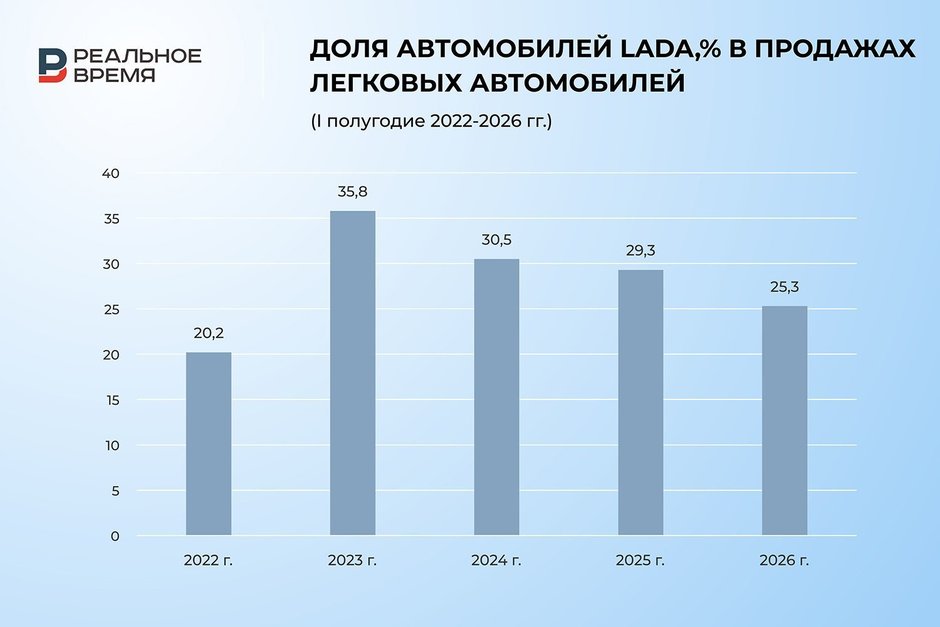
And AvtoVAZ's share of total sales in the first half of 2026 turned out to be the lowest in the last 4 years — 25.3% (in 2023, Lada cars accounted for more than a third of sales (35.8%).
Theoretically, the situation in the passenger car market could be changed by banks' lending policies. For example, in Tatarstan, according to eKredit, in the second quarter of 2026, the average rate on new car loans decreased to 11.1%, and the banks' approval rate rose to 79%, with the Russian average reaching 77%. The approval rate for car loans in Tatarstan increased by 1 percentage point, while the average price of a new car in the region increased slightly — to 2.69 million rubles. However, the volume of lending in monetary terms, as reported by Avto.ru, remained stable, and the average car loan amount and car price did not change — 1.84 million rubles and 2.76 million, respectively.
The buyer chooses “Chinese” cars
— Our most popular car is the Lada, — says economist and head of R-Invest, Rustem Shayakhmetov. — And if we talk about the results of passenger car sales over the past 6 months, a quarter of the cars sold were new Ladas. The passenger car market as a whole has improved — in 2025 there was a decline, while in the first half of 2026 sales grew by 14.8%, but Lada sales fell by 2.2%. At the same time, in June 2026, a total of 116 thousand cars were sold, of which 28 thousand were Ladas. Overall sales growth was 29%, while Lada sales growth was only 16.2%.
The expert sees the reason for the “stalling” of domestic car sales in the successful competition from the Chinese. He believes that the increase in the recycling fee, on which great hopes were pinned, did not have a positive effect, and the “dependency mentality of manufacturers” is worsening the situation and the competitiveness of Russian cars, which are inferior to “foreign” ones primarily due to outdated production technologies and weak service:
— The first 7 most sold car brands today are Chinese, followed by Toyota and Mazda, which are also returning to the market. In the first half of 2026, for example, 84 thousand HAVAL cars and 11 thousand Mazdas were sold. That is, the main market is actually being shaped by Chinese manufacturers who are displacing our cars.

At the same time, Rustem Shayakhmetov noted, labor productivity in the Russian auto industry is low, therefore, the cost of producing one car is higher than in China, while workers' salaries are lower.
— The management of AvtoVAZ should think about how to respond to today's challenges, rather than going around with a begging bowl for more bailouts, — he believes. — Especially since billions of dollars were already poured into it in the late 1980s and 1990s, but no results were achieved that would allow it to compete with foreign manufacturers. Today, we have high customs duties and a recycling fee — this is artificial support for the manufacturer at the expense of the buyer. And the fact that the cost of servicing cars over their life cycle is higher than their purchase price is not taken into account — that is, the main expenses are in any case incurred within the country, and by restricting the import of foreign cars, we are primarily also restricting the development of the Russian auto service industry.
Shayakhmetov recalled that in 2025, for the first time in modern history, Russia saw a decrease in the number of registered cars, and this is an alarming factor. It means that the purchasing power of the population has decreased, the affordability of cars has decreased, and not everyone who wanted to can replace “retired” cars with new ones. What was done to support the domestic auto industry has resulted in a collapse of the car market.
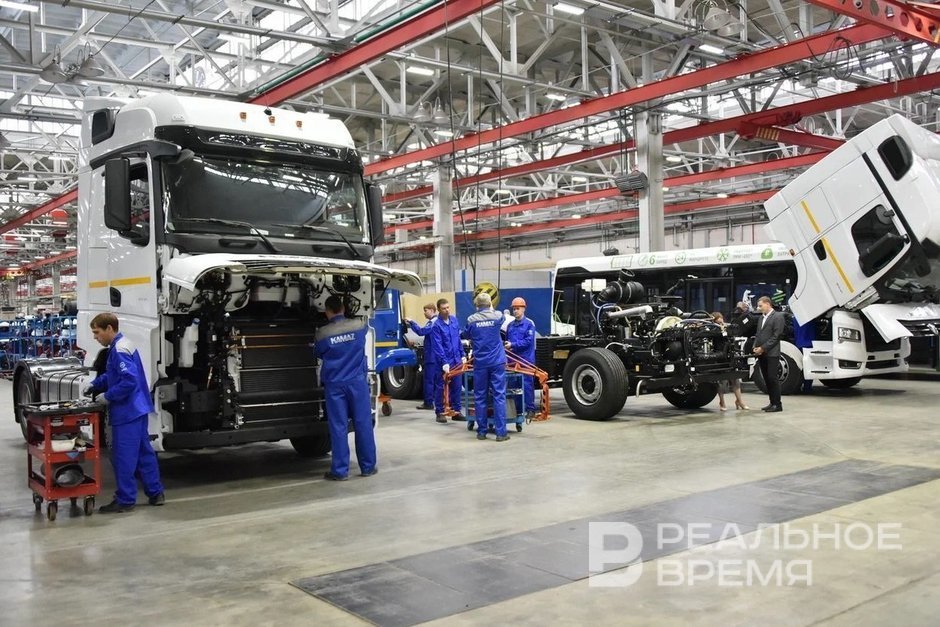
As for trucks, the drop in demand for them may also be partly due to the successful competition of Chinese and Kazakh carriers, the expert believes. They pay taxes in their countries, their costs are lower than those of Russian companies, and given that unmanned transport is rapidly developing in China, to win the battle for the freight transport and truck market, Russia needs to create conditions for domestic road transport to be cheaper.
“Freight transport is being destroyed at the root”
Realnoe Vremya expert, former fleet director of “Black Auto," Airat Gatin, believes that the growth in passenger car production in the first half of 2026 is a consequence of government stimulation of the auto industry:
— There is no demand as such for them today, but the adoption of the law on taxi localization has borne fruit; Russian cars began to be bought specifically for commercial purposes — for taxi fleets, for rental. Demand is negatively affected primarily by the import of cars from abroad, first and foremost from China. Since the Chinese have better quality and more comfort, the buyer chooses what to spend 2-3 million rubles on. Russian cars, in my opinion, are 'stuck' at the level of the 1990s; many are still produced without power steering, automatic transmissions, or air conditioning, and their price tag reaches 2 million rubles.

Gatin explains the continuing decline in truck production by problems in the freight transport market, in particular the fact that today, due to economic circumstances, carriers have to pay many “bills” at once, while they receive payment for their services later:
— Freight transport in our country is being legislatively destroyed at the root for some reason. Gasoline and diesel fuel must be refueled immediately, Platon, toll roads, fines must be paid immediately, while payment for services comes with delays of 10–20 days. Today, the customer actually has no money in the accounts — first he sells, then he pays suppliers and carriers. At the same time, transport services have become cheaper. This is because all orders are distributed through a single portal — ATI.SU — and the price per kilometer has fallen sharply — if before something was transported, for example, for 150 thousand, now it is transported for 70. In addition, Chinese carriers, whose transportation costs are lower, are taking over the market. And the decline in truck production may in principle be a response to the fact that there is no demand for them due to the curtailment of the Russian transport market. The domestic market, in my opinion, is being destroyed; it will take a few months to destroy it, but years to restore it.
The expert explained the decline in bus production simply: due to cuts in municipal budgets, bus purchases have decreased, public transport is not being renewed, and there is no point in enterprises producing into a void.
“Long-term planning is needed”
Sergey Sotnikov, head of the logistics company “Reverse” and chairman of the relevant committee of the Tatarstan Chamber of Commerce and Industry, says that for a correct assessment of the market situation, one should take into account statistics not of one or two, but of several years, and in order for production to operate normally, without “ups” and “downs," government support is needed, but not in the form that exists now:
— For example, if we take public transport, which the state cannot leave without control, we need to switch to government procurement. Then factories will be properly provided with orders. No factory can function normally if sales fluctuations are in the range of 15–30, or even 50 percent — this puts the factory on the brink of ruin. And our domestic auto industry is largely unregulated, and we see the result of the lack of proper regulatory activity.

Sotnikov links the decline in production of tractors and trucks to a set of mistakes: in 2022–2023, preferential loans appeared and they gave a “takeoff," but when they were exhausted, it turned into a “fall.”
— The automotive industry needs to be supported, but it should be supported not through banks, in my opinion, — says Sotnikov. — Because for banks, the main thing is to issue loans, and it is especially profitable to issue subsidized loans, on which they receive guaranteed interest from the state. The banks' profit is built into the initial stage of loan repayment, and then they deal with the seizure of collateral trucks from debtors. This is exactly what happened when the crisis began and freight transport sharply declined, and there were simply no people willing to invest in it. At today's prices, it is unprofitable to buy trucks; banks will probably lobby for subsidized loans again. But, in my opinion, they are not needed — long-term planning of the industry and guaranteed orders from the state to certain enterprises are needed.
In addition, the expert believes, while supporting the domestic automaker, it is also necessary to support the entire motor transport industry — both the seller and the buyer. Producing something that no one can afford to buy is pointless, he emphasized.