Sugar skulls and Calavera Catrina: do Mexicans really laugh death in the face?
Book of the week — Ksenia Yamasheva's study “The Day of the Dead in Mexico”

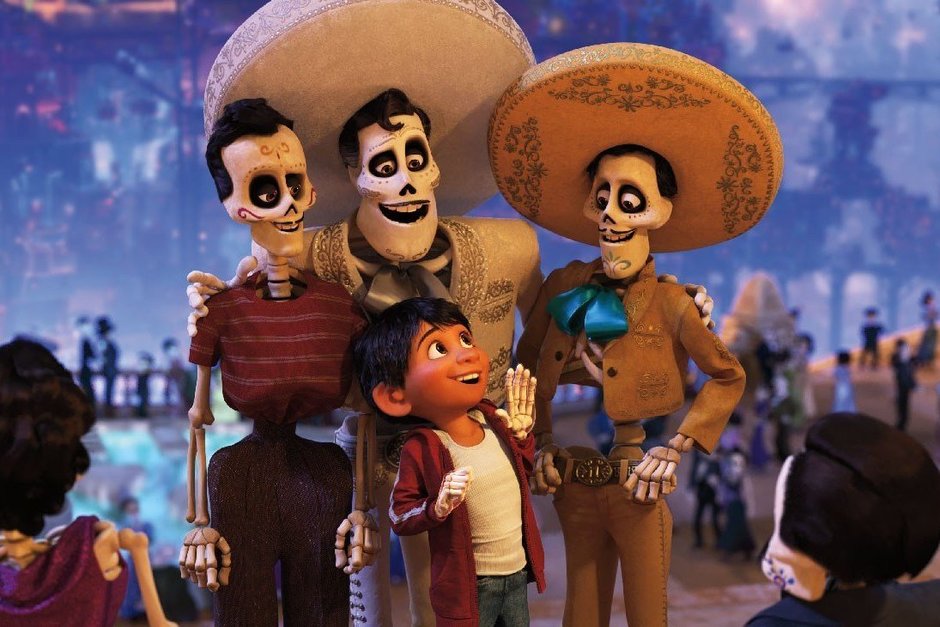
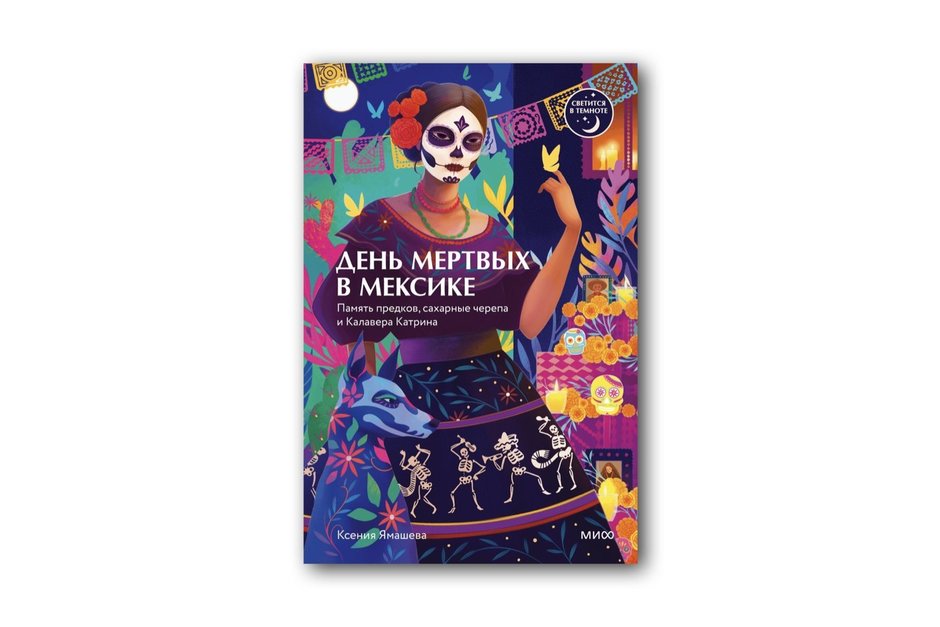
In 2017 the animated film “Coco” came out on screens. In it the twelve-year-old Miguel on the Day of the Dead accidentally ends up in the underworld, where he meets his deceased relatives and gradually reveals the story of his family. It is precisely this animated film that colorfully demonstrates the Mexican tradition of celebrating the Day of the Dead on November 1 and 2: bright skulls, candles, photographs of deceased relatives, rose petals, treats and merriment. “Coco” perfectly conveys the emotional side of the holiday but inevitably simplifies the historical picture. The literary reviewer of “Real Time” Ekaterina Petrova tells how the researcher Ksenia Yamasheva sorted out the origins of the holiday in the book “The Day of the Dead in Mexico”: why Mexicans celebrate death so brightly and whether it is true that they relate to it with less fear than representatives of other cultures.
The Day of the Dead — the calling card of Mexico and a source of stereotypes
The historian, art historian and specialist in the fine arts and iconography of pre-Columbian Mesoamerica, Ksenia Yamasheva, begins her book with the stable contradiction that has taken root in relation to the Day of the Dead. On the one hand, this holiday attracts attention to the history and culture of Mexico, and on the other — contributes to the formation of superficial ideas about the country.
In the mass consciousness Mexico is firmly associated with death: Aztec sacrifices, sugar skulls, skeletons, Calavera Catrina, Santa Muerte. And all this unites into a kind of abstract “Mexican death cult.” It is precisely against such a simplification that the author of the book “The Day of the Dead in Mexico” speaks out. This is not a homogeneous national festival with identical rites across the whole country. For example, in Central Mexico and in Yucatan the deceased are commemorated in completely different ways. In Yucatan the holiday has a more intimate and serious character.
To explain this, Yamasheva turns to the beliefs in pre-Columbian Mesoamerica. For the ancient Mesoamericans death was not a complete break between the living and the dead. The cult of ancestors lay at the base of the religious system. It was considered that the deceased continue to interact with the living, and the ancestral connection does not cease even after death. For example, the ancient Mesoamericans had such a concept as the Cave of Ancestors — a space where the souls of the deceased dwell. Therefore earlier caves and gorges were perceived as a passage to the underworld. Mourning for the deceased continued for four years; during this time the soul had to pass a series of trials and return to the space of the ancestors, with whom the living continued to maintain a connection.
This idea of cyclicity lay at the base of the beliefs. The author tells about the Mayan goddess Ix Tab, whom Yuri Knorozov (it was he who deciphered the Mayan script) called the rope-maker. She is connected with hanging and acts as the patroness of those who left life in this way. Yamasheva cites the testimony of the second bishop of Yucatan, Diego de Landa. In his work “Account of the Things of Yucatan” he wrote: people believed that those who died by hanging ended up in a special paradise where the goddess Ix Tab met them. But the researcher does not limit herself to this. She points to the symbolism of the rope as an invisible umbilical cord connecting a person with his ancestors.
The presence in the pantheons of the Mesoamericans of deities connected with the underworld does not at all mean that their whole religion was built around the worship of death. Yamasheva fundamentally emphasizes that one should not confuse the veneration of ancestors and of the deities of the underworld, which, by the way, exist in many mythologies, with the worship of personified death.
The meeting of two religious traditions
After the Spanish conquest the Christianization of the indigenous population began. But the Indian ideas about death and the veneration of ancestors did not disappear. As the author asserts, Christianity and the local beliefs had points of contact. Both traditions venerated ancestors, and the dates of the Catholic memorial holidays coincided with the period close to the traditional periods of veneration of ancestors among the Indians. All Saints' Day (November 1) and All Souls' Day (November 2) came to Mexico together with the Spaniards in the 16th century, and the local rites gradually adapted to the Catholic culture. But this concerns the merging specifically of local Indian funeral practices.
It is easy to be mistaken if one judges the origin of a custom exclusively by its outward appearance. Yamasheva says that only some elements of the modern Day of the Dead really go back to the pre-Columbian era. The tradition of placing photographs and memorials on the altar appeared in Mexico only at the end of the 19th — beginning of the 20th century. Although the Mesoamericans created posthumous masks, this practice was also widely spread in the Old World, for example among the Romans. So it is hard to speak of a direct continuity.
And the treats on the altars are, of course, connected with the ancient cult of ancestors and the belief that souls are satiated by smells. But at the same time Yamasheva makes the caveat that the bread of the dead is an adaptation of the Catholic tradition. Before the arrival of the Europeans the Mesoamericans used maize dough rather than wheat flour and did not bake special memorial breads. There is a merging of two similar customs.
But the marigolds on the Day of the Dead, according to the researcher, have clear pre-Columbian roots. The name of the flower (cempasúchil) comes from the Nahuatl language, and the plant itself is mentioned in the descriptions of the Aztec holiday in honor of the goddess Xochiquetzal. Finally, sugar skulls — the brightest element of the holiday. The symbol of the skull was extremely important in the culture of Mesoamerica, but the technique of making sugar sculptures came from the Arab tradition through the Spanish colonists.
In some regions, especially in isolated villages, the ancient customs manifest themselves more strongly than the Catholic ones. For example, in Yucatan they celebrate Hanal Pixán — the “food of souls.” This holiday is more intimate than in Central America. Here three-tiered altars are built and pib (tamale baked in a pit) is prepared. But the brightest and most unusual tradition — the cleansing of the bones. The relatives literally clean the bones of the deceased, talk with them, tell family news and each year change the cloth in which the remains are wrapped. The place where the bones are placed is decorated and painted with bright colors. For the living this becomes a new “place of residence” of the deceased relative.
Why Mexicans laugh at death
Mexico and the neighboring territories in the 16th—17th centuries were swept by epidemics of diseases brought by the Europeans. And for the local population this became a catastrophe. Whole small settlements died out. It was then that the cult of San Pascual Bailón arose. He was a Spanish monk whom the indigenous population began to depict in the form of a skeleton on a throne, in a crown and with the attributes of death. The legend about him appeared in Guatemala during the epidemic of 1650. Then, under the influence of the local worldview, the transformation of the Christian image occurred. Yamasheva notes that the Catholic Church did not approve of such a depiction of the saint and even ordered some figurines to be confiscated and burned.
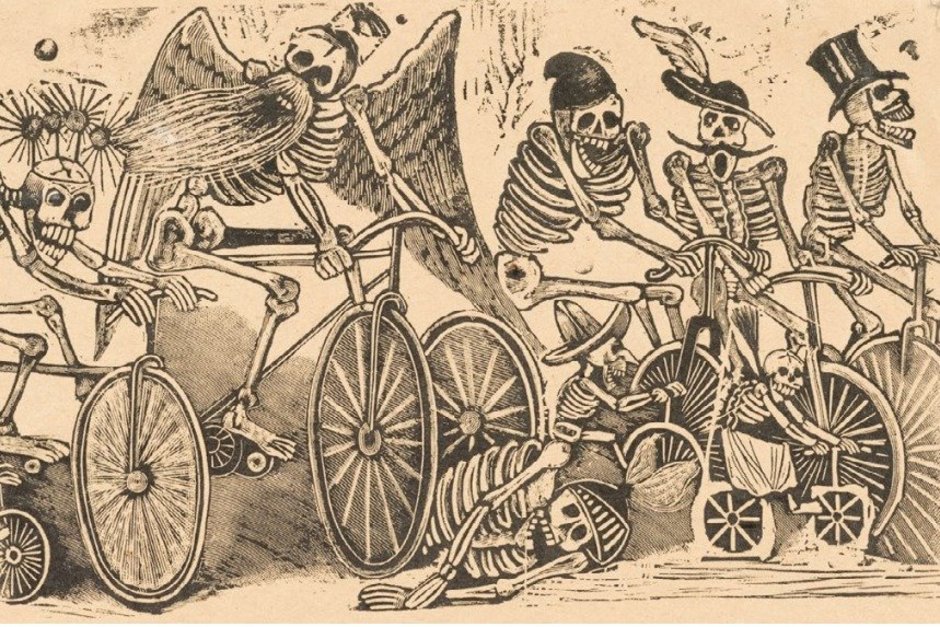
The next “transformation” of the image of death occurred already at the end of the 19th century, when Mexico was shaken by political conflicts and class inequality, and also the struggle for national identity began. In the newspapers of this period calaveras began to appear — satirical poems with illustrations in which skeletons depicted politicians, the rich, representatives of various professions and social strata. At this moment death turned into an instrument of social criticism, since before it both the rich and the poor are equal. An important role in the popularization of this genre was played by the artist José Guadalupe Posada. His skeletons are an artistic language with the help of which he ridiculed power and the striving of the Mexican elite to imitate Europe.
The brightest example of the calavera, which has become a national symbol of Mexico, is Calavera Catrina. It is the skeleton of a woman in a luxurious hat and elegant clothing. Her image precisely ridiculed those Mexicans who were ashamed of their origin and tried to copy European fashion.
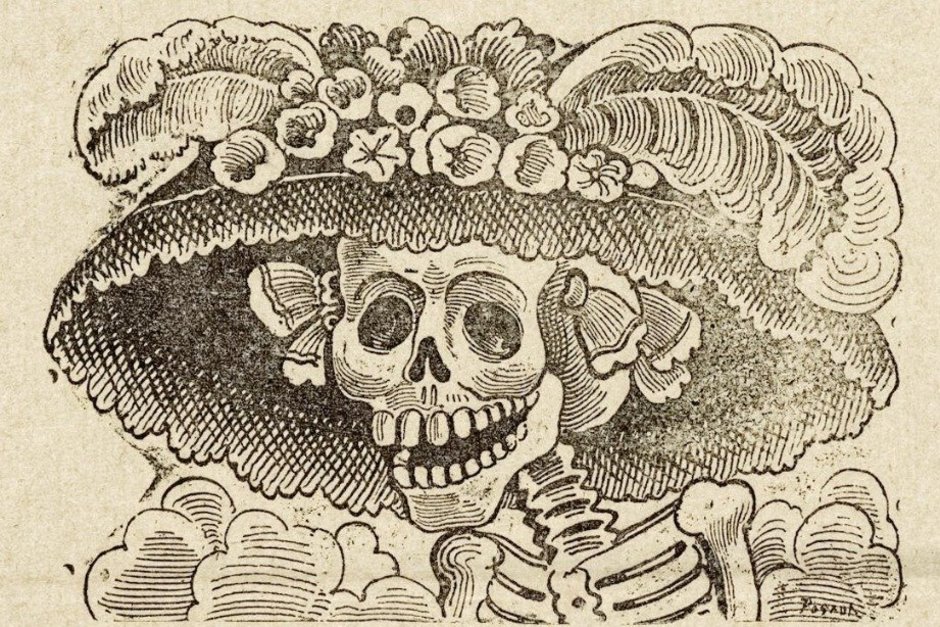
But at the same time the appearance of Calavera Catrina did one more important thing: she turned death from a frightening image into an object of humor. Yamasheva gives a curious interpretation. She writes that Mexicans began to laugh at death after the bloody events of the beginning of the 20th century (several civil wars, dictatorships, changes of political regimes, repressions). And this happened not because people stopped fearing death; they simply grew tired of being afraid.
Santa Muerte — a real cult of death in Mexico?
Santa Muerte is death in the image of a female skeleton. People turn to her with requests for protection, health, luck and help in life circumstances. Yamasheva clarifies that the cult of Santa Muerte cannot be considered a direct continuation of the cult of the ancient Mesoamerican death gods. The researcher compares her with the Aztec goddess Mictecacihuatl. There is indeed an outward similarity between them, but their functions are completely different. If Mictecacihuatl is the mistress of the world of the dead, then Santa Muerte is the personification of death itself. Yamasheva also notes that her iconography in many ways resembles the depictions of the Virgin of Guadalupe. And the attributes of Santa Muerte are connected with Chronos and the symbolism of vanitas, that is, with the European tradition.
The cult of Santa Muerte is incredibly popular in Mexico. But its main followers are those who feel rejected by society. These are prisoners, the poor, the addicted, migrants, sex workers. Yamasheva writes that the idea of the equality of all before death is attractive for the socially unprotected population. These people cannot count on the support of the state or traditional social institutions. The followers of the cult create home altars, buy figurines and bring gifts. The highest way to show devotion to Santa Muerte is to make tattoos with her image. The relationship with her is very personal and resembles a contract: a person asks for help and undertakes to thank for the fulfillment of the request.
Besides this, Yamasheva connects the growth of the popularity of the cult with violence, instability, the criminal situation and the feeling of universal insecurity in modern Mexico. The researcher tells about the spread of the veneration of Santa Muerte in prisons in the 1990s, when prisoners united for joint worship and mutual help. A kind of socialization occurred against the background of veneration.
But Yamasheva also emphasizes that not every representative of the cult is a criminal. The worship of death has a complex nature that rather performs a unifying function for marginalized groups. At the same time the author is wary of all attempts to romanticize Santa Muerte and present her exclusively as a harmless folk tradition. Especially against the background of several waves of suicides in Mexico.
So does a cult of death exist in Mexico? Yamasheva answers: “Both yes and no.” The cult of death is first of all a cultural image of the country that was formed over centuries. In it there are both ancient ideas about the soul and the underworld, and the European artistic iconography of death. Here the veneration of deceased ancestors is mixed with Christian funeral practices. And political satire and national identity packaged by modern mass culture were added. In 2003 UNESCO recognized the Day of the Dead as intangible cultural heritage. This, in turn, strengthened its significance as a national symbol but at the same time made the holiday part of the global tourist industry.
At the end of the book Ksenia Yamasheva cites the words of the Mexican poet and man of letters Octavio Paz, which best show what death is for Mexicans:
— What is death? We have not come to a new answer. And each time we ask ourselves about this, in the end we merely shrug our shoulders: what do I care about death if I do not care about life?
Publisher: MIF
Number of pages: 224
Year: 2026
Age restriction: 16+
Ekaterina Petrova — literary reviewer of the online newspaper “Real Time," host of the Telegram channel «Булочки с маком».