A small lie, big consequences: how Liane Moriarty taught us to fear perfect families
Book of the week — Liane Moriarty's psychological novel “Big Little Lies”

Today the writer Liane Moriarty turns 60. Her main novel “Big Little Lies” at one time made a lot of noise with its exposure of the perfect life of a wealthy suburb. The action of the book takes place in Pirriwee — a well-off Australian coastal district. Here there are beautiful houses, well-kept streets, a beach, a good school, wealthy families and parents who actively participate in the life of their children. But one day at a school trivia evening a tragedy occurs — one of the parents dies. Behind the glossy facade of the ideal life of the district and the outwardly harmless conflicts, something far more serious emerges. The literary reviewer of “Real Time” Ekaterina Petrova sorts out why in a well-off community where everyone knows each other, no one noticed how dangerous the situation had become.
A small lie as a way of survival
The plot of the novel “Big Little Lies” is built around three heroines — Jane, Madeline and Celeste. They have an absolutely different way of life, and they do not resemble each other. But each in her own way hides the truth, and each is not ready to accept reality and face the consequences.
Celeste has a luxurious life that one can only envy. Before marriage she was a lawyer, and then she met the charming and very wealthy Perry. They live in a chic house by the sea, raise two restless twin boys, and from the outside look like an ideal family. But Celeste hides from everyone that behind the closed doors of their luxurious life domestic violence reigns. Moreover, she tries to explain to herself why violence can be tolerated. Celeste hopes that the former relations will return, because Perry beats her not regularly; it happens episodically. The rest of the time he is a caring, loving, attentive husband, and they also have amazingly passionate sex. Besides, Celeste understands that admitting the problem will entail hard decisions that will destroy the customary life, including that of the children.
Jane appeared in Pirriwee quite recently. She moved to the coast together with her son Ziggy, who came into the world as a result of sexualized violence. Jane raises the boy alone and differs greatly from the other women of the school community both in age and in social position. She hides the identity of Ziggy's father even from her parents. For her it is in principle hard to recall this traumatic experience, since the past still influences her present. And she also wants to protect her son so that Ziggy is not perceived through the circumstances of his birth.

Madeline seems the most open and emotional of the three heroines. She is active, sociable, energetic, loves to control what is happening and furiously participates in school life. But in Madeline's own life too not everything is so simple. She still keeps a grudge against her ex-husband Nathan, who left her with the newborn daughter Abigail and in no way participated in her upbringing. And now he has a young wife Bonnie and a little daughter from his second marriage. But most of all Madeline is enraged that Abigail, already a teenager, has decided to live together with her father. Madeline tries to preserve control over the situation and prove to herself and those around her that everything is fine with her.
Unlike Celeste and Jane, Madeline has no big secret. Her problem relates more to self-deception and the inability to admit grievances and her own vulnerability, as well as the fact that not all relations can be controlled. For Madeline a lie to herself is a way of maintaining her customary image.
The facade of family well-being
In Pirriwee there is an unspoken standard of a good life. A woman must necessarily have a happy marriage with a wealthy and handsome husband. Their children must look well-kept and behave decently, and also study well; it is desirable that they be gifted. The family must have a beautiful house and excellent relations with the other residents of the coast. Parents must be active in school life and not be exposed in public scandals.
Everyone evaluates everyone, and everyone knows about it. This manifests itself especially vividly when the women bring their little ones to school. They never tire of competing over who brings up their children better, who devotes more time to the children, who eats properly, and who can afford a certain way of life. Family life becomes a spectacle in which it is important not only to be happy but also to look happy.
For example, Celeste's marriage is part of her identity and position in society. For her the admission of domestic violence will be the destruction of her own way of life and the beautiful “picture” in the eyes of those around her. After all, otherwise she will move into the category of a woman who could not preserve her family. It is easier for Celeste to continue playing the customary role than to admit that her whole life is built on an erroneous idea of happiness.
The school community is an ideal space for maintaining the social mask. It plays the role of a kind of showcase of parental achievements, and children's conflicts quickly grow into conflicts of the parents. When Renata's five-year-old daughter accused Ziggy of cruel treatment, Jane became almost a blood enemy of Renata. In the struggle for influence on the school playground everything is used: accusations of bullying and discussion of upbringing, children's events and parents' meetings. The parents have learned to masterfully mask social competition as care for the children.

In Pirriwee everyone knows each other, but this does not mean that people really understand what is happening in other people's families. They discuss almost everything: children, relations, school conflicts, habits, appearance and social position. But one cannot say that they truly participate in the life of another person. Their gossip creates the illusion of awareness. The heroes of Moriarty's book know many details about the life of their neighbors but do not notice the main thing. For example, the parents hotly discuss the accusations of school bullying, since it is a visible and public conflict, but they do not pay attention to what is happening in the families of the children themselves.
At the same time the children see far more than it seems to the adults. They observe the behavior of their parents both at school and at home. It seems to Celeste and Perry that their quarrels and fights are not heard by the twins, but this is far from so. They see and know everything. At the same time the lie with which the parents explain the domestic violence turns it into the norm. In the end the attempts to preserve the appearance of a normal family do not protect the children. On the contrary, they leave them inside an unsafe situation.
From a small silence to a big catastrophe
The novel “Big Little Lies” begins with a murder at a school trivia evening. But the reader does not know who was killed, who did it, what led to the tragedy and how all this is connected with the participants of the events. Then the narration returns half a year back, and Moriarty like a ball of yarn begins to unwind the chain of events. She acquaints us with the main heroines and their surroundings, and between the chapters the testimonies of the witnesses of the murder investigation appear. These short remarks are extremely important. In them people tell about the events from their point of view, give assessments, discuss others, contradict each other and recall individual episodes. The result is a vivid canvas of mutual delusions.
But all the participants of the events agree on one thing: the tragedy began from the day when the parents of the new pupils brought their children to the orientation day. It was then, at the first school meeting, that Amabella accused Ziggy of violence. The other parents, without sorting out the circumstances, immediately concluded that the boy was an aggressor. The unconfirmed accusation against Ziggy generated a wave of gossip and bullying in the parents' chat. Renata initiated the collection of signatures for the exclusion of Ziggy from the school; as a result the opinions split into two warring camps. It was precisely this children's conflict that became the catalyst of all the subsequent events.
Renata and her supporters were sure of Ziggy's guilt; they acted aggressively toward Jane and her son. Madeline stood up for her new friend and entered into an open conflict with Renata. At the same time no one knew who had actually acted aggressively toward Amabella. When the parents learned the real culprit of the story, the lie of all three heroines converged at one point. Then too the reader learns who was killed and who the murderer is.
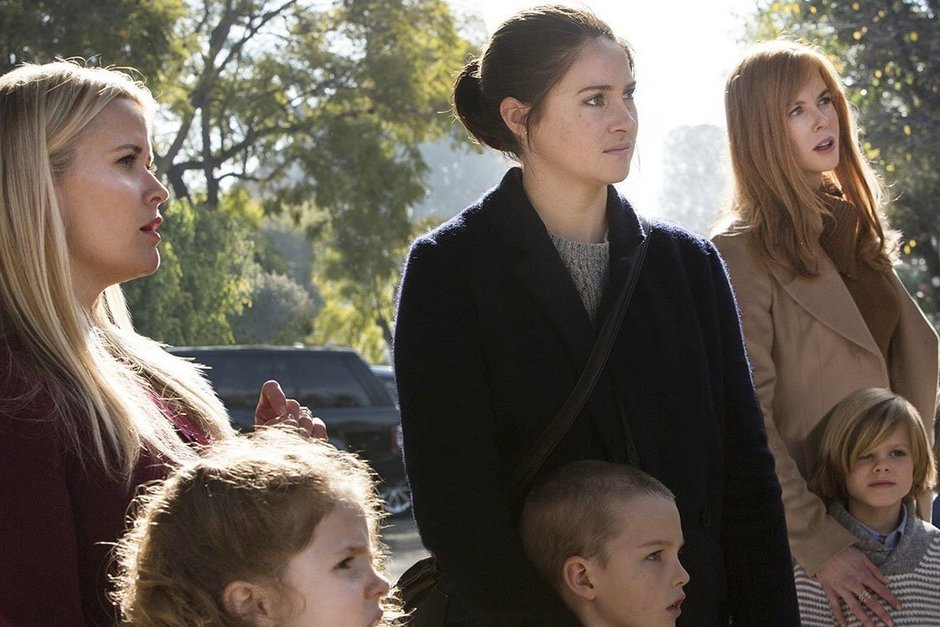
The finale of the novel is paradoxical in that after the tragedy the participants of the events decided to hide the circumstances of what happened in order to protect the murderer. That is, a person committed a murder in order to stop the violence, and the people who hid their real life united around a common lie. And here each decides for themselves where the difference is between a lie that supports violence and a lie that arose as a reaction to it.
In “Big Little Lies” Liane Moriarty makes one doubt the system of evaluating another's life. Often to the public (especially noticeable in social networks) people show only the best moments of life: amazing travels, fun family holidays, expensive gifts, the achievements of children, romantic gestures. But who said that this is the truth? And what is hidden behind the beautiful picture demonstrated to the world? “Big Little Lies” frightens and shows that terrible things can remain unnoticed for a very long time if it is more convenient for everyone to believe in the beautiful version of what is happening.
Publisher: “Inostranka”
Translation from English: Irina Ivanchenko
Number of pages: 544
Year: 2021
Age restriction: 16+
Ekaterina Petrova — literary reviewer of the online newspaper “Real Time," host of the Telegram channel «Булочки с маком».