Shishkin: “What garrison revolt, where is the party's leading role, workers' movement?”
Authentic documents of the October armed uprising have been put on display at the Lenin House-Museum
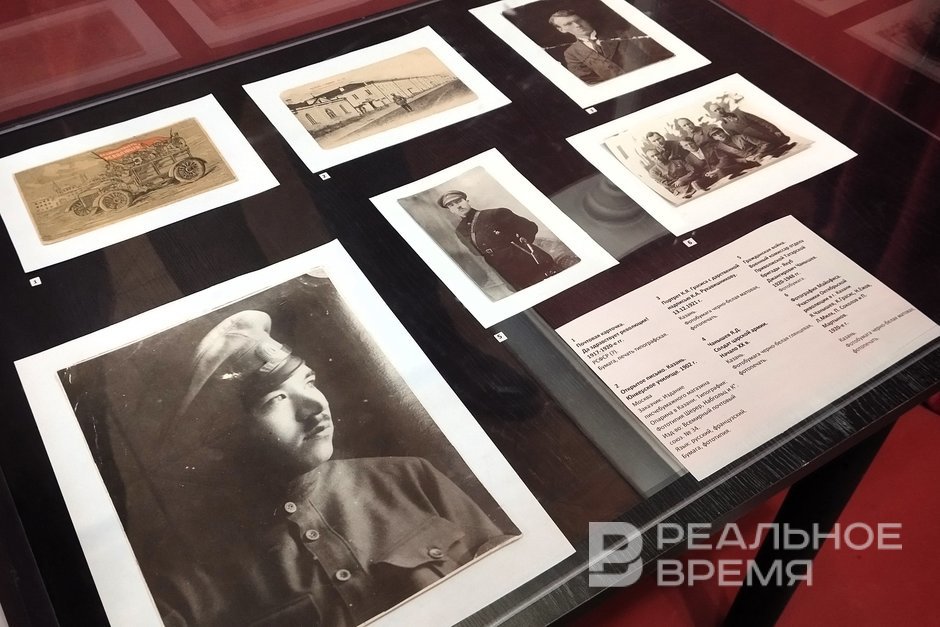
The true history of the October armed uprising has been shown since November 7 at the V. I. Lenin House-Museum in Kazan — through original documents and recollections of eyewitnesses. At the center of the narrative are Nikolai Ershov, Karl Grasis, Yakub Chany shev and Ivan Gladilov. The title of the exhibition — “Such a great revolution the world has never seen” — became a phrase from Ershov's order of October 29, 1917.
Who started first?
The exhibition is timed to the 89th anniversary of the museum itself and the anniversary of the October Revolution. It is located in the “catacombs” of the building and tells about the events of October 24—26, 1917. The story of how power in Kazan changed as a result of the armed uprising repeatedly changed its official interpretation; this can be judged also by the graphic works of Mansur Rakhimov: on one of them we see a scene at the building of the Nobility Assembly (now — the Kazan Town Hall). The director of the house-museum, Mark Shishkin, draws attention to the fact that sailors are depicted on it, although in Kazan the main “striking force” were the artillerymen.
— At the beginning of the thirties they began to say: “Guys, what kind of garrison revolt is this, where is the leading role of the party, where is the workers' movement?” — describes the processes of those years Shishkin. — In the post-war time the main leitmotif was — the uprising was planned under the leadership of the Bolshevik party, and was not a reaction to some events in Kazan. In the post-Soviet years the interpretation is such — it is an adventure of Nikolai Ershov, Grasis and all the comrades.
In fact, the event is a natural part of the general revolutionary process across all of Russia, notes Shishkin, where the movements of workers, the national one, the soldiers' movement were superimposed on each other. Much of this can be learned in the book “Military Kazan in 1917” by Nazar Yezhov, which was always valued by prominent Kazan local historians headed by the late Lev Zharzhevsky.
One of the heroes of the exhibition — the Tatar commander Yakub Chany shev, in 1917 — a company commander within the 240th infantry regiment, then — an ensign, the head of a Red Guard detachment at the Kazan Powder Factory, and in the end — a commissar for the administration of the Kazan Military District. The 240th regiment can be seen on the map of the October battles in Kazan and one can assess the whole scale of the events, when the military surrounded the Kremlin from all sides.
— Chany shev is a truly legendary figure! — says Shishkin. — He is from an impoverished princely family, from Ufa Governorate, studied at the Kazan Teachers' School, heard the live speech of Tukai, was married to the cousin of Mullanur Vakhitov, was friends with Khusain Mavlyutov, worked as a teacher, in the First World War received the St. George Cross of the fourth degree. Unlike many other representatives of the Tatar national movement, he linked his life with the Bolshevik party, participated in the confrontation with the “Trans-Bulak Republic," went through the whole Civil War, commanded the first Kazan Rifle Division. Repressed in 1937, but then released in 1939, and he went from Moscow to Germany. One of the leaders of the Tatar community of Moscow.
The role of Karl Grasis
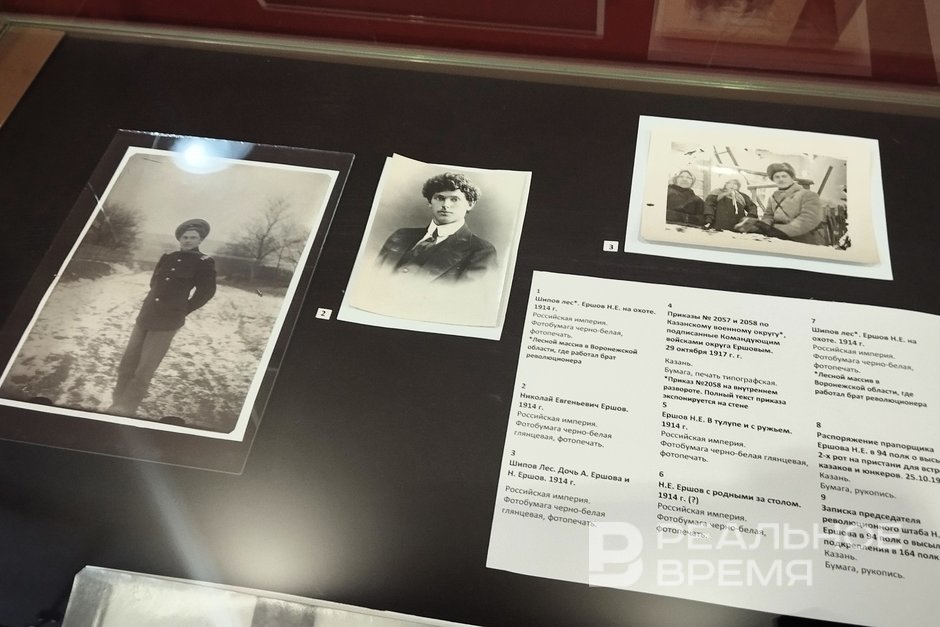
Another character of the exhibition — the Latvian Karl Grasis. A popular orator in the barracks, he was arrested on the night of October 24 by the forces of the Provisional Government. Grasis passed a note to Ershov, who, having traveled around all the barracks, raised the whole garrison by morning. That is, the arrest of Grasis became the occasion for the start of the uprising.
— Grasis in his publicistic writing argues with Russian religious philosophers like Berdyaev concerning Oswald Spengler, referring to Oscar Wilde and to the philosopher Konstantin Leontiev, says Shishkin. — This was a man of quite a broad outlook. Also Nikolai Ershov, according to the recollections of eyewitnesses, read Vladimir Solovyov, that is, was a quite enlightened person, and at the same time of peasant origin.
Interesting in this regard is Ershov's letter to his brother Alexander, a forester in Voronezh Oblast, where he says: “Perhaps the first shot of the October Revolution rang out in Kazan on the initiative of Ershov.”
Without question, the role of the workers in these events is also important, therefore at the exhibition there is the story of Ivan Gladilov. After the First World War he got a job at the Alafuzov Factory, where he headed the factory committee, and then became the head of the Red Guard detachment of the Alafuzov enterprises.
— The workers' movement was tried to be highlighted as a more significant phenomenon in order to balance the soldiers and the workers, says Shishkin. — But in fact it did not need any balancing: Kazan is a powerful industrial center, both sides participated in these events.
“Remember, comrades, that we live in a great time”
But at the same time the recollections of the workers Khisamutdinov and Bikeev are curious: "...a Tatar army man in his elderly years, shell-shocked in the imperialist war, without first taking a word from me, came out of the crowd of standing army men to the table and, turning his face to the assembly, said: 'Comrades, I was mobilized in 1914 and was in battles all the time, personally saw all the horrors and mockeries of us, saw how the comrades suffered in the death agony and died, further we must not endure this,' — turns toward the pyramids (a construction for storing small arms, — author's note), goes and takes a rifle and continues to speak: 'I am the first at the call of the Communist Party, whose representative in our team is comrade Bikeev, I will go to destroy that scum which oppressed us for centuries — WHO WHOM.'"
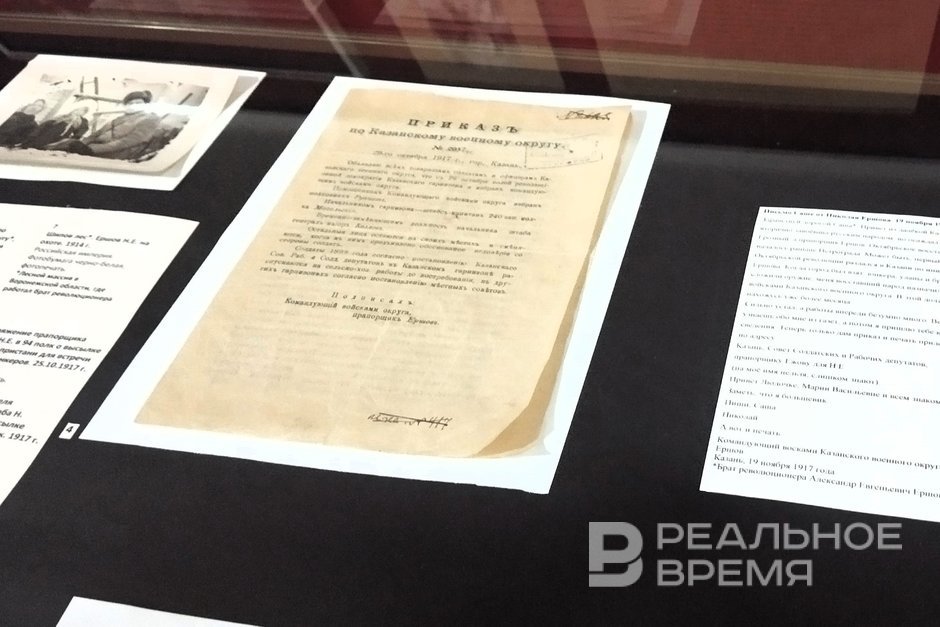
And, perhaps, the most important document is Ershov's order as commander of the Kazan Military District, where he sets out his version of the events: the autocracy was overthrown, then there was the Kornilov revolt, and the parties headed by Kerensky — this is a new wave of conspiracy, and now the military have risen against this:
“While the struggle is not over, while the Kerenskyism is not strangled, I call on the comrades soldiers and all officers loyal to the interests of the people, who did not leave their post during the people's struggle, to rally around the Soviets, to look forward cheerfully, where freedom, equality and brotherhood await us. Remember, comrades, that we live in a great time. Such a great revolution, such a ruthless struggle between the oppressed and the oppressors the world has never seen, we must smash all the old goals, we must conquer both peace and bread and land” (the author's punctuation preserved, — author's note).
Ershov after these events left for Omsk, then for Blagoveshchensk, worked in civil structures and died accidentally in 1928 — he was hit by a car.
— I cannot say that this is the first publication of this order, says Shishkin. — But we decided to show it as a document, a fixation of reality from first hands. Documents of this kind cannot be exhibited for quite long, therefore the exhibition will last only a month.