By the path of film: how Russia lived and what it watched
The State Film Museum brought a large-scale exhibition to Kazan
An exhibition has opened at the National Museum of Tatarstan, “By the Path of Film: The History of the Country Through the History of Russian Cinema. 24/100” — from “Battleship Potemkin” and “Man with a Movie Camera” to “Assa” and “Hard to Be a God.” This is a joint project with the State Central Museum of Cinema. This summer it already presented its exhibits in Tula and Orenburg, but in Kazan it assembled the most large-scale exposition.
The oldest film museum
The Central State Museum of Cinema marks its centenary this year; in 2017 it moved to the restored three-story pavilion No. 36 at VDNKh. Its collection contains more than 220 thousand exhibits.
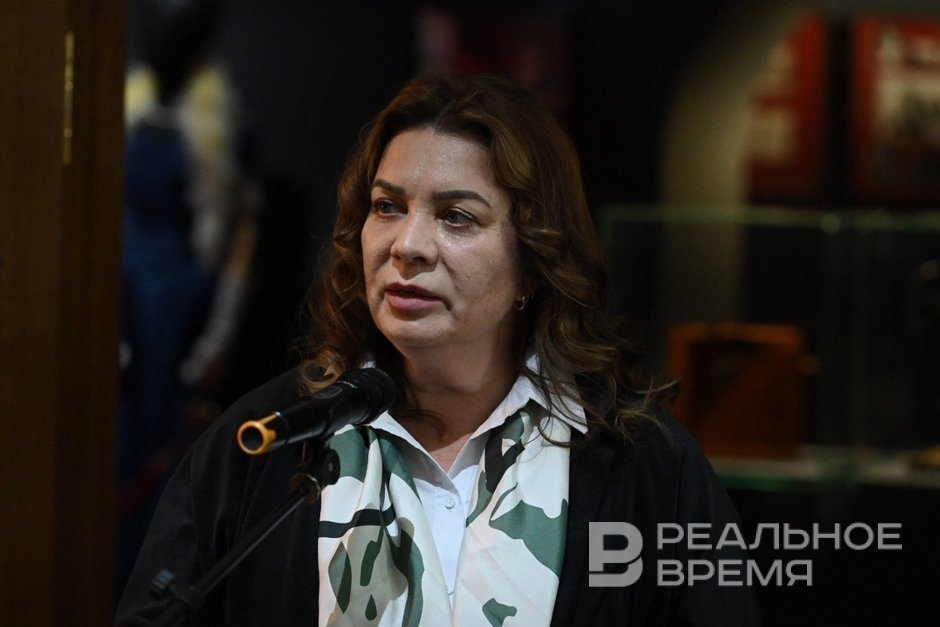
— For a long time it was considered that the “French Cinémathèque” in Paris was the first in the world, says the director of the State Museum of Cinema, Larisa Bazhenova. — This is not so. The State Central Museum of Cinema worked with a huge number of state archives, and to date the legal fact has been established that it was precisely the museum of cinema in Russia that was the first museum in the world entirely dedicated to the art of cinematography. Moreover, we are the only state museum in Russia that preserves cinematic heritage.
Bazhenova added that earlier they collaborated with the “Kazan Kremlin” Museum-Reserve and with the National Library of the Republic of Tatarstan, but it is precisely at the National Museum that the collection is presented most extensively.
— More than four hundred exhibits are presented at it, says the curator Elizaveta Puchkova. — It was important for us to tell the history of our country through the history of cinematography, of our museum. Therefore we chose the chronological principle and at each stage tried to choose key, reference points that would create the image and mood of this era.
Kazan history — starting from “Pathé" and “Vostokkino”
At the same time the exhibits from Moscow here neighbor treasures from the collection of the National Museum of the Republic of Tatarstan, adding a local context to the capital exhibition. These are, for example, the French stereoscopic projector “Taxiphote," the films “Soviet Tataria” by Lenfilm, “Lenin in Kazan” by the Kazan Television Studio and “Comrade Kamai” by the Kazan Newsreel Studio, materials of the “Altyn Minbar” festival.
— Our cinema developed in the general channel of Russian cinematography, emphasizes the researcher of the National Museum, Egor Borodkin. — In 1896 the company “Pathé," which is engaged in film production, comes here, and the following year it already shows the first films.
Before the revolution about 15 cinemas operated in Kazan, says Borodkin; from this time the “Pathé-KOK” film projector has been preserved. Interest in cinema was so great that the authorities issued decrees prohibiting too frequent operation of a cinema where many people gathered and the film could catch fire.
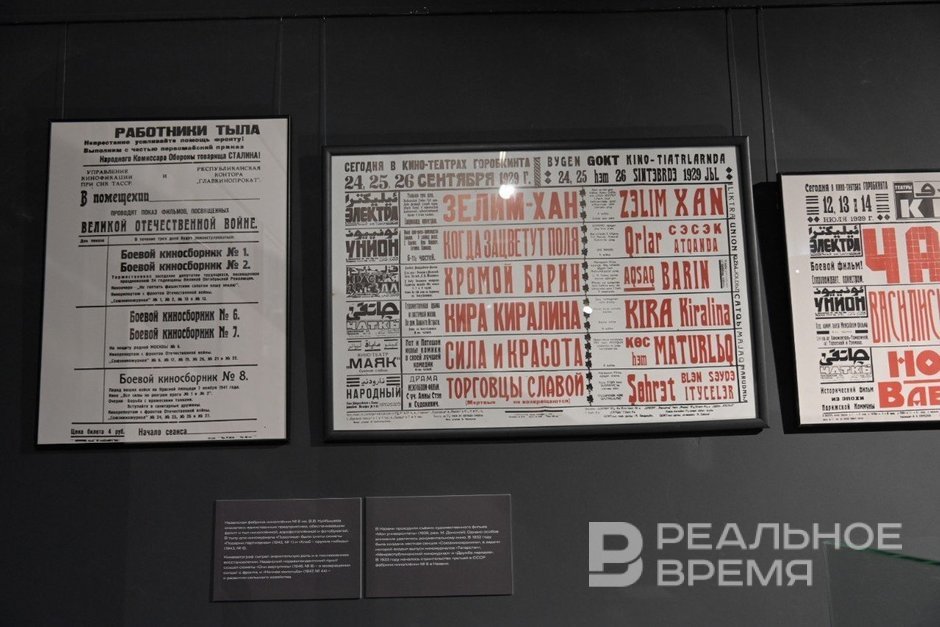
Also in the exposition one can become acquainted with the era of “Vostokkino," with which Tatar writers collaborated: here one can see a letter in which the poet Khadi Taktash is refused the filming of his screenplay “Kamil," as well as posters of Soviet cinemas.
The film is ours, the Oscar is American
The exhibition begins with the era of experiments of the pre— and post-revolutionary era, moves into the period of the Great Patriotic War. Further — the thaw, the pictures of the 70s—80s and contemporary films. At the finish there is another greeting to Kazan — films and objects connected with the Kazan native Stanislav Govorukhin.
In several halls one can also take a quiz along the way, answering, for example, the question of whose legs flash in the famous rain scene in “I Am Walking Around Moscow.”
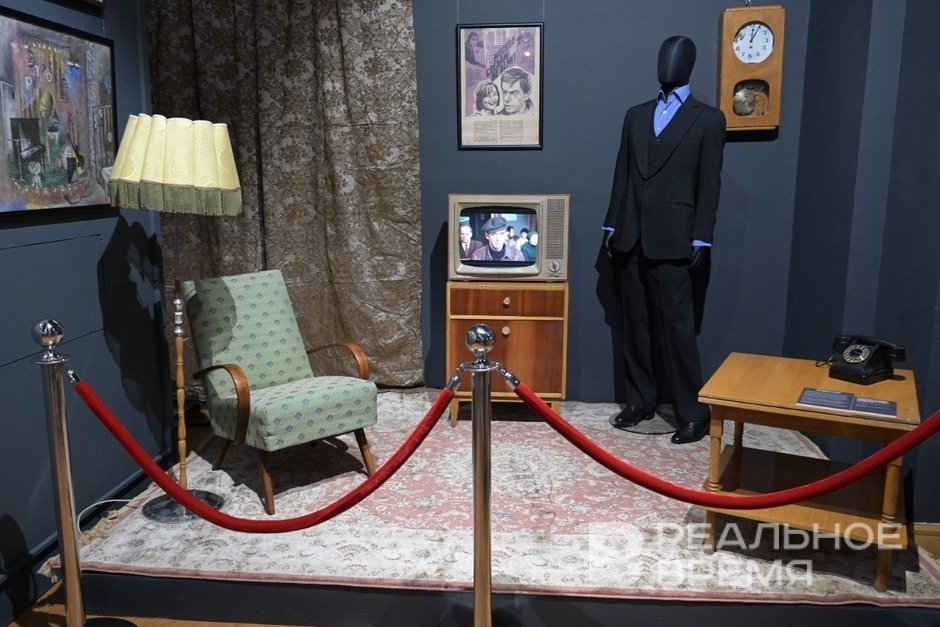
An exhibition about cinema is not only props, fragments from films, film cameras and film posters; there are less obvious things. A series of graphic portraits by Alexander Razumny of directors of the first Soviet wave, like Lev Kuleshov and Dziga Vertov. A multitude of sketches for films — for example, a whole wall is devoted to the film “Garage," which looks even a little more interesting than the corner devoted to the picture “Moscow Does Not Believe in Tears," with Gosha's real jacket.
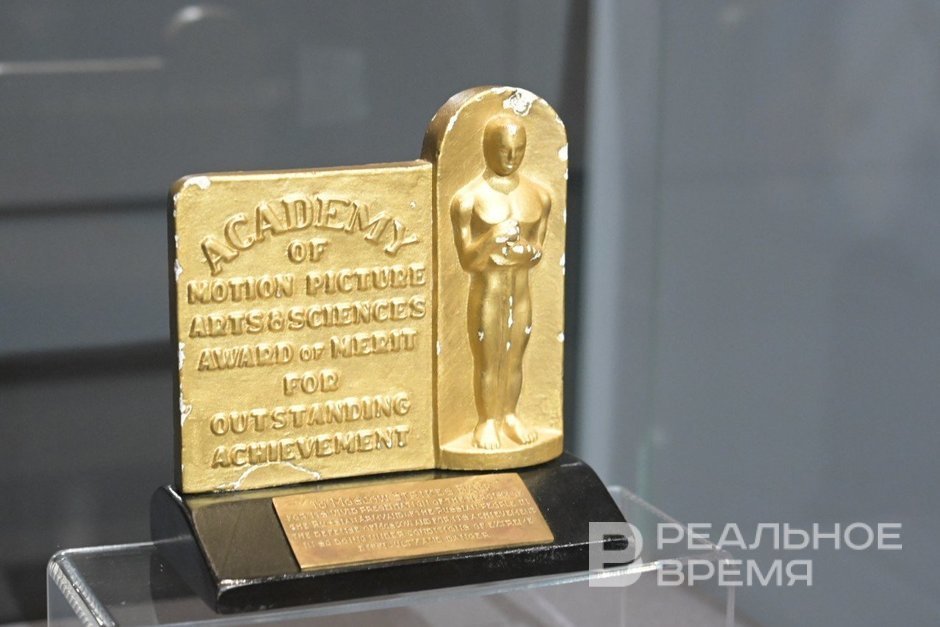
The strongest part is devoted to 1941—1945. One of its symbols is the shoulder board of the cameraman Lieutenant Anatoly Krylov pierced by a splinter — at that moment he was filming the liberation of Vilnius. Right there — a plaster “Oscar” received for the film “The Rout of the German Troops near Moscow” of 1942; by the way, the American title of the picture is “Moscow Strikes Back.” Incidentally Borodkin points out that although feature films were almost not shot in Kazan, here in the 1930s they began to produce film stock. It was precisely on it that that Oscar-winning film was shot, which, they say, influenced the decision of the allies to open a second front.
In the contemporary part of the exposition there is an enormous quantity of materials from Alexey German's picture “Hard to Be a God," including masks and puppets. Unnoticeably and organically they neighbor the “mobiles” from “The Brigade," the mock-up of Leo Tolstoy's head from the picture of the same name and a television set with a bas-relief based on “Kidnapping, Caucasian Style," made for the centenary of Leonid Gaidai.
In short, this is a very family exhibition, where the path from “Battleship Potemkin” to “The Horde” turns into an evening of memories of a time in which many of us did not live, but in an amazing way remember everything.
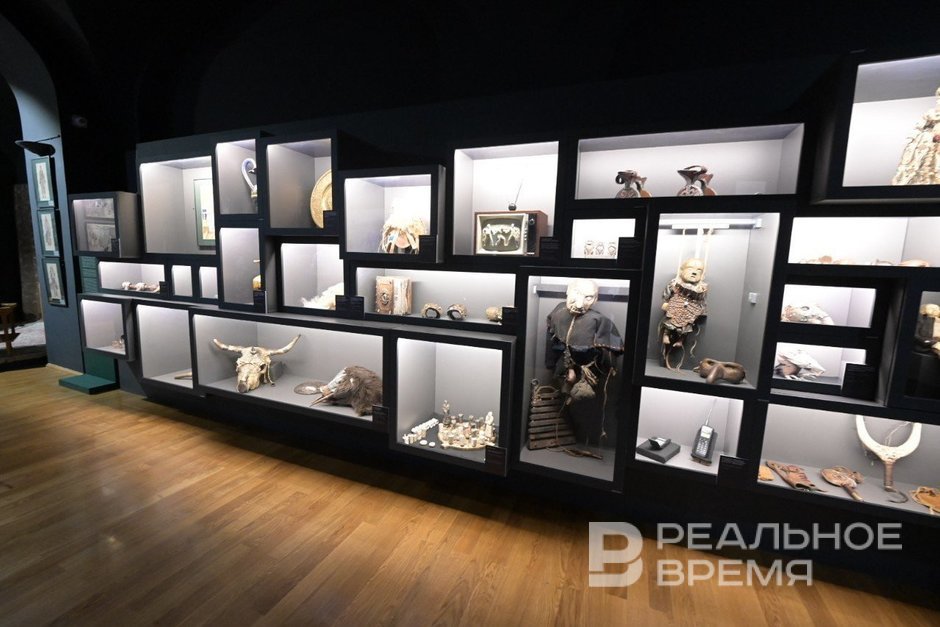
The exhibition works in the main building until December 16. Here too will take place the lecture “Cinema and Youth Culture” by the director of the State Museum of Cinema Larisa Bazhenova, the lecture-performance “Optical Illusions, or When There Was No Cinema” about the scientists of the 18th—19th centuries, during which spectators will be able to make a toy with an optical illusion, a thaumatrope. Also at the museum they will show the new documentary film “In Golden Letters” about Tatar theater, and the film scholar and curator of the exhibition Adilya Khaibullina will conduct a master class “How to Watch Cinema Correctly?” The film scholar will tell about the language of the original, light and color in the frame and the rules of “film viewing.”
In December in the conference hall of the museum another curator, the film historian Stanislav Lugovoy, will give two lectures: “From 'Carnival Night' to 'The Girls': Youth Culture Before the Internet” (with a showing of the film “Give Me a Complaints Book”) and "'The Guest from the Future' and 'The Adventures of Elektronik': What Your Parents Feared and Dreamed About in Childhood," after which one can see “The Lilac Sphere” of 1987.