Dangerous chili peppers, a cosmic shapeshifter, and the secret of gold's eternity
Interesting science news of the week

The risk of developing gastrointestinal cancer is on average 64% higher among chili pepper lovers than among those who dislike spicy food. A dark comet unexpectedly changed its trajectory, surprising scientists who thought it was an asteroid. Excess weight can be gained even from a slight lack of sleep — an hour and a half deficit per day is enough. Nanoparticles formed during fuel combustion are responsible for the deaths of two million people annually. Gold shines for millennia and does not develop an oxide film because the atoms in its crystal lattice constantly swap places and do not have time to react with oxygen from the air. The science news of this week is in the review by Realnoe Vremya.
Spicy food lovers are three times more likely to develop esophageal cancer
An international group of scientists conducted a large meta-analysis, studying data from more than 11,000 people: the task was to find a link between the love of chili peppers and the risk of developing digestive system cancers.
No statistically significant link was found with stomach or intestinal cancer. However, the esophagus was found to be seriously affected: in the group with maximum consumption of hot peppers, the likelihood of developing esophageal cancer was three times higher than in the control group. Overall, the risk of developing gastrointestinal cancer was on average 64% higher among chili lovers than among those who dislike spicy food. At the same time, the most pronounced association is observed in Asia, Africa, and the Americas, where national cuisines are traditionally spicy.
Explaining this effect, researchers point to capsaicin (the substance that makes peppers hot). It is possible that the mucous membrane, which frequently comes into contact with capsaicin, is constantly chronically inflamed and irritated. Damaged cells may begin to repair themselves with errors — and this could trigger the transformation of healthy tissues into cancerous ones.

The debate, however, remains open: perhaps the pepper is not to blame, but associated factors — smoking, alcohol, genetic predisposition. After all, large-scale population studies have previously been published that refute the risk of esophageal injury from frequent consumption of hot peppers.
Dark comets disguised as asteroids may threaten Earth
Thanks to modern observation methods, scientists are increasingly finding cosmic objects that combine the characteristics of several celestial bodies and, as a result, change their “generic identity.” For example, they were thought to be asteroids all their lives, but turned out to be comets — just “dark” ones, with a barely noticeable coma and almost no tail. What distinguishes such a comet from an asteroid is its trajectory or speed, which does not match the calculated values at all. And this can already be dangerous: when a celestial body “surfaces” where Earth astronomers least expect it.
One such case is the subject of this report. Asteroid 1998 SH2 has been observed for 30 years. In 2025, it approached Earth, greatly surprising astronomers: it deviated significantly from its calculated orbit. Scientists realized that it was experiencing non-gravitational acceleration. But what kind? After all, asteroids are not equipped with built-in “engines.”
Researchers suspected that they were actually dealing with a dark comet — a body containing ice that evaporates when it approaches the Sun. In normal comets, the evaporation process creates a noticeable cloud of gas around the head (called a coma) and a characteristic tail. In dark comets, this amount is very small, so the coma and tail are practically impossible to see during observations unless specifically searched for. In 1998 SH2, they were found — both a faint coma and a thin dust tail. That is why the object changed its trajectory — when water molecules evaporate from the surface, they create a weak reactive thrust, which gradually changes the orbit of the “host.”
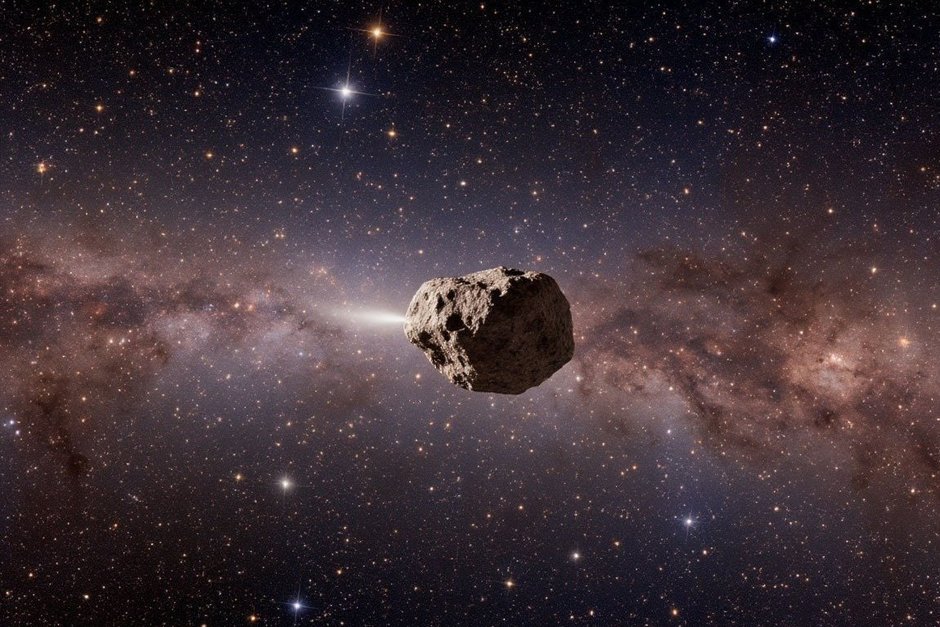
Now the former asteroid has been renamed — it has been given the comet name P/1998 SH2. But the main news is not this — this case suggests that there are other “shapeshifters” among the numerous asteroids around Earth. And this means that our planet may face potential unexpected danger, because the calculated orbits of these celestial wanderers may be completely different from what they actually are.
Even an hour and a half of sleep deprivation per day leads to weight gain
There has long been data that for effective weight loss, one must establish a proper sleep-wake schedule. If you regularly get insufficient sleep, you will gain weight, even without changing your diet. How much sleep deficit is needed to get a significant effect? Until now, there was no clear answer because experiments were only conducted with critical sleep deprivation — when a person sleeps only 4–5 hours per day. But the everyday situation — with a deficit of an hour to an hour and a half daily — was not examined (perhaps for fear of the results?).
Now, at Columbia University (USA), they decided to finally close this gap. Scientists analyzed two studies involving 95 adult volunteers. In their normal lives, they had at least 7 hours of sleep per day, while they had an increased risk of cardiovascular and metabolic diseases. Each experiment lasted six weeks. During the first period, the subjects slept as usual, and during the second, they got up as usual but went to bed an hour and a half later.

At the end of the sleep-deficit period, participants gained an average of half a kilogram in weight, their waist circumference increased, and the entire gain was mainly due to fat tissue. At the same time, people moved 17 minutes less per day than usual.
It turns out that critical sleep deprivation is not necessary for weight gain. A deficit of just an hour and a half of sleep per day is enough. And that makes one think.
Nanoparticles kill up to two million people per year
Since the beginning of the century, it has been known that microparticles smaller than 2.5 microns cause high mortality — up to 4 million people per year. This is because the human respiratory system is designed only to filter out larger particles — which are most common in the natural environment. Smaller particles enter the lungs, from there into the blood, and then become centers for thrombus formation.
But there are also much smaller particles — nanoparticles. A new study has recently been published in which scientists attempted to assess their contribution to mortality.
They compiled a map of air pollution with such particles. It turned out that a cubic meter of air contains between 10 and 30 billion nanoparticles. They are formed during the combustion of solid fuels — coal, wood, etc. The mass of this dust is negligible, but its surface area is enormous.
Then epidemiological data from Europe and North America were overlaid on the map: comparing the typical mortality increase at a given location with the increase in nanoparticle concentration. The correlation was quickly established.

It turned out that in Europe, mortality from nanoparticles was 35.7 cases per 100,000 residents (about 210,000 per year in total). In North America, mortality is lower — 27.4 per 100,000 residents (100,000 in total). Globally, the average was 28.9 per 100,000 population.
Not only is this dangerous, but nanoparticles are also still not regulated by environmental legislation. At the same time, on a global scale, they lead to the premature death of almost 2 million people per year.
Why gold shines and does not tarnish
At Tulane University (USA), the configuration of the atomic structure of gold and the behavior of electrons within it were modeled. Until now, it was thought that the preservation of luster for millennia was solely the result of gold's inertness and the stability of its crystal lattice. But if this were the case, the metal would still darken over time — because the surface atoms of gold would inevitably bind with oxygen from the air and form a thin oxide film.
However, it turned out that everything is not so simple. The surface of gold's crystal lattice is not as stable as it might seem. Atoms within it constantly rearrange, swap places, and block oxidation. That is why coins from pirate hoards dating back to the discovery of the Americas, Schliemann's gold in the Pushkin Museum, and the rings of Egyptian pharaohs in the Louvre still shine as if they were just created.

The article describing this discovery has practical significance. Gold is now used in industry as a catalyst — a substance that does not participate in chemical reactions itself but accelerates them. At the same time, excessive stability reduces its chemical effectiveness. For gold to interact with other elements in complex industrial processes and be a more powerful catalyst, the atomic rearrangement must either not occur or be reversed.