Dyakov is already in Paris, Minakov will fight for a ticket to the European Championship
The Russian Swimming Championships, serving as a qualifier, begins in Kazan
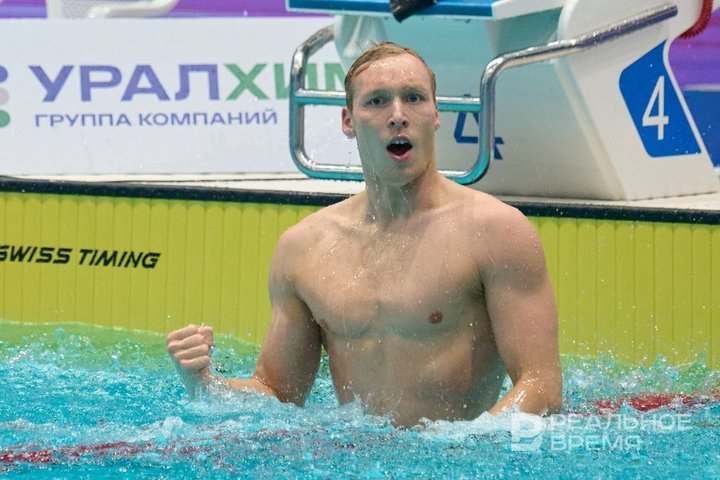
On June 6, the Russian Swimming Championships, which will serve as a qualifier for the European Championships in Paris, begins at the Kazan Aquatics Palace. What to expect from the tournament — in the preview by Realnoe Vremya.
Team Tatarstan has four medal contenders
In the super sprint, Andrey Minakov (50m butterfly, 100m breaststroke and freestyle), as well as Dina Kiramova (butterfly) and Ralina Gilyazova (breaststroke) could reach the finals.
Tatarstan's signature swimming event — the 200m freestyle — is not as successful now. First, the men left the ranks of favorites, then the women, although Anastasia Kolpakova and Kamila Giniyatova can compete for a spot in the final, and in the relay, even for medals. However, in the 200m butterfly, Kolpakova is among the favorites, as is Almetyevsk's Eduard Valiakhmetov in the individual medley.
Interestingly, the situation is better in the long distances. In the 400m freestyle, the brilliant Sofya Dyakova is among the favorites, along with Kolpakova and Anastasia Chernyshova. In the 400m individual medley, we can count on Yaroslav Sokolovsky, Karina Akinova, and Chernyshova again. Finally, in the 800m freestyle, Margarita Vazykhova will contend for a place in the final.
Dyakova's participation only in the 400m is possibly explained by the fact that she has already achieved the qualifying standard for the European Championships and the European Junior Championships. The selection was based on the results of the April Russian Cup in St. Petersburg. All the leaders have already made the national team: Kliment Kolesnikov, Egor Kornev and Kirill Prigoda, Daria Klepikova and Evgenia Chikunova — a total of 20 swimmers. Andrey Minakov will have a double task with his performance — winning medals and qualifying for the European Championships, although his coach Alexey Kuznetsov noted that his preparation process is geared towards the Short Course World Championships in December 2026.

A warm-up for foreigners
On Saturday, June 6, at 16:20, after the opening ceremony of the Russian Swimming Championships, a farewell swim will take place for two-time Olympic champion Evgeny Rylov. It is noteworthy that he first made a name for himself in Kazan, in the outdoor pool during the 2015 World Championships, becoming a bronze medalist. All his rivals have already finished; the last to leave the pool was American Ryan Murphy, who swam to Olympic Paris in 2024, when Rylov's daughter was born. His compatriot Tyler Clary managed to switch from swimming to motorsports. Rylov is finishing on the eve of his 30th birthday.
Among the participants in the upcoming Russian Championships will be over a dozen Serbs and one Belarusian. Speaking of athletes from Serbia, special attention deserves Luka Cjavic, who is called a rising star of world swimming. Luka, who turned 16 on April 22, broke Phelps' junior records for under-16s in both the 200m and 400m freestyle. Swimming fans may recall that the Serbs already had a swimmer with a similar last name — the famous Milorad Cjavic, who became vice-champion of the Olympics in Beijing, where he lost to the aforementioned Phelps, and before that became European champion, setting a continental record in the non-Olympic 50m butterfly. After that, he came to the awards ceremony wearing a T-shirt with the inscription “Kosovo is Serbia.”
In this case, the Cjavics are namesakes, both born in California. The currently competing Luka attends high school in Pleasanton, California, representing the Serbian club “Vracar” from Belgrade. Nevertheless, even record results at the junior level do not make him a favorite at the Russian Championships, but his compatriot and rival in the 200m freestyle, Nikola Simic, could qualify for the final in the 1500m.
By the way, at the Russian Cup, swimmers from Belarus (Daniil Buchelnikov, grandson of Soviet swimmer Elvira Vasilkova, Grigory Pekarsky, Ilya Shimanovich), Afghanistan, and Uzbekistan competed without official standing.
“We will win together”
Everything is learned in comparison, and the three countries' swimmers at the Russian Cup and the two countries' swimmers at the national championships are a minuscule number compared to what could have been. Especially since we will only see one swimmer from Belarus — Roman Khanevsky, whose participation may be driven by personal motives. For comparison: among the participants of the X All-Russian Special Olympics swimming tournament “We Will Win Together” for athletes with Down syndrome, which took place last weekend at the Burevestnik pool in Kazan, there were representatives of Belarus and Kazakhstan. They were awarded medals and certificates by our swimming legends Mikhail Vekovishchev, Sergey Fesikov, Anton Chupkov, and again Rylov. Among the participants was Bozhena Garazha from Rostov-on-Don, an example of media promotion and personal involvement in active life, inspiring many children with Down syndrome.
At the competition itself, which a Realnoe Vremya correspondent also attended, there were a large number of participants, including from the farthest regions of the country, such as the Far East, which helped to form quite a few relay teams. It's simple: there are few events, people are ready to travel from the “ends of the earth," in other words, they haven't become “spoiled," which is sometimes encountered in professional sports. It's no wonder that Rafis Burganov, Rector of the Volga Region University of Sports, said that “today we have so many worthy ones that they are still choosing: to compete or not...” referring to participation in events.
The duality of Russian sport
Now swimmers will be concerned with the issue of peaking or maintaining form. Starting in Kazan on June 6, they will need to maintain their condition until the beginning of August to perform as successfully as possible at the European Championships in Paris. The Football World Cup has logically shifted two major events — the European Swimming and Athletics Championships — to the end of summer. And in our specific case, this will ease the path to medals for the likes of Noè Ponti from Switzerland, David Popovici from Romania, or Diogo Ribeiro from Portugal, who have no competition at home and can calmly prepare for the main events.
Russian “aquatics” are at the forefront of returning to international competition, along with wrestlers (bronze for Kazan's Svetlana Lipatova at the 2026 European Championships in Tirana), which is unsurprising, as the leadership of those federations was in close cooperation with ours. The fact that rowers and weightlifters have returned to the international arena is rather pleasantly surprising (5th place for Chelny's Zulfat Garayev at the 2026 European Championships in Batumi), as they were the first to be guillotined from international competition after the 2016 Rio de Janeiro Olympics. On the other hand, the latest international event for our taekwondo athletes in Munich, Germany, took place without us — Germany did not grant entry visas. Although last year, Russians participated in both the European Championships in Serbia and the World Championships in China. World sport is confidently entering a zone of turbulence, where there are no guarantees for athletes from our country to participate in international events.
For example, there is no progress regarding the return of footballers, who have already missed two World Cups and are close to missing a second European Championship (Euro 2028), whose draw will take place in December. Russian national teams are absent from the qualification for the 2027 European Championships in basketball, volleyball, and handball, which will serve as qualifiers for the 2028 World Championships.
The duality in perceiving what is happening is related to the fact that Belarusian Olympians have returned to international competition while Russians remain suspended. The issue of quotas for events will arise with the potential return of figure skaters, and in hockey, a humiliating situation may arise where the Russian and Belarusian national teams would have to again start in third-division tournaments with Hong Kong, Mongolia, and the Philippines.
Concluding the topic of coordinating the activities of the new aquatics federation, it is worth noting the venues for the national championships. Last year, diving and synchronized swimming took place in Yekaterinburg, as did this year's synchronized swimming championship. Diving moved to Kazan, which has continuously hosted the long-course swimming championship since 2017. The emergence of Yekaterinburg to the forefront is apparently also explained by the fact that the city was actively preparing to host the 2023 International Summer Universiade, which was later replaced by the Friendship Games, now partially losing their relevance.
This brings us to the topic of the “roadmap” for the return of Russian athletes to the international arena. Participation of our water polo players in the second group of the World League, which ended with our women's water polo team advancing to the final of the World Group... The qualifying status of all national championships for “aquatics," which includes not only events for adult athletes but also a full range of events for juniors.