Earth, speak! A story about femicide in Argentina
“The Earth Eater” by Dolores Reyes — one of the major books about violence against women in contemporary Latin America

Sometimes the only witness to a crime in a novel becomes the earth itself, and then the writer has to invent a girl who knows how to listen to it. This is how “The Earth Eater” begins — the debut novel by Argentinean Dolores Reyes, published in 2019 and immediately receiving wide critical and commercial response, translations into more than ten languages, and international recognition. The novel quickly transcended the local Argentinean scene and established itself as one of the key texts of new Latin American prose about violence. The literary critic of Realnoe Vremya, Ekaterina Petrova, tells how in “The Earth Eater” social reality combines with elements of mystical vision to give a voice to those who remain silent.
Dolores Reyes — a writer who gave a voice to the disappeared
Dolores Reyes was born in Buenos Aires in 1978, received a pedagogical education, and studied Greek language and ancient culture at the University of Buenos Aires. For many years, she was a teacher in the western districts of Greater Buenos Aires. According to her, it was her work in school that gave her material for future books and the living voices of her characters. Later, she linked this experience to her choice of theme: violence against women in Latin America became Reyes's central focus, to which she consciously turned.
“The Earth Eater” did not emerge as an attempt to create a mystical plot. Reyes emphasizes that she prefers non-autobiographical writing and uses fiction as a way to work with what causes pain, making it more “physical and sensual.” Her novel does not explain violence but records its repetition and everydayness, turning social reality into a single field of observation. Reyes's book is an attempt to develop a language for talking about systemic violence and the disappearances of women.
At first glance, “The Earth Eater” resembles a mystical detective story. After her mother's death, an unnamed teenage girl discovers that by eating a handful of earth from a place where a person has been, she can see their past or find out what happened to them. Gradually, neighbors begin to bring her earth from their yards, roads, and wastelands, hoping to find missing relatives. Almost every time, it is about girls and women who have disappeared without a trace.

However, it quickly becomes clear that the investigation here is only an outer shell. Reyes is hardly interested in intrigue in the usual sense: the reader follows not so much the search for answers as how evidence of others' pain emerges one after another. The novel from the very beginning rejects the classical laws of detective fiction and turns into a story about memory, which turns out to be stronger than the official investigation.
The definition of genre is equally deceptive. The protagonist's gift can easily be taken for another example of magical realism, but Reyes consciously distances herself from this tradition. In her world, the paranormal is not a natural part of everyday life; it does not create a fairy-tale feeling. On the contrary, it intrudes into the text as the only way to tell about what cannot be explained rationally.
“The Earth Eater” can rather be classified as contemporary neo-fantasy, where the fantastic element does not lead the reader away from reality but, on the contrary, allows it to be seen more clearly. The protagonist is simultaneously a medium, a witness, and a kind of detective. But her unusual gift does not negate the reality of violence. It only makes audible the voices of those whom society and the state have already ceased to notice.
Instead of one big mystery, Reyes builds a narrative from individual episodes and appeals to the heroine, each of which is a new encounter with someone else's tragedy. These stories form a general picture of a world where the disappearances of women cease to be an exception and are perceived as a terrible pattern. The reality Reyes writes about is so monstrous that realism alone is no longer enough to talk about it.
The language of the earth and the language of violence
Almost every vision of the heroine begins the same way: someone brings her a handful of earth and asks her to find a missing girl. Very soon, it becomes clear that the supernatural gift is not the main theme of the novel. Dolores Reyes writes about femicide as an everyday reality of modern Argentina and all of Latin America. Every year, more than 250 women die in the country, and many investigations never reach trial.
This fact has become so ingrained in everyday life that society begins to get used to it, and literature must resist this. Therefore, Reyes combined in one image the disappearances of women and the earth in which they continue to be searched for. The writer does not show a single tragedy. She repeatedly demonstrates how one story repeats another, turning into a terrible pattern.

People go for help not to the police, but to a teenager who can eat earth. This fantastic plot is born from a very real problem — the absence of the state where it is needed most. Reyes has said more than once that the families of missing women are ready to turn even to psychics because official searches often yield no results. Moreover, the writer noted that in Argentina, a significant portion of femicides are committed using state weapons, and in some cases, police officers themselves are involved in the crimes.
“The state does not answer for the lives of its citizens, so women protect each other themselves," she explained in an interview with Pen America. Against this background, the Earth Eater (as one of the disappeared women called her during a vision) is a metaphor for the work that investigators should be doing: searching for the disappeared, returning bodies to families, and helping loved ones learn the truth.
But among the main characters is not only the girl-medium but also the earth itself. It keeps the memory of every step, becomes a witness to crimes, and the only archive that cannot be destroyed. Dolores Reyes said that she grew up watching mothers and grandmothers search for the remains of their children who died during the military dictatorship, and later — women who became victims of femicide. These searches were never a metaphor for her: it was about real bones, teeth, any find that allowed them to know what happened to a person and where they are.
No less important is the ritual of eating the earth itself. The Earth Eater does not subordinate the earth to her will; on the contrary, she allows it to enter inside herself. Reyes describes what the heroine feels when the earth is on her tongue, passes through her throat, and seems to begin to live inside her body. At some point, a true inversion occurs: it is no longer the person who owns the earth, but the earth settles inside the person and continues to speak even after the vision ends. Incidentally, in almost all ancient cultures, the earth embodies the feminine principle: it gives life, receives the dead, and keeps their memory.
The protagonist of the novel is not given a name for a reason. Everyone calls her the Earth Eater, by her gift, as if her own identity has gradually dissolved in others' pain. At the same time, the heroine herself says at the end of the book:
— I would also like to gain a name.
Reyes explained that she deliberately refused to give her an ordinary name. If disappeared women are deprived not only of their lives but also of their identity, then the one who brings them home also remains nameless. Her gift is both a power and a curse. It helps others but deprives the heroine of the ability to live as an ordinary teenager.
Reyes moves the novel to the working-class suburbs of Buenos Aires, which are rarely given a central place in literary narrative. There are no tourist views here, but there are cramped neighborhoods, poverty, teenagers, schoolyards, and a constant feeling of danger. The writer noted in an interview with Página/12 that literature has spoken for too long in the voice of the center, while the outskirts also deserve their own language.
The language of the novel serves this same task. Reyes writes in short phrases, avoids embellishment, and almost never shows the violence itself. She is interested not in crimes as spectacle, but in people who have to live after them. The writer abandoned the aestheticization of the female body, common in crime literature, and tells the story through the eyes of daughters, sisters, and those who have survived loss.
At the same time, the text remains surprisingly physical. The protagonist feels the earth with her tongue, skin, and throat, and every sentence sounds almost bodily. Reyes said that she constantly reads her texts aloud to find their inner music and precise rhythm. Thanks to its rhythm, “The Earth Eater” makes such a strong impression. The novel speaks of monstrous things without naturalism. The power of the prose is given by the surprising precision of the human voice.
How a literary text became political
The success of “The Earth Eater” is difficult to explain solely by the literary merits of the novel. Of course, Dolores Reyes offered an unusual image of a medium heroine and found an almost hypnotic language to talk about violence. But the book appeared at a time when Argentinean society had been trying for several years to comprehend the consequences of the Ni Una Menos movement, which turned the topic of femicide from newspaper chronicles into a subject of national conversation.
Reyes did not document this reality directly and did not write a political pamphlet. She showed how public trauma changes the very way stories are told. If conventional realism proves powerless against the scale of violence, then literature has to find another language — one in which the earth can keep memory better than people, and the supernatural becomes a form of ultimate truthfulness.
This is partly why the novel so naturally fits into the new wave of Latin American literature, where the fantastic is increasingly used not to escape reality but to describe it more accurately. “The Earth Eater” is inevitably compared to the prose of Mariana Enríquez, Samanta Schweblin, and Selva Almada, but Reyes occupies a special place among these authors. If Enríquez explores how horror grows in urban space, and Schweblin turns anxiety into an almost abstract state of the world, then Reyes makes a very specific social problem the object of her attention. In Dolores Reyes's mysticism, there is always an address and a name.
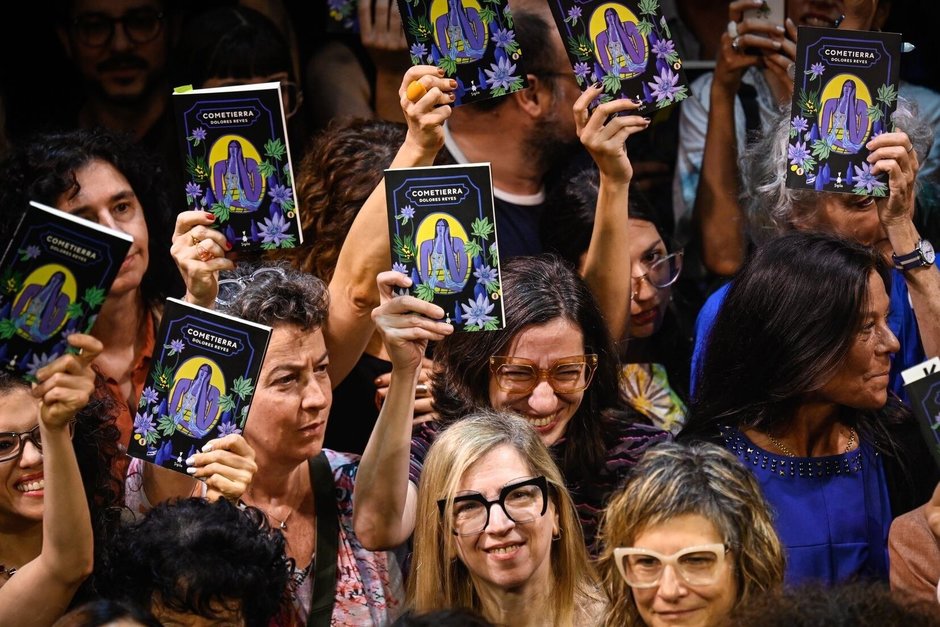
It is telling that the public fate of the novel turned out to be almost as turbulent as its content. Attempts to restrict the book in school curricula, accusations of “inappropriate” themes, subsequent public readings, and a surge of reader interest only confirmed the main paradox of “The Earth Eater”: the debate was not about the literature itself, but about its right to speak openly about violence. In this sense, the novel showed that contemporary fiction can be simultaneously aesthetically complex and socially significant.
Publisher: Livebook
Translation from Spanish: Anna Berkova
Number of pages: 176
Year: 2026
Age rating: 18+
Ekaterina Petrova — literary critic for the online newspaper Realnoe Vremya, host of the Telegram channel «Булочки с маком».