What to read: American classics, Southern Gothic, books about racism, and a comic about the Holocaust
Realnoe Vremya presents 15 of the most important books in American literature

Tomorrow, July 4, marks the 250th anniversary of the founding of the United States of America. For a month, American media have been publishing various lists of books that can help understand modern America, its history, people, and the situation in which the country finds itself today. For the anniversary, Publishers Weekly asked critics to select works that would reveal the country better than a museum tour. The literary critic of Realnoe Vremya, Ekaterina Petrova, presents these books.
Herman Melville. “Moby-Dick," MIF (translated from English by Inna Bernstein, 16+)
First publication: 1851

Today, “Moby-Dick” is called one of the major works of American literature, but after its release in 1851, the book received mixed reviews, sold poorly, and by the time of Herman Melville's death, it had almost disappeared from bookstores. It was only in the 20th century that the work was rediscovered by critics and readers. “Moby-Dick” is an adventure novel with elements of philosophical prose. At the center of the story is the sailor Ishmael, who signs on to the whaling ship Pequod. The ship's captain, Ahab, pursues not a commercial goal but a personal one: he is obsessed with revenge on the great white sperm whale Moby-Dick, who once bit off his leg. Gradually, an ordinary whaling voyage turns into a dangerous pursuit, where the crew becomes a hostage to someone else's obsession.
This book is much more complex than an adventure novel. In addition to the plot, there are chapters devoted to whaling, the ship's structure, and even a kind of “encyclopedia” of whales. But these digressions serve the book's overarching idea: the hunt becomes a way to explore human nature, the limits of knowledge, and the price of obsession. It is no coincidence that the narrative is conducted by Ishmael — an observer. He does not try to understand what is happening, while Ahab sees the world through a single goal.
Walt Whitman. “Leaves of Grass," Eksmo (translated from English by Korney Chukovsky, 16+)
First publication: 1855

Walt Whitman's poetry collection “Leaves of Grass” is a book that the poet rewrote, expanded, and rethought for practically his entire life. From the first edition with twelve poems to the last during his lifetime, 37 years passed, and the book's volume grew to over four hundred texts. Unlike the conventional poetry of the mid-19th century, Whitman abandoned strict rhyme and meter. His poems are built as a free conversation with the reader, where the main character becomes the person himself — his body, thoughts, freedom, labor, love, nature, and life in a young American democracy.
The central work of the collection became “Song of Myself.” The narrator speaks in the first person, but this “I” gradually turns into a voice that seeks to encompass the experience of a wide variety of people. Through this image, Whitman reflects on the individual and society. Later, other famous texts were included in the book, including “I Sing the Body Electric," “Crossing Brooklyn Ferry," and the elegy in memory of Abraham Lincoln, “When Lilacs Last in the Dooryard Bloom'd.”
The publication of “Leaves of Grass” in 1855 immediately sparked loud controversy.
Contemporaries were shocked by the frank reflections on physicality and sensuality; Whitman was even fired from the US Department of the Interior because of the book, and later individual editions were attempted to be banned as “obscene.” The poet himself refused to soften the texts, believing that censorship contradicted the very nature of literature.
Mark Twain. “Adventures of Huckleberry Finn," Makhaon (translated from English by Nina Daruzes, 0+)
First publication: 1885

Mark Twain's “Adventures of Huckleberry Finn” is a continuation of “The Adventures of Tom Sawyer.” The book has long ceased to be perceived as a teenage one: today the novel is among the major works of American literature and remains a subject of debate, research, and new readings. It is a picaresque novel and a coming-of-age story. Its hero, Huck Finn, escapes from his abusive father, stages his own death, and sets off on a journey down the Mississippi with the runaway slave Jim. Their path turns into a series of encounters with swindlers, family feuds, violence, and human greed. But the main test unfolds within Huck himself. Raised in a society where slavery is considered the norm, he gradually realizes that friendship, compassion, and a sense of justice are more important than imposed rules.
Twain worked on the book for almost seven years — from 1876 to 1883, repeatedly putting aside the manuscript and returning to it. The novel was first published in Britain in late 1884 and then in the United States in 1885. One of its main innovations was the language: Twain was one of the first to write a major American novel in living colloquial English using local dialects. Because of this, the first-person narrative from Huck's perspective sounded unusually natural and greatly influenced the development of American prose.
F. Scott Fitzgerald. “The Great Gatsby," Azbuka (translated from English by Evgenia Kalashnikova, 16+)
First publication: 1925

F. Scott Fitzgerald's novel “The Great Gatsby” is set in the summer of 1922 on Long Island, near New York, during the “Jazz Age," economic boom, and Prohibition. The story is narrated by Nick Carraway, the neighbor of the mysterious millionaire Jay Gatsby. Every weekend, lavish parties are held at his mansion, but the host himself almost never participates in them. Gradually, it becomes clear that all this wealth, the rumors surrounding his name, and the carefully crafted image are needed by Gatsby for one purpose — to win back Daisy Buchanan, the woman from whom he was separated several years earlier. The attempt to rewrite the past leads the characters to a chain of events with a tragic ending.
Gatsby's love story largely grew out of Fitzgerald's own personal experience. In his youth, he was in love with the wealthy heiress Ginevra King, but her family believed that a young man without a fortune could not hope for such a marriage. Later, the writer admitted that it was precisely the feeling of injustice — when a poor young man cannot be with a girl from a wealthy family — that lay at the heart of the novel's conception.
At the same time, immediately after its publication in 1925, the book was not a commercial success. True recognition came only after World War II, when the novel began to be widely read in the United States. Today, “The Great Gatsby” is considered not only a story of unfulfilled love but also one of the most accurate literary statements about where the line lies between success, self-deception, and the American Dream.
William Faulkner. “Absalom, Absalom!” Gudyal-Press (translated from English by Mary Becker, 16+)
First publication: 1936

“Absalom, Absalom!” published in 1936, is one of William Faulkner's major novels and a classic of Southern Gothic. The action spans several decades — before, during, and after the American Civil War. At the center of the narrative is the story of Thomas Sutpen, a poor man who comes to Mississippi to get rich, build a huge plantation, and found a dynasty. His carefully constructed plan collapses due to old secrets, racial prejudices, and the desire to preserve the family legacy at any cost. The novel's premise suggests a family saga, but Faulkner quickly breaks the familiar form. The reader learns Sutpen's story not directly, but through the memories of several narrators — each knows only part of the events, makes mistakes, makes guesses, or retells others' words. The same episodes appear again and again, growing new details and contradictions. As a result, this is a novel about how people create their own version of the past.
It is this unusual composition that has made the book one of the most discussed in Faulkner's oeuvre. The author said that none of the narrators knows the whole truth because “no one can see the truth whole," yet each has their own part of that truth.
There is also an interesting detail that has long become a literary legend. For many years, “Absalom, Absalom!” was listed in the Guinness Book of Records due to one of the longest sentences in fiction — it contains 1,288 words. But even this formal record well reflects the novel itself: Faulkner deliberately builds long, multi-layered sentences in which the voices of different characters are intertwined as closely as the history of the Sutpen family.
John Steinbeck. “The Grapes of Wrath," Inostranka (translated from English by Natalia Volzhina, 16+)
First publication: 1939
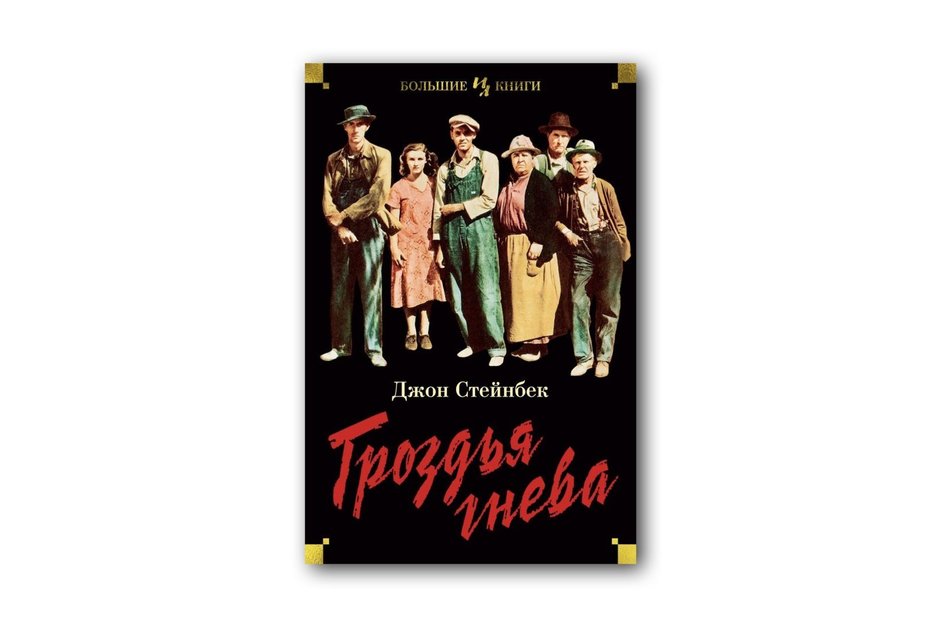
John Steinbeck's “The Grapes of Wrath” is a realistic novel about the Great Depression, mass migration, and the price ordinary families pay for the collapse of their familiar way of life. The story centers on the Joad farmers from Oklahoma, who lost their land due to drought and debt. Together with thousands of other migrants, they set off along Route 66 to California, hoping to find work and start a new life. But the promised “paradise” turns out to be a market for cheap labor, where despair becomes the employers' main resource.
The novel begins with Tom Joad's return home after a prison term. However, there is no home anymore: the farm has been taken, and the family is already preparing to leave. The road west turns into a series of losses — relatives die, loved ones leave, and ahead lies not salvation but new trials. Steinbeck shows the mechanism of economic catastrophe: how banks and large landowners change the lives of millions of people.
The novel won the National Book Award and the Pulitzer Prize, but at the same time sparked fierce controversy. The book was banned in libraries and schools, publicly burned, and Steinbeck was accused of political propaganda. Yet it was precisely this work that was later named one of the main reasons for awarding the writer the Nobel Prize in Literature in 1962. Almost nine decades later, the novel remains one of the most accurate literary accounts of what happens to society when an economic crisis turns into a personal tragedy for millions of people.
Ralph Ellison. “Invisible Man," MIF (translated from English by Elena Petrova, 16+)
First publication: 1952

What does it mean to be invisible in a society where you are constantly being looked at? This is the paradox with which Ralph Ellison's book “Invisible Man” begins. It is a realistic novel with elements of picaresque narrative and existential prose, in which the author explores the structure of American society, race relations, and the search for one's own identity.
The unnamed hero tells the story of his life as a chain of attempts to find a place in the world. A young African American who grew up in the American South gets a chance at education but soon realizes that promises of equal opportunity exist only in words. His path passes through university, New York, political organizations, and confrontations with a variety of ideologies. Each new stage brings disappointment: those around him see him as a symbol, a tool, or a representative of a group, but not as an individual person. That is why the hero calls himself an invisible man — society refuses to notice his true identity.
The novel was published in 1952 and became Ellison's first and only book published during his lifetime. He worked on it for almost five years. As early as 1947, Horizon magazine published the famous “Battle Royal” episode, which was later included in the novel. In 1953, the book won the US National Book Award, making Ellison the first African American writer to receive this honor. The author himself emphasized that he did not want to write another “protest novel.” Instead of direct political statement, he created a complex narrative about how a person tries to preserve himself amid others' expectations.
Harper Lee. “To Kill a Mockingbird," AST (translated from English by Nora Gal, Raisa Oblonskaya, 12+)
First publication: 1960

Harper Lee's “To Kill a Mockingbird” is both a coming-of-age novel and Southern Gothic, a story of growing up, justice, and prejudice told through the eyes of a six-year-old girl. Through a child's perspective, Lee shows a world where conventional ideas of good and evil begin to crumble upon confronting reality.
The action takes place in the small town of Maycomb, Alabama, during the Great Depression. Jean Louise Finch, nicknamed Scout, her brother Jeremy, and their friend Dill spend the summer trying to unravel the mystery of their reclusive neighbor, Arthur “Boo” Radley. But the main event becomes the trial: Scout's father, lawyer Atticus Finch, takes on the defense of a black man, Tom Robinson, accused of raping a white girl. Despite compelling evidence of the defendant's innocence, it becomes clear that in this case, facts matter less than skin color. For the children, the trial becomes their first serious lesson in how society and justice work.
After the book's publication in 1960, publishers expected modest sales, but the novel immediately became a bestseller and won the Pulitzer Prize a year later. The book largely grew out of Harper Lee's personal experience. The prototype for Atticus Finch was her father — a lawyer from Alabama — and the character of Dill was based on her childhood friend Truman Capote. Perhaps that is precisely why the novel gives the impression not of a literary construct, but of a story heard from a person who truly saw everything with their own eyes.
Ursula K. Le Guin. “The Left Hand of Darkness," Azbuka (translated from English by Olga Vasanta, Andrey Novikov, Irina Gurova, 12+)
First publication: 1969

“The Left Hand of Darkness” was published in 1969 and became a turning point for Le Guin: it was after its publication that the writer was recognized as one of the major authors of American science fiction. The novel won both major genre awards — the Nebula and the Hugo — and was later reprinted numerous times, selling in the millions.
The action takes place on the icy planet Gethen, which Earthlings call Winter. Genly Ai, an envoy of the interplanetary union Ekumen, arrives there. His mission is to persuade the local states to join the union of worlds. But the diplomatic mission quickly turns into a trial. Genly does not understand Gethen's political rules, becomes embroiled in palace intrigues, ends up in a labor camp, and is saved only by Estraven — a politician whom he long considered an unreliable ally. The most important part of the novel is their difficult crossing of the glacier, where distrust gradually gives way to mutual understanding.
The novel is written as a mix of travel notes, personal diaries, myths, and legends of Gethen. Later, Le Guin recalled that while working on the book, the story itself began to grow local lore and new narrator voices.
Sylvia Plath. “The Bell Jar," AST (translated from English by Syuzanna Alukard, 18+)
First publication: 1971

This is a novel about a young woman who seemingly had every chance for a successful future but gradually realizes that she no longer feels joy or meaning. American poet Sylvia Plath turns the story of her depression into a tale of the pressure of expectations and the search for identity.
“The Bell Jar” is Plath's only novel. It was published in Great Britain in 1963 under the pseudonym Victoria Lucas. Plath feared that too many people would recognize real people in the characters: the book is largely based on events from her own life. A month after its publication, the writer took her own life. It was only several years later that the novel was first published under her own name, and in the United States it was only published in 1971, as Plath's husband Ted Hughes and her mother objected to an earlier release. The book immediately became a bestseller.
In genre, it is a psychological novel with a strong autobiographical basis. The main character, nineteen-year-old Esther Greenwood, wins a prestigious internship at a New York magazine — an opportunity many dream of. But instead of a feeling of success comes alienation. Upon returning home, her plans for study collapse, her depression intensifies, and she begins to search for a way out of a state in which ordinary life seems impossible. The story gradually turns into a tale of treatment, suicide attempts, and a long journey back to the ability to live. Like Esther, Sylvia Plath herself won the Mademoiselle magazine contest in 1953 and underwent an internship in New York. Her experience of depression treatment, including a psychiatric clinic and electroshock therapy, also formed the basis of the book.
Octavia E. Butler. “Kindred” (not translated into Russian)
First publication: 1979
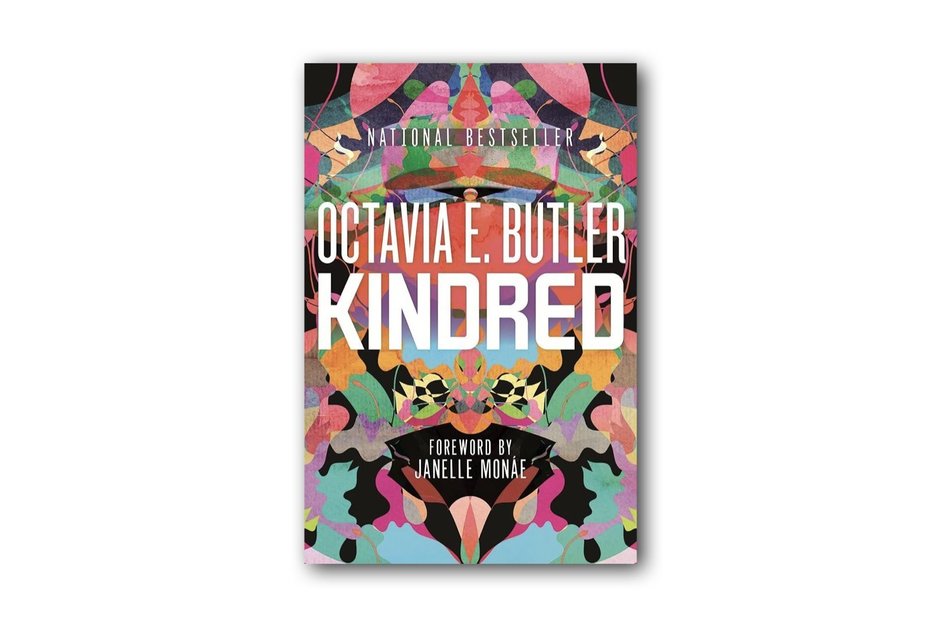
Octavia Butler's novel “Kindred” combines science fiction, historical fiction, and the neo-slave narrative — a genre that reinterprets the experience of American slavery through a modern lens. The book was published in 1979 and became Butler's most famous work. The writer said that she conceived the novel after a conversation with a young activist who accused previous generations of African Americans of submission. Butler wanted to show that, once inside the slave system, a modern person quickly understands that many decisions were dictated not by weakness, but by the struggle for survival. To achieve this, she literally sent her heroine back in time.
Young writer Dana lives in Los Angeles in 1976. Unexpectedly, she is transported through time to a plantation in Maryland in the early 19th century. There, she saves a white boy, Rufus, who will later become a slaveholder and, at the same time, her ancestor. To preserve her own lineage and return home, Dana has to return to the past again and again, where she faces the daily reality of slavery, violence, and the constant choice between resistance and survival.
Time travel here is a way to show that the past continues to influence the present. Butler deliberately combines science fiction with the tradition of former slaves' narratives, creating a text in which historical facts are perceived as the heroine's personal experience. Incidentally, Butler herself considered “Kindred” more of a dark fantasy than science fiction.
Cormac McCarthy. “Blood Meridian," Azbuka (translated from English by Igor Egorov, 18+)
First publication: 1985

“Blood Meridian” is set on the American-Mexican border in the mid-19th century. The main character, known as the Kid, runs away from home and, after a series of chance events, finds himself in John Glanton's gang — a real group of scalp hunters. Formally, they are paid to kill Indians, but very quickly they start killing anyone for whom a reward can be obtained.
Gradually, the central figure becomes Judge Holden — one of the most enigmatic characters in American literature. Huge, hairless, highly educated, and at the same time terrifyingly cruel, he turns into a philosopher of violence, convinced that war is the natural state of man. The novel's ending leaves the main question unanswered: McCarthy deliberately does not explain exactly what happens during the Judge's final encounter with the Kid.
After its publication in 1985, “Blood Meridian” was almost unnoticed by both readers and critics. Over time, its reputation completely changed: today the novel is called McCarthy's major work, regularly included in lists of the greatest American books, and many literary scholars consider it one of the main contenders for the status of the “Great American Novel.” Paradoxically, it is precisely the work that dismantled the classic myth of the Wild West that has become one of the most influential books about it.
Art Spiegelman. “Maus," Corpus (translated from English by Vasily Kistyakovsky, 12+)
First publication: 1986

In 1992, Art Spiegelman's “Maus” became the first graphic novel to win a Pulitzer Prize. “Maus” is based on the memories of the author's father, Polish Jew Vladek Spiegelman, who survived the Holocaust. The book is built on two temporal planes. In the late 1970s, Art records the stories of his elderly father in the New York neighborhood of Rego Park, while at the same time the reader is transported to pre-war Poland, where Vladek meets his future wife Anja, starts a family, and builds his own business. Then ordinary life collapses: German occupation, the ghetto, the loss of loved ones, attempts to hide, betrayal by guides, and the road to Auschwitz. An equally important part of the book is the relationship between the author himself and his father, whom the war changed forever.
Spiegelman depicted people as animals. Jews became mice, Germans became cats, Poles became pigs. This device shows the conventionality and absurdity of any attempt to divide people into categories by nationality. The minimalist drawing, the constant switching between past and present, and the documentary precision create the effect of a living conversation.
Toni Morrison. “Beloved," Inspiria (translated from English by Irina Togoeva, 16+)
First publication: 1987

“Beloved” is a psychological novel with elements of magical realism about memory and trauma. The book is set several years after the American Civil War. The main character, Sethe, is a former slave living with her daughter Denver in house number 124 in Cincinnati. It has long been considered cursed: it is haunted by the spirit of Sethe's deceased older daughter. When a mysterious young woman calling herself Beloved appears in the house, the past begins to literally invade the present. Gradually, it becomes clear why Sethe once killed her own child: she decided that death was better than returning to slavery. The novel has a non-linear narrative; it is built as a gradual restoration of memory, where personal tragedy becomes inseparable from the history of an entire people.
The impetus for the book's creation was the real story of Margaret Garner — a fugitive slave who, in 1856, killed her young daughter to prevent her from being returned to her owners. Morrison came across a newspaper clipping about this case while working as an editor on a collection of materials on African American history. However, “Beloved” did not become a historical reconstruction. The writer was interested in something else: how slavery continues to live in the memory of those who managed to survive, and how this memory affects children and subsequent generations. The novel was published in 1987, won the Pulitzer Prize a year later, and later literary critics and writers repeatedly called it the major American novel of the late 20th century.
Percival Everett. “James," Corpus (translated from English by Yulia Poleshchuk, 16+)
First publication: 2024

Percival Everett's “James” is one of the most discussed American books of recent years. It is simultaneously a historical novel, a literary reinterpretation of a classic, and an independent story about slavery, freedom, and a person's right to tell their own story. Everett takes Mark Twain's “Adventures of Huckleberry Finn” as his basis but shifts the narrative focus to Jim.
Upon learning that his mistress plans to sell him and separate him from his family, he runs away, hoping to later buy back his wife and daughter. On the island, Jim meets Huck, who has staged his own death to escape his abusive father. The heroes then set off down the Mississippi again, but the events familiar from Twain's novel take on a completely different meaning. While Huck experiences adventures, Jim fights for survival every day, hides, falls into the hands of slave traders, ends up in a minstrel troupe, tries to find his family, and gradually comes to the realization that freedom cannot be obtained if others define it for you.
One of the book's strongest devices is its language. In the presence of white people, Jim and other slaves deliberately speak a broken dialect, feigning ignorance. Among themselves, they speak literary English, argue about philosophy, read books, and mock those around them. Thus, Everett shows that the mask of ignorance is part of a survival strategy. It is no coincidence that Jim dreams not only of gaining freedom but also of writing down his own story: the ability to write turns out to be no less important to him than the ability to escape from his pursuers.
Ekaterina Petrova — literary critic for the online newspaper Realnoe Vremya, host of the Telegram channel «Булочки с маком».