Vyacheslav Miller: “The larger you are, the harder it is to earn”
The owner of the Tatarstan franchise of Dodo Pizza — on the crisis in catering, labor shortages, and business survival
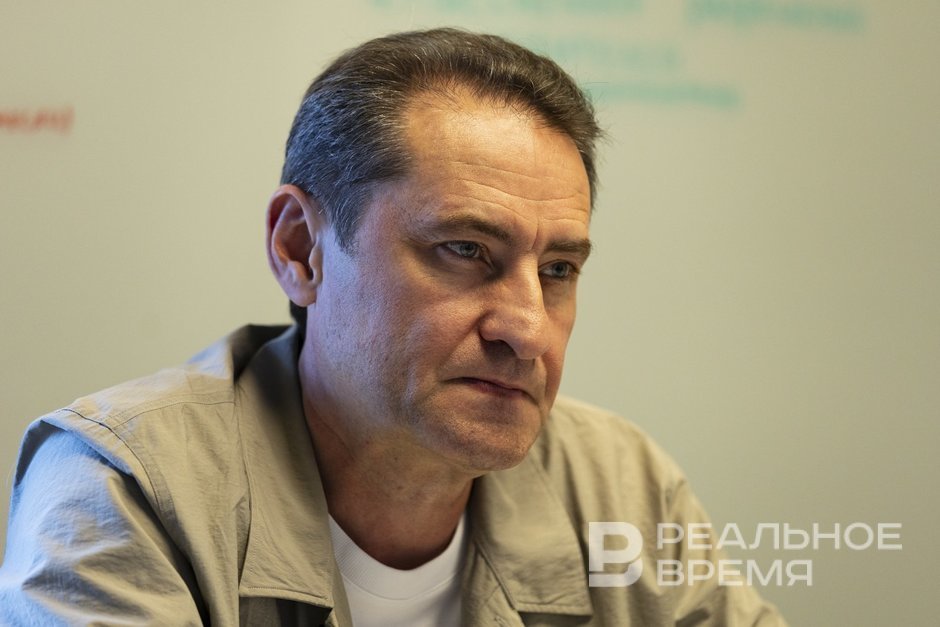
The restaurant market in Tatarstan is balancing on the edge: costs are rising, demand is falling, margins have dropped by 30–35%, and entrepreneurs increasingly feel that decisions about the rules of the game are being made without their input. In an interview with Realnoe Vremya, Vyacheslav Miller, the owner of the Tatarstan franchise of the Dodo Pizza chain, spoke about how the tax burden, labor shortages, and declining traffic are eating away at profits, why fast food is becoming the “safest” niche, and what technological solutions the restaurateur is betting on to stay afloat.
“Business is practically not being heard”
— Vyacheslav Arturovich, you said that 2025 was a “stop” for you in terms of development: the tax burden “will take away profits.” If we recalculate the economics of one pizzeria under the new rules, including VAT for simplified taxation system payers, by what percentage does the margin fall?
— It's not just about taxes — profitability is being squeezed by a whole range of factors. The biggest pain is the unresolved labor shortage problem: it has been dragging on for five years now and has not found a solution. And, perhaps, the most acute part of the whole picture is that business is practically not being heard. I get the feeling that all decisions are being made somewhere in closed corridors, without the participation of the entrepreneurs themselves. We are forced to live and work under rules that are handed down from above, without asking our opinion. But, as in all times, business continues to develop, despite everything.
If we talk specifically about profitability, the key factor is the wage fund. Salaries in our industry are growing manifold; according to the experience of my company and my colleagues, the annual increase averages 30%. The cost price creeps up like a domino effect: as soon as the tax burden on one enterprise increases, all our suppliers immediately raise prices, passing this burden on to each other. At the same time, the main blow has fallen on demand — it has dropped everywhere. Not only in catering; I have spoken with entrepreneurs from various fields, and the same trend is observed everywhere. Against the backdrop of rising costs and falling revenue, our profits have declined significantly.
At the same time, we are consciously not raising prices — we consider this a mistake in the current conditions. We, for example, have been holding prices for about a year and a half. Now we have to endure, wait, and hope for an improvement in the situation.
— The industry estimated that the decline in profits could be 35–40%. What is your estimate, and by how much has your profit decreased? What in the network's expenditure structure has the greatest negative impact?
— I agree with the estimate of 30–35% — that is exactly how much our profitability has decreased. The most painful item in the expenditure structure is the wage fund, which is directly related to the unresolved personnel issue. Migration policy is tightening, and this is extremely detrimental to the labor market and, consequently, to wages: salaries are skyrocketing.
We are not against reasonable tightening, but we propose constructive mechanisms. For example, we could take Dubai's experience, where the migrant's problem is the employer's problem: we invite people ourselves, control their track, report on dismissals, and even on movements between companies. If there is a will, such issues are quite solvable.
It is especially bitter to see that highly qualified specialists — people who could work in manufacturing, science, or teaching — are now forced to become couriers. Migrants' places have been taken by local personnel, and this is a serious loss for the economy as a whole. It is truly sad to see this.
“The growth in catering turnover in Tatarstan is largely 'paper'"
— Returning to the topic of the tax burden, some restaurateurs are thinking about splitting their business into several legal entities to stay below the 60 million rubles threshold and not pay VAT. What do you think about this?
— Many are forced to resort to such schemes, and what else can they do? I have already outgrown this stage, but I perfectly understand those who are now forced to act this way. It creates a feeling that instead of forming conditions for the growth of the tax base, the state is simply withdrawing income from entrepreneurs, and not only through taxes. Labeling, new regulatory requirements — all this forces businesses to look for workarounds instead of developing peacefully. This is a difficult and, frankly, sad situation.
— Since April, the rules for benefits for catering have been temporarily softened: for those who were on the simplified taxation system or the patent taxation system and pay VAT, the condition regarding the compliance of the average employee salary with the regional industry average has been removed. How do you assess the change, and does everyone meet these requirements?
— This is a necessary change, and we definitely welcome it. Yes, not all enterprises will be able to meet the requirements, but for many, this will be serious support. Our company already maintains high salaries, so we meet the standards, but I understand how important this measure is for other market players.
— In 2025, catering turnover in Tatarstan grew by 7.5% to 97 billion rubles. But market participants said that this growth was mainly driven by price increases, not by an increase in actual guest traffic. At the same time, the average check increased by 11%. How do you assess this dynamic: do you feel that the turnover growth was largely “paper”?
— Of course, this growth was largely “paper.” The real picture should be seen in the number of orders, as well as in the number of closed establishments, and these figures look alarming. For example, in St. Petersburg, 700 catering establishments closed in a year. Unfortunately, such statistics are not kept in Kazan, but judging by how many points are ceasing operations, the situation is no better.
In the first place, establishments in the mid-range and premium segments are closing: people are reallocating their budgets and moving to more budget-friendly formats — fast food and other affordable niches.
— Which segments are currently showing real growth, and where is demand cooling? How is this affecting your business strategy?
— Currently, the so-called “popular” formats feel best. Fast food, perhaps, remains the safest niche in the current conditions. But there is an important nuance here — a family business where the owner himself performs all the functions of a director, cashier, and cook can remain profitable. But when you develop a large company or have several points, this becomes a problem: now the larger you are, the harder it is to work, to earn, and to remain profitable.
Therefore, we have shifted our focus from expansion to increasing efficiency. The development of new points is temporarily slowed down, and our main emphasis is on productivity and optimization. We already have good coverage in Kazan; delivery is our forte. This is precisely the direction we are actively working on now.
“Productivity is becoming the main lever of survival”
— What metrics of the restaurant market are most important now: the dynamics of the average check, traffic in the halls, delivery share, conversion of new points?
— For me now, the key metric is productivity — it allows for comprehensive optimization of all costs. Of course, we are not abandoning marketing tools to increase revenue, but the priority is precisely on reducing costs. In conditions of falling demand and rising costs, productivity is becoming the main lever of survival.
— The industry is discussing a market shift to residential areas. Has this trend in Kazan already become systemic? Is the average check growing there, has traffic become more predictable?
— This trend is very evident, especially in dynamically developing segments such as coffee shops. Opening points in residential complexes or in sleeping areas is quite justified. Overall, the picture is that brands are primarily surviving in the market: people remain loyal to familiar brands and trust them.
— How do you estimate the share of fast food in the total turnover of catering in the republic?
— I don't have exact statistics, but based on my observations, fast food accounts for at least half of the market.
— How have the cost of products, the wage fund, utilities, and other expenses changed over the year? How do these items relate to each other in the final cost of dishes?
— All expense items have shown growth. The wage fund increased by about 30%, the cost of products by 20–25%, utilities by 10–20%, and rent grows by at least 10% annually. All these factors together seriously pressure the business economics.
— How has the fuel situation affected your activities? Has it affected logistics? In general, how much does delivery affect the economics of a pizzeria, and how do you compensate for the growth in transport costs?
— The situation in Tatarstan remains relatively stable; the regional authorities are maintaining the balance. But across the network as a whole, the picture is uneven. I know that colleagues in the Moscow region and in the south of the country are facing serious difficulties due to fuel disruptions, up to the closure of points.
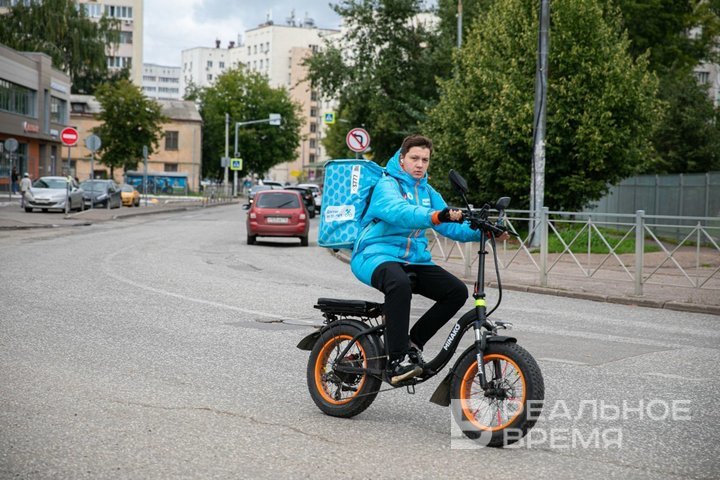
We consider delivery a key factor and strive to reduce its time for clients from 35 to 25 minutes. The hotter the product reaches the guest, the higher their satisfaction and demand. Therefore, we continue to actively develop this direction.
“The chicken market remains scarce, Russia cannot cope”
— You have switched to Russian and Belarusian ingredients: sauce, chicken, cheese. What risks are possible here: dependence on one supplier, seasonality, price volatility? Do you have a plan B in case of disruptions?
— We actively cooperate with different manufacturers and are open to new partnerships. We work at the regional level as well, for example, we are currently working on interaction with the “Makheev” brand.
At the same time, the chicken market remains scarce: to meet our needs, we purchase products in Belarus and even Kazakhstan, meaning Russia cannot cope. So, if any local producer has surpluses, we are ready to consider their offers.
I call on everyone to cooperate; we are definitely interested. Although, here, of course, a different scale of supplies is needed — the network consumes large volumes of products.
— How did the transition from foreign-made ovens to Russian ones go? Are ours inferior in terms of parameters: reliability, price, availability of spare parts, energy consumption?
— The transition process is ongoing, we are at the stage of testing and experimentation. So far, Russian ovens have not caught up with Italian ones in terms of reliability — they break down more often. However, they have their advantages: lower cost and ease of maintenance — spare parts are easier to obtain. Manufacturers continue to improve, and we help them by participating in pilot projects. Among the brands being tested are ovens from Abat, RoboChef, and “Delovaya Rus.”
— How do you solve the personnel problem, and what works best: increasing rates, flexible scheduling, referral programs?
— We use everything; we have a comprehensive approach. The referral program has proven particularly effective; with its help, we fill about 50% of vacancies. We additionally motivate employees by paying rewards for bringing friends and colleagues. At the same time, we work through classic job search aggregators and also develop our own resource, which has become an important channel for attracting staff.
At the same time, we strive to cooperate with educational institutions. For five years now, I have been trying to launch a dual education system, where students study half the week and work at the enterprise the other half. But so far, we have not been able to coordinate the curriculum with the Ministry of Education and colleges. I understand the problem lies in legislative restrictions. There are targeted training programs, but they also face a number of difficulties.
“The main problem is the growing distrust of business towards management decisions”
— You have already said that laws for business should be discussed with business. Can you give examples where the lack of dialogue led to losses and other negative consequences for business?
— Almost any decision made without considering the opinion of entrepreneurs turns into problems. A clear example is the recent initiative to create a design code for Almetyevsk, which involves standardizing signs in gray and white colors. Such an approach effectively deprives business of individuality and recognizability: clients are accustomed to associating brands with certain colors. For example, Dodo with orange, Ozon with blue. And now we are being forced into a uniform neutral look that completely deprives us of identification.
It looks like the decision has already been made, and we will not be heard again. The administration informed us that there will be a vote by the deputies of the Almetyevsk City Council at the end of this week, and all entrepreneurs are confident that they will simply raise their hands and vote “for.”
A similar situation is developing in other areas, whether it be labeling or migration policy. The main problem is the growing distrust of business towards management decisions because they are formed without our participation. At the same time, entrepreneurs sincerely want to work for the good of the country but are faced with the fact that their vision is not taken into account.
— What is your priority now: opening new points, increasing the efficiency of existing ones, strengthening delivery, developing related formats, such as Drinkit?
— Our main focus is on increasing efficiency and maintaining a high level of service. We are working on reducing delivery time. Previously, in the familiar market conditions, we set a goal to open 25–30 establishments in Kazan, launching 3–4 new points annually to increase coverage and speed up delivery. But due to the drop in demand last year, we had to adjust our plans: now 13 points are operating in Kazan, and the 14th pizzeria is being built.
In parallel, we are developing the Drinkit format. We have opened two coffee shops and are considering three more locations in the city center. This direction has proven popular with Kazan residents. In terms of investment, opening one coffee shop costs 25 million, while a network restaurant costs 55 million rubles.
“Hard work awaits restaurateurs”
In Almetyevsk, we literally opened a third restaurant two months ago, but that has its own story. On the city's main square, they want to build an organ hall — they are introducing us to culture. But at the same time, they are going to demolish four restaurants near the square, including our establishment, which operated there for 12 years. Moreover, the building is owned by us, and no compensation or alternative option has been offered to us yet — we have already been officially notified of this.
Because of this situation, we had to urgently take out a 50 million ruble loan and urgently launch a third point, otherwise we would not have been able to ensure territorial coverage. Now we work through three establishments at once and bear additional costs, as we have to maintain three separate teams.
— How is the “Aida Est” project developing? When do you plan to take the network beyond Almetyevsk?
— The project has been temporarily put on hold due to the overall economic situation. The legal entity is registered under the brand, but the launch of new points has been postponed. Currently, resources are directed towards maintaining the current network and developing priority areas, such as coffee shops.
— What risks do you consider critical for the network in the next 12 months, and what actions are already included in the plan to mitigate them?
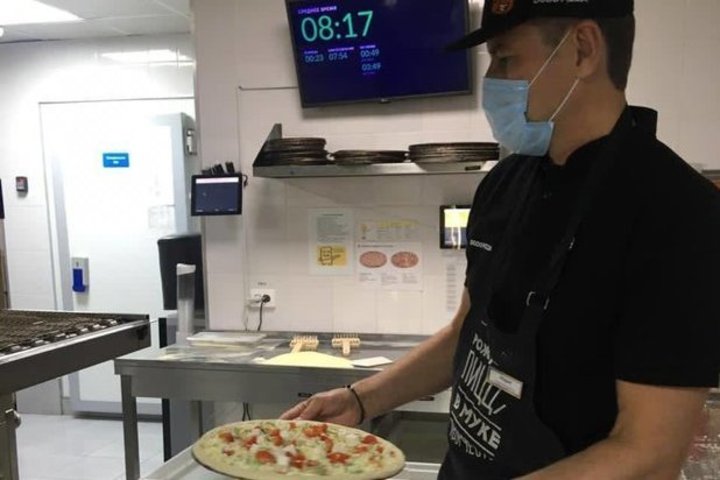
— The main risks are personnel shortages and rising operating costs. To minimize them, we are betting on automation and increasing productivity. We are introducing electronic self-order kiosks — this frees up cashiers and contributes to an increase in the average check. We are testing dough rolling stations that can increase productivity by about 20%. We are also experimenting with auxiliary solutions, such as carts equipped with a self-lifting mechanism. They save pizzamakers from unnecessary bending and save seconds that, on the scale of the flow, turn into a noticeable effect.
— Your forecast for the industry: what awaits restaurateurs in the next couple of years?
— Hard work lies ahead of us. The reduction in the key rate makes money more accessible, but the public's habit of saving rather than spending persists, and it has enriched our bankers. Restaurateurs will have to optimize processes even more, maintain the quality of dishes and the level of service — do everything possible to keep customers satisfied.
It is difficult to make forecasts now; we live in unstable times, and any long-term plans have to be built with high uncertainty in mind. We, like the whole country, are working for victory. We understand that the current difficulties are an inevitable part of the overall process, and we are ready for them. Guys are fighting in the SMO, and we here, on the home front, are trying to do our job: to survive, to preserve the business, and at the same time ensure that our people are also happy and working.