Big Little Adults
Book of the week — American writer Tom Perrotta's novel “Little Children”

On August 13, Tom Perrotta turned 65. His “Little Children” was published in 2004, when the writer was 42. The book established his reputation as an author capable of speaking about adults with the precision usually associated with teenage prose. The novel made the best book lists of 2004 according to The New York Times Book Review, Newsweek, NPR, and People, while Publishers Weekly called it a “smart, gripping story of suburban anxiety.” Perrotta gathered here adults who already have families, children, homes, and clear social roles, yet they are still searching for a way out of adolescence. The literary critic of Realnoe Vremya, Ekaterina Petrova, tells how Perrotta managed to turn a banal story of family dissatisfaction into a portrait of an entire generation of adults who were promised that a proper life would automatically make them happy.
Adults who never grew up
Tom Perrotta sets the action of his novel “Little Children” in a quiet Boston suburb, where several families spend a hot summer near a playground. At the center of the plot are Sarah and Todd. Sarah once considered herself a feminist, but now spends her days at home with her daughter and feels like an ordinary housewife. Todd, whom the neighborhood mothers nicknamed “The Dreamy Hero," stays home with his young son while his wife Kathy supports the family and demands that he finally pass the bar exam.
Around the idyllic family life in the suburbs, another line gradually emerges. A convicted sex offender, Ronnie McGorvey, returns to town. His appearance makes neighbors look differently at the familiar safe space. Against this backdrop, Sarah and Todd grow closer, and a romance develops between them. They try to decide what each of them should do about their marriage.
All the major decisions in the novel are made by adults, but Perrotta nevertheless titled the book “Little Children.” Little children indeed surround the heroes on the playground, but first and foremost, the parents themselves constantly demonstrate emotional immaturity.

Adults respond to the pressure of new gender roles by regressing to adolescent behavior. Sarah grows tired of the housewife role, while Todd cannot accept the position of a man who stays home while his wife earns money. Even their interest in each other is not built on suddenly ignited love. Primarily, Sarah and Todd get the chance to feel young, desirable, reckless, and free of parental responsibilities again. Their relationship is an easy way to temporarily escape their own lives.
At first glance, “Little Children” seems like a story of infidelity. But Perrotta shows two parents using each other to regain a lost sense of freedom while their former lives continue to demand responsibility. Instead of preparing for the exam, Todd watches teenage skateboarders and joins a nighttime amateur football team, where he again feels the energy of youth. Sarah tries to understand how she ended up in a traditional marriage she once didn't want. Their connection grows from a shared desire to temporarily stop being the adults life has made them.
A playground for adults
When the novel was first published in 2004, critics gave it a fairly straightforward description: “Little Children” is a satire of suburbia. But Perrotta rejected such a simple reading. He said he held no contempt for suburbs and that “Little Children” was about “not so much a place as a time of life.” The main characters are roughly thirty or so. This is the age when adulthood finally takes hold. And thirty-somethings in the early 21st century had an ambivalent attitude toward parenthood.
Perrotta shows a social script imposed by society. You need to buy a house, get married, have a child, become a good parent, and appear happy. At the same time, the characters find that life does not match their previous plans. They seek a way out, but each remains trapped in expectations in their own way. Perrotta himself noted that his thirty-something characters want “sexual satisfaction and parenthood” but struggle to accept the need for self-sacrifice. And there is tension between the person the hero was in adolescence and the adult he needs to become.
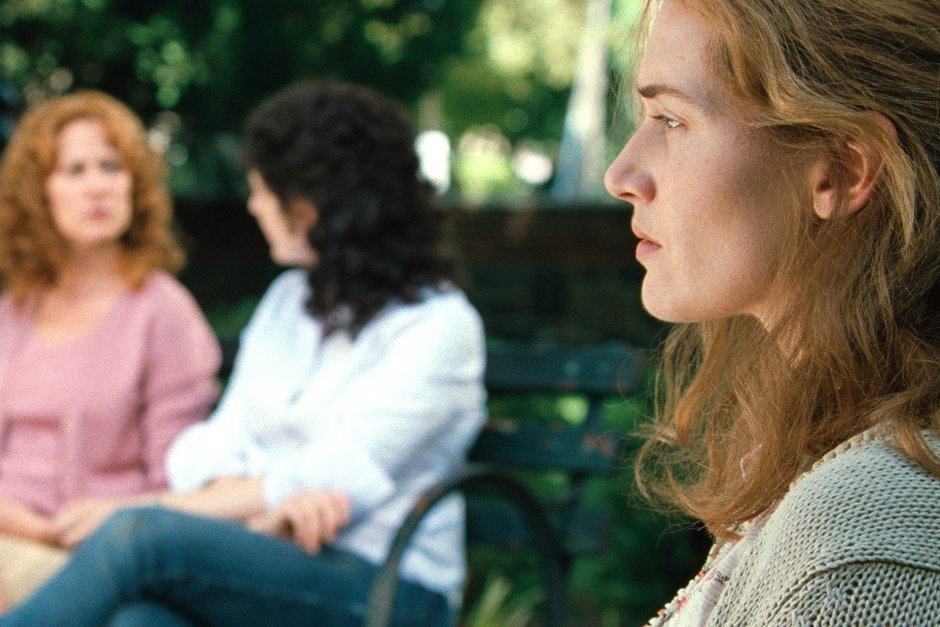
The most accurate place for this norm is the playground. Adults bring children there but quickly turn it into a space of mutual control. Mothers discuss daily routines, nutrition, kindergartens, and upbringing, watching each other and judging others' parenting habits. Mary Ann believes a strict schedule is key not only to a healthy marriage but also to effective parenting. Every day at 10:30, her children, and then everyone else on the playground, have a snack that acquires almost ritual status.

On this same playground, Sarah and Todd first grow close. The same place attracts Ronnie. And here, the final clash of all plot lines occurs. The space created specifically for children gathered the entire adult world around them. On the playground, mothers compete for the status of “best," a criminal plans to realize his sexual desire, young parents commit adultery. And there is also fear and a struggle for the right to be considered normal.
Sarah and Mary Ann occupy different positions within this system, but both face its limitations. Sarah is dissatisfied with the housewife role and distances herself from her daughter. Mary Ann, on the other hand, fully accepts the rules of “proper” motherhood. At the same time, neither woman gets the expected satisfaction from her role.
Perrotta constructs the male crisis on the same principle but in different forms. Todd is an attractive former athlete and a father who stays home with his child. He graduated from law school, failed the bar exam twice, and didn't even try a third time. The neighborhood mothers perceive him exclusively as a sexual object. Todd himself feels insecure and returns to teenage pursuits and memories of his school glory. Todd is satisfied in a traditionally female role. His affair with Sarah allows him to feel young and desirable again.
Sarah's husband, Richard, chooses a different path. He retreats into internet pornography and tries to adapt his desires to existing family life. Thus, the novel places two forms of escape from full adulthood side by side: Todd returns to the physical reality of adolescent experience, and Richard retreats into sexual fantasy.
Another character, Larry, takes the male crisis to another extreme. The former policeman lost his job after accidentally shooting a young man and then directed his frustrated feelings into fighting Ronnie. Larry became a self-appointed defender of the neighborhood. It is he who persuades Todd to play on the football team, again returning him to the teenage world. Larry's storyline shows an attempt by a man to restore traditional masculinity through violence.
Ronnie makes this system particularly uncomfortable for the suburban residents. Perrotta introduces him as a man whose return after prison for a sex crime against a child forces the entire neighborhood to define the boundary between normal and abnormal. Locals want to push him out of the community, and Larry turns this campaign into a personal battle. At the same time, Ronnie's mother, May, does not identify her son with his crime and tells him:
— You did a bad thing, — May admitted, — but that doesn't mean you're a bad person.
Ronnie acknowledges his “psychosexual disorder” and says he would like to be attracted to an adult woman. These confessions do not erase his past or the danger he poses to children but prevent the character from being reduced to a villain's function. Against this backdrop, the neighbors' reaction is particularly important: fear of Ronnie becomes part of a collective struggle for moral order. Larry gets the chance to act as a defender of children, Mary Ann as a defender of the proper family, and the neighborhood itself to confirm its own idea of normalcy.
Ronnie destroys the main internal agreement of the suburb, according to which home, school, parents, and the playground no longer guarantee safety. Ronnie's story brings the question back to the same adults who tried to protect children: who exactly gets to define the norm and at what cost does the community maintain its boundaries.
Satire that does not negate sympathy
Perrotta laughs at his characters precisely when they themselves are least amused. Sarah is bored in the prosperous suburb, Todd cannot pass the bar exam, Richard retreats into internet fantasies, and Larry turns his fear of Ronnie McGorvey into a personal war. The author does not absolve them of blame but also does not leave them alone with their weaknesses.
William Blythe formulated this paradox in question form: how can a writer be simultaneously “so caustic and yet so full of compassion”? In the novel, satire is constantly interrupted by the most tender scenes. Later, Perrotta explained his method:
— A sympathetic character is one you understand. The task is to make you understand a character who might initially seem unsympathetic to you.
People continue to care for loved ones, even when they do not approve of their actions. That is why The New York Times called Perrotta “the American Chekhov," whose characters, even in the most absurd situations, retain human dignity. The resemblance here is not in the plot or the structure of the American suburb. Perrotta, like Chekhov, observes everyday life and does not divide people into absolutely right and wrong. He turns petty humiliations and family boredom into dramatic material.

At the same time, the author spoke of the influence of another American chronicler of everyday life. He named John Updike's books and particularly singled out the novel “Rabbit Redux” (1971) for its ability to create a microcosm of an entire era within one house.
Todd Field's 2006 film adaptation, titled “Little Children," showed how much of the novel depends on its ambiguity. Field initially thought the book would make a better miniseries than a feature film. After unsuccessful negotiations for an eight-episode version for HBO, he condensed the material into a film, preserving the main lines of suburban conflict and some comic episodes. At the same time, the director deliberately changed the ending. He told Perrotta:
— I love your book very much. And I hate the ending. It has nothing to do with your book.
After that, Tom Perrotta joined the reworking. Ronnie's unexpected confession was removed from the film because Field was more interested in the relationships of mothers with their children and husbands than in the story of a sex crime and sensational exposure.
“Little Children” is a novel about adults trying to understand when their youth ended. Perrotta shows how a socially successful adult can live in a stable family, own a home, have a child and a job, and still not know what to do with their life.
Publisher: Amphora
Translation from English: Irena Pander
Number of pages: 446
Year: 2007
Age rating: 18+
Ekaterina Petrova — literary critic for the online newspaper Realnoe Vremya, host of the Telegram channel «Булочки с маком».