MOÑ theatre venue closes the season with the launch of film photography exhibition
“This exhibition is not about perfection, but on the contrary, about chance,” say its organizers
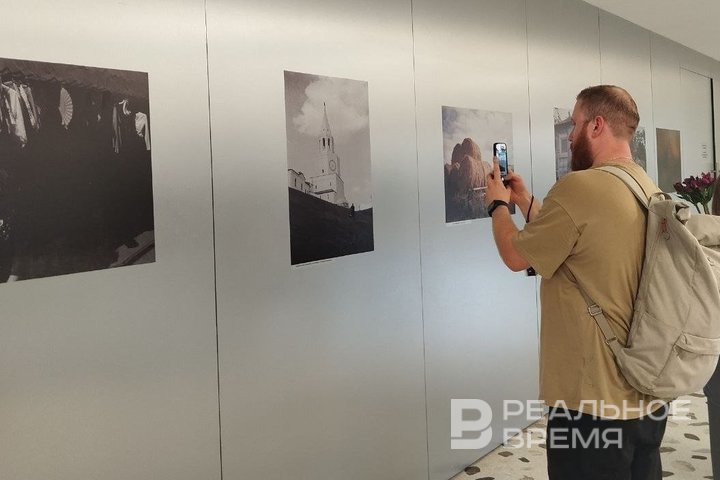
Like most friendly organizations, Kazan MOÑ theatre venue also closed the season. It will not have any performances at the National Library of the Republic of Tatarstan until August. But for now, you can come and see the film photography exhibition Extreme Point inspired by the philosophy of Henri Cartier-Bresson. 150 photographs applied for it.
What Cartier-Bresson has to do with it
The project was conceived by Alexandra Davydova, PR manager of the Living City Foundation, MOÑ theatre venue, and a photographer. The starting point for her was the reflection of Henri Cartier-Bresson, a classic of documentary photography. When the Louvre decided to organize its first photography exhibition in 1954, it was this author's works that were on display.
Interestingly, Cartier-Bresson himself did not develop the film or print the photographs. He usually explained it this way: you have to click the shutter at the “decisive moment.” According to him, photography is “instant recognition, in a split second, of the significance of what is happening and, at the same time, the precise organization of forms, which gives this event the expression that corresponds to it.”
Davydova opened the call for applications on 18 June, accompanying it with the following text: “The focus is on the extreme point. The moment in which everything becomes more acute: form, gesture, pause. Not just a frame, but a state. Peak, vulnerable, filled. When the story reaches its limit, and you release the shutter. That is when the photograph ceases to be just an image and becomes a statement.
This is not about a beautiful angle or an effective composition. The context is important here — what is really happening. A lonely woman with a cigarette on the beach is not a pose, but a story. About fatigue, loneliness, and the inner landscape.
The exhibition is presented on the walls of the MOÑ theater venue — a space where contemporary Tatar culture is explored. It is important for us that the photographs are about this: about how people in Tatarstan live, feel, are silent, and look.”
Applications were accepted until 25 June, and 10 photographs were selected from 150.
Photographers say
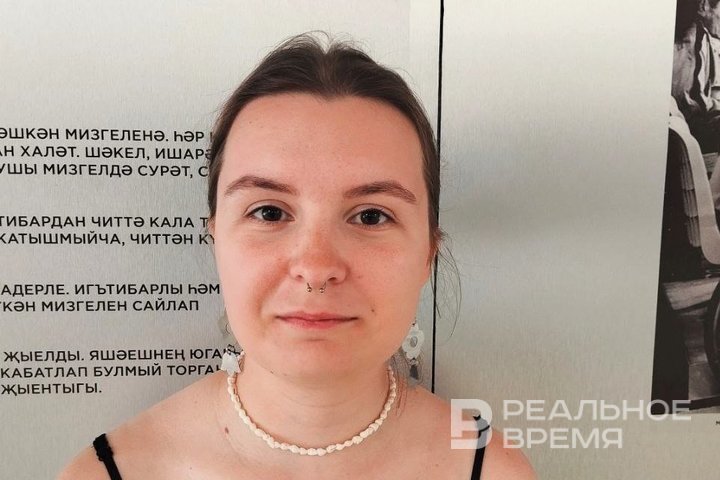
“It seemed to us that they best convey the context of Tatarstan, the context in which the people of Tatarstan live,” explains Davylova. “Here are the people themselves, and what they are looking at, a still life or, for example, hay. Each photograph is accompanied by an audio description. I asked to voice each author independently, because it seemed to me that this way you can be even closer to the author and to the story. And we also made a voiceover in the Tatar language.
The recordings were clearly made on built-in voice recorders, so the authors are really close, they speak differently. Here Maria Norden explains in detail: “2018. The football championship between Iran and Spain at the World Cup. A football fan or a former football player himself enthusiastically follows the match. There are no limits for a true fan.”
Sofia Khapina notes: The Bird Market is a magical space that is impossible to ignore: “When you just go to the market, magic occurs and everything happens by itself, you don’t even have to intrude into the space. The market is such a living and breathing place, for a photographer this is, of course, significant.”
Dinara Sayetova briefly shares: “The photograph shows an August still life with the harvest, on which my grandfather worked all year.” “It seems to me that if a person just wants to finish thinking, he has such an option,” says Davydova. Or you can listen to what the author of this photo really wanted to convey.
For someone, it will be just a photo of a grandmother making pies, and someone who listens to the audio guide will already know the real story.
Some photos of the participants of the exhibition Extreme Point
How to choose from 150
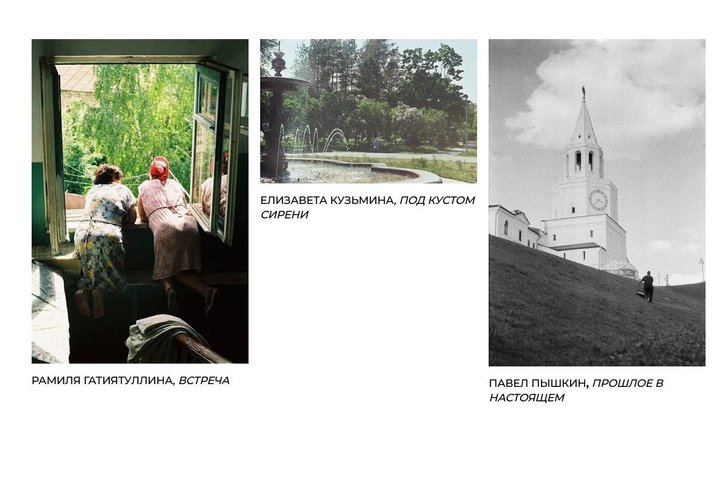
Out of 150 photographs, 10 were selected by Davydova herself, explaining that she tried to collect the pictures into a single concept, so that each complemented the other, and also observing a certain parity ratio of people in the frame and just the nature of Tatarstan.
“Instantly, I think I eliminated about 40%,” says Alexandra. “It was not because the photographs were bad, but because they simply did not fit conceptually into this exhibition. There was an ideal picture, there were models, and this exhibition is not about ideality, but on the contrary, about chance, about a moment caught by chance. The rest was eliminated during immersion in the material, during reading the description.”
I had a small principle of taking not only photographers, but ordinary people who caught some cool moment and showed it. Among the professionals here are Sergey Uskov, Maria Norden, Bulat Arslanov. The rest, for the most part, are amateur photography.
In addition to the above-mentioned authors, Pavel Pyshkin, Leysan Gilmetdinova, Aliya Latypova, and Elizaveta Kuzmina are participating.
An important reminder: all photographs were taken on film. According to Davydova, this topic is gaining momentum again now, due to the retro trend, and film is just one of them, more people are getting involved.
“Mostly people just take pictures of themselves and their friends. But there are those who take pictures of what is already happening around them,” says Davydova. “This is not a grant story, but simply my initiative. The only place where the exhibition could be held was the wall of our theatre.»
Film photography is a story with different budgets, notes photography master Timur Khadeнev:
Interest in film photography began to grow in the late 2010s, reached a certain level and has been maintained for several years, notes Khadeyev.
“Many take film on vacation, in the summer a lot of people try to shoot. Someone even starts printing manually — this is a separate topic. Film has gradually been pushed aside by the fashion for retro-digital point-and-shoot cameras, but film is still an important part of the photo life for many.”
The exhibition will run until 4 August.