The drunken monkey hypothesis, hereditary goosebumps, and stone age geometry
Interesting science news of the week
Perhaps the human craving for alcohol is not a habit acquired through civilization, but a genetic inheritance from primate ancestors. Goosebumps as a physiological reaction to art may be hereditary. Stone Age hunter-gatherers, as far back as 60,000 years ago, drew precise geometric patterns on ostrich eggshells. 3.6 million years ago, an asteroid struck Earth — traces of this event have been found in South America. A dog can selflessly help a person, while a cat only interacts if it sees a benefit. More details on these interesting science stories from the past week are in this review by Realnoe Vremya.
Humans probably inherited drunkenness from apes
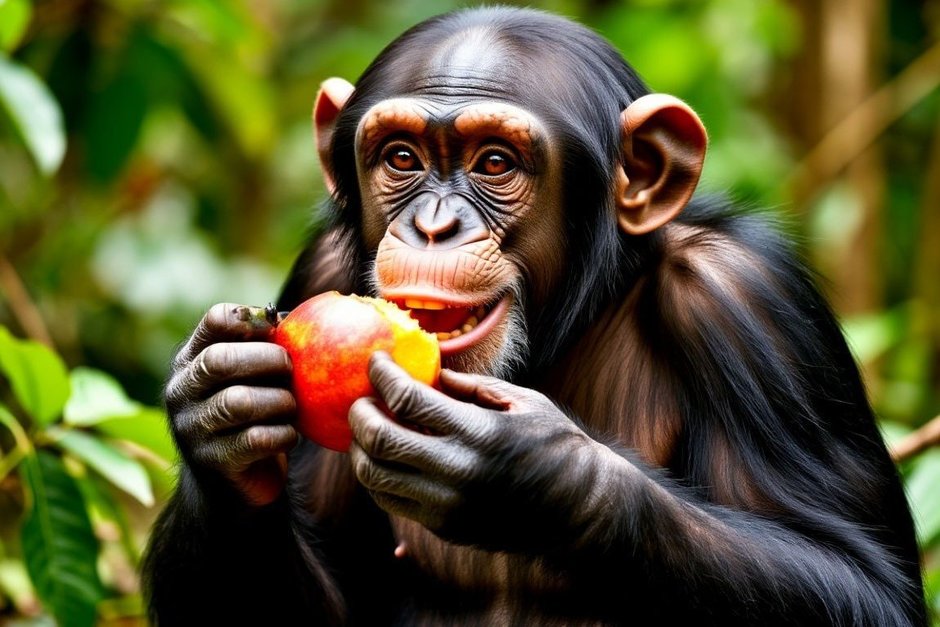
Biologists studying anthropogenesis at the University of California, Berkeley, have proposed the “drunken monkey” hypothesis. According to this idea, the human attraction to alcohol is not a harmful habit that randomly emerged during the development of civilization. It is an inheritance from our primate ancestors, who were not averse to feasting on fermented, overripe fruit. This fermentation causes the fruit to become “drunken”—meaning the monkeys that eat it also get drunk.
The American biologists tested this hypothesis on wild chimpanzees in Uganda's Kibale National Park. In a previous study, they went to the park, observed which fruits the monkeys preferred, and measured the ethyl alcohol concentration in the overripe pulp. They also roughly estimated how much an average chimpanzee could eat. Their calculations at the time suggested the monkeys live a merry life: about 14 grams of alcohol enters their system daily (equivalent to a 0.33-liter beer or a shot of vodka).
But they didn't stop at calculations. In August 2025, the scientists returned to Kibale to materially prove monkey drunkenness. To do this, they collected 20 urine samples from 19 chimpanzees. Before this, the monkeys had been observed by the researchers appetizingly eating slightly fermented fruit. Analysis showed that 17 of these samples contained ethyl glucuronide—a breakdown product of ethanol. In most samples, the level of this substance was above the threshold “sober” value and corresponded well with the earlier calculations.
Thus, the drunken monkey hypothesis gained another point in its favor. But the main thing remains unproven: the scientists did not record a situation where chimpanzees deliberately chose the most fermented, the most “drunken” fruits. That is, whether they developed a conscious love for alcohol. This remains to be determined.
Traces of earth's encounter with an asteroid 6.3 million years ago found in brazil
When a large celestial body—for example, an asteroid—falls to Earth, not only does it create a giant crater on our planet's surface. The rock also melts as a result of the tremendous impact, forming pieces of natural glass—tektites. And if geologists find a place with a lot of this glass, it indicates a site where Earth and an asteroid once met. By studying tektite fields, scientists can understand that such a collision occurred—because due to lithospheric plate movement and wind erosion, a crater can disappear, “smoothing out” over millions of years. But the glass remains. Until now, only five tektite fields had been discovered in the world.
Now, an international group of geologists has found a sixth in Brazil. Over an area stretching 90 km, they collected about 600 tektites, the largest weighing over 85 grams. Later, reports of similar finds came from neighboring states, and the field “expanded” to 900 kilometers. This suggests the impact was quite powerful. It occurred about 6.3 million years ago—the age of the tektites was determined by isotopic analysis.

Until now, no asteroid impact from this time period was known in South America. Now, the fact of the impact is beyond doubt, even though the crater has not yet been found. Research will continue.
Stone age people were not strangers to geometry
Fragments of vessels made from ostrich eggshells, found at Stone Age sites in Namibia and South Africa, show that tens of thousands of years before the first civilizations, humans already understood geometry. 60-65 thousand years ago, ostrich eggshells served as water canteens for ancient hunter-gatherers. People decorated them, making engravings. Scientists discovered these finds long ago, but only now have they analyzed the mathematical structure of the primitive patterns.
They studied 109 engraved eggshell fragments. They digitized 1,275 lines, consisting of 1,635 segments and having 1,405 intersection points. They conducted statistical modeling, examining numerous parameters—trying to understand whether the engraver's hand moved randomly or whether they were trying to depict an ordered geometric ornament.
The results are astounding. A third of the lines intersect almost strictly at right angles. 83.4% of the design elements are part of strictly parallel groups. The Stone Age artists repeated patterns, rotated them, made synchronous shifts of fragments, and even nested one figure inside another. There was also a hierarchy in the design: one group of elements became a frame for another. And all this is not a random find. These patterns remained stable across different sites for at least 5,000 years.

Thus, we have the oldest evidence of humans structuring form and considering (even if intuitively) the rules of geometry that Euclid would only formulate a staggering 60,000 years later.
Altruistic dogs and opportunistic cats
Hungarian scientists decided to settle once and for all whether dogs truly love their owners selflessly, while cats, when helping people, pursue their own gain. They attempted to study the nature of animal altruism by comparing the behavior of cats and dogs with the behavior of... small children.
This choice was not accidental. Children represent an early stage in the development of human prosociality. Dogs have been domesticated over a long period, with clear selection: humans chose (and thus bred) those that interacted best with them. But cats were never required to be obedient or loving from the start; their task was to protect crops from rodents. That's why they were domesticated.
The scientists conducted the experiment as follows: a subject (a child, a dog, or a cat) was in a room. In front of the subject, the experimenter hid an unfamiliar object in the room. Then, the child's parent or the animal's owner entered the room and began searching for the missing item. They were to act confused and hint at their difficulty, but not directly address the cat, dog, or child. In the second part of the experiment, everything was the same, except that a treat or the subject's favorite toy was hidden in front of them. The subjects' behavior was recorded.
The result: when the unfamiliar object was being searched for, children and dogs often pointed the adult to the hiding place. Sometimes they picked up the object themselves and even frequently gave it to the seeker. Cats never did this. However, when the favorite treat was hidden, dogs and children did not change their behavior. But cats suddenly became very cooperative and social: they actively showed where the hidden item was.

The conclusion is obvious. Dogs are more altruistic, and their behavior is close to that of humans. Millennia of selection for cooperation have indeed borne fruit. The selfish cat, on the other hand, is not inclined towards selfless help. Even if it loves its owner, it has no desire to help. That's not why it was tamed. But if the cat sees a reward in the form of a treat—why not?
Goosebumps from music and poetry may be hereditary
Have you ever gotten goosebumps when hearing brilliant music or reading poetry? It's known that some art lovers have this physiological reaction, while others enjoy culture without it. Dutch scientists decided to get to the bottom of the truth: where do “cultural” goosebumps come from? And why don't everyone get them? It turns out that this is partly genetically determined.
You might be surprised, but goosebumps have long interested Dutch researchers. Previously, it was found that the same neural systems in the brain responsible for biological stimuli (e.g., reaction to tasty food) are also responsible for aesthetic or musical goosebumps. Armed with this information, the researchers analyzed the DNA of 15,606 participants in a large multigenerational study conducted in the Netherlands. The participants had previously reported whether they experienced “cultural” goosebumps or not. Knowing this, the researchers compared the data.
They found that this physiological trait is hereditary in 29% of cases. So if your grandmother got goosebumps listening to Chopin's nocturnes—perhaps that's why you also feel good music in your skin.

Only one question remains: why are the Dutch scientists researching this? They answer that they are paving the way for studying the biological foundations of emotional experience. Not like the Hungarians in the previous section with their cats and dogs.