Olga Agapova: “We've switched to women 40+; it's not even interesting to make clothes for young people”
The creator of the Free-DA-sagan brand — on the Russian clothing market, her business, and living across four countries
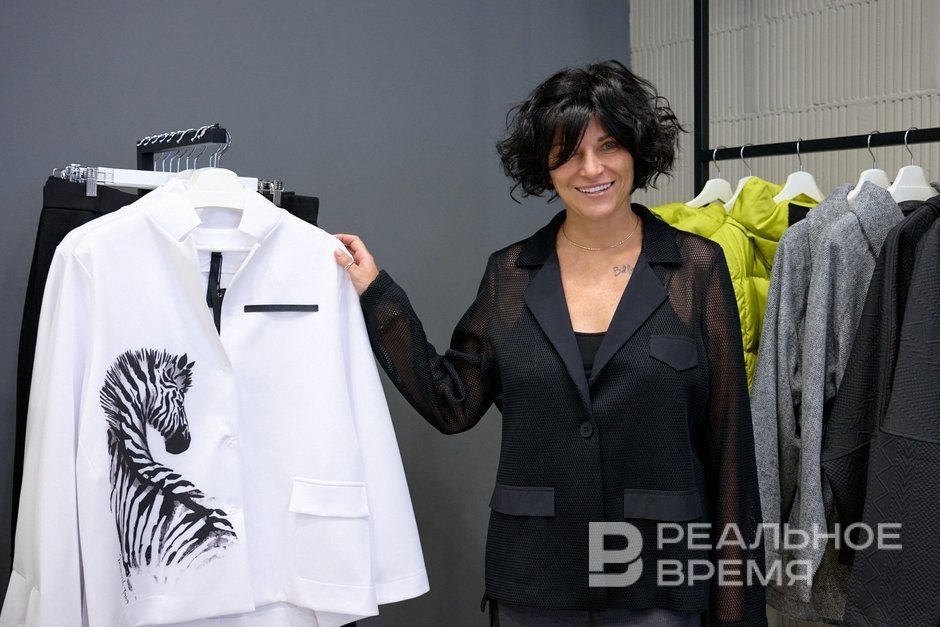
Olga Agapova, the creator of the Free-DA-Sagan brand, who opened her third store in Kazan after Moscow and St. Petersburg, told Realnoe Vremya in an interview why she chose not to move production from Kazakhstan to Russia, opting instead for Belarus; how specialized brands lost out to the oversize fashion trend; why Italians buy Chinese fabrics; and how to be a mother of five children while running a sewing business across four countries.
“Few People Knew That the Brand Was Actually Kazakhstani”
— Olga, you're a marketer, originally a medical professional. Tell us, how did you get into clothing design?
— My basic education is indeed in medicine, but I never worked in that field. I moved into advertising and marketing, and I've been doing that for about 20 years, I think. I've been in the sewing business since 2006. The first brand we launched on the Russian market was clothing for expectant mothers.
For two consecutive years, the company was the industry leader according to the rankings of the Chamber of Commerce and Industry in Russia. Moreover, it was a Kazakhstani brand: the brain center was in Kazakhstan, and the factory was located in Kyrgyzstan, in a free economic zone. Firstly, labor is cheaper there; secondly, at that time Kyrgyzstan was a member of the WTO, making it easier for us to export to Russia. Kazakhstan is a small market; we wanted to enter Russia with its large population.
— Was it really cheaper to export than to produce here in Russia?
— Yes, in those years, definitely. So the model was this: head office in Kazakhstan, production in Kyrgyzstan, sales in Russia. Stores in Kazakhstan, by the way, only started opening two years later. So we were perceived as a chain brand, and for a long time, few people knew that this brand was actually Kazakhstani.
Initially, even in Russia, we worked exclusively as a wholesale manufacturing company. There were no retail stores, but we had 1,200 partners. Some simply bought wholesale for their multi-brand stores, while others opened mono-brand stores under our label, exclusively with our presence on the sales floor. Three years later, another maternity clothing brand appeared, but for the premium segment — Paola Laroni. That one had more expensive fabrics, more complex models — a more fashionable style.
— So you were working in two segments?
— Yes, but it was exclusively maternity wear. I have five children myself, and I constantly had nothing to wear. What was on the market was either Turkish, which we considered awful, or Italian, which cost a huge amount of money, and it felt like a shame to spend that much on clothes for just a few months. So I decided: if there's no clothing I want to wear, I need to make it.
“When oversize came into fashion, maternity wear became irrelevant”
— How old are your children now, and how did you manage to balance family and work?
— My eldest daughter is 26, and the youngest is seven. I don't think the question of balancing ever really came up for me. Everything happened in parallel and somehow naturally.
— Is this solely your business, or a family affair? How did you develop it further?
— It's my business; my husband works in a completely different field. We closed the maternity brand in 2010 or 2011. We didn't sell it; we closed it down. We stopped production. We let people go. We gradually sold off the remaining stock from the warehouses. Why? The market changed. Firstly, there were a series of devaluations, first in Russia, then in Kazakhstan. And that wasn't even the main reason. A business can survive devaluations or any market upheavals. What was irreversible for us was the change in fashion trends. If you remember, back then clothes were fitted to body shapes; we loved and wore tight blouses and skinny trousers. And with that fashion, yes, specialized clothing was needed, because regular clothes just don't work as your belly grows.
It's not even interesting to make clothes for young people: you can put a sack on them, and they already look beautiful. But when you're 35-40+...
Then oversize suddenly came into fashion. And as soon as that happened, specialized maternity wear simply became unnecessary for the market. I watched our competitors… We closed down in time; that is, we retrained. We switched to smart casual, for women 40 plus. Moreover, we created the new brand Free-DA-sagan — the store we're opening today — considering not only fashion, style, and trends, but also consumer marketing. We chose 40+ because there's no point in creating yet another brand for the young and slim — the whole world makes clothes for them. Actually, it's not even interesting to make clothes for young people. You can put a sack on them, and they're already beautiful. But when you're 35-40+, when your body starts to undergo age-related changes, there are areas we want to hide — some want to conceal the décolletage, some the arms, some don't want to emphasize the waistline. You're smart, successful, wise, and mature, but you're no longer 90-60-90, and that needs to be taken into account.
Essentially, oversize also hides a non-ideal figure. But it's a very subtle thing: with “size-less” clothing, you can adorn a woman, or you can turn her into a locomotive model, making the silhouette square and shapeless.
“The most important stage is developing the prototype”
— Actually, in any real and serious production, the most expensive and complex stage is the experimental one. When a model is conceived and a prototype is refined. We have our own experimental design bureau. An idea pops up: “Oh, let's make trousers like this.” Raw materials are selected, patterns are drafted. Then these trousers are put on a live person, and we see: how do they fit? Do they shorten the legs or not? Does the volume need increasing or decreasing? Is it comfortable with an elastic waistband or not? In some cases, for example, when we're testing new trousers, I might take them and wear them myself for 2-3 days. I see how they feel overall and how I feel in them. Is the fabric tactilely pleasant or unpleasant? Do the knees bag out? We can't allow customer disappointment. She buys them, drives to the office once, gets out of the car — and that's it, she no longer feels beautiful. That's sad.
Clothes should be comfortable, durable, and easy to care for. All this is achieved through the right choice of raw materials and the fact that we spend a lot of effort, time, and resources on developing the prototype. I select the fabric myself. I actually fly to China and look at and touch everything there. We have factories we work with regularly, but if some new raw material appears, we first buy a small batch, literally a roll. We test it and only then buy the volume for the seasonal collection.
Half of Italy buys in China and passes it off as Italian. There is no other country in the world that can make such amazing fabrics as China.
— So, all fabrics are from China?
— There is no other country in the world that can make such amazing fabrics as China. We looked at Italy — half of Italy buys in China and passes it off as Italian. Or it's completely exclusive and handmade. We looked at Turkish fabrics. Turkey works well with natural fibers. But we use very expensive synthetic, modern, high-tech fabrics. By the way, everyone thinks natural fabrics are more expensive than synthetics. But modern synthetic fabrics, the breathable and durable ones, cost much more than natural ones because they are high-tech fabrics, with a lot of money spent on their development and production.
Everyone says: “China is cheap.” Not at all!
— How much more expensive are synthetic fabrics compared to natural ones?
— It can be 20, 30, 40% more, it varies. Some are several times more expensive. Some of our fabrics cost from $15-20 per meter wholesale from the factory. That's the cost excluding logistics and customs. And that's not cheap. We don't choose cheap fabrics.
Everyone says: “China is cheap.” Not at all! Cheap China has long been an illusion.
— And the clothing design is your own?
— Yes, the clothing design has always been our own. I come up with the models myself.
I have a designer dress I bought 8 years ago and haven't worn once
— But you're not a fashion designer?
— I'm a person with a medical education who has worked for many years in advertising, marketing, and the field of clothing design. We're not a runway brand where imagination runs wild. That's when you buy designer clothes and they end up hanging in your closet because you really don't understand: where to wear them? I have a designer dress I bought 8 years ago and haven't worn once. Yes, it's wonderful, designer, cost a huge amount of money, but its practicality is a negative. When getting ready to go somewhere, you put it on and think: “Well no, it's too much for this event, or not enough.”
Therefore, even though we say it's “designer clothing," it's only to tell the consumer that these aren't “basic” models, but ones that make people turn and notice. A minimum of creativity, a maximum of analytics and cultivated taste.
“We're restructuring — closing production in Kazakhstan and moving to Belarus”
— Are you inspired by fabrics?
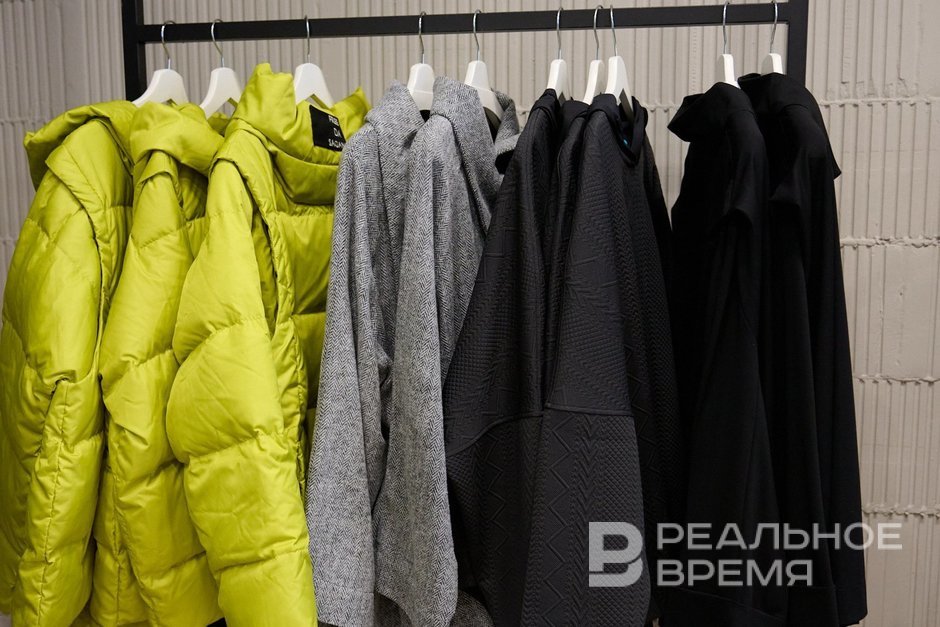
— Yes, sometimes you start from the fabric. And sometimes it happens that a certain model is conceived, and the fabric is chosen to match it. I like it when it's unexpected and not like everyone else's. In the March spring collection, we will have... automotive mesh. I haven't seen this fabric used in clothing yet — it was used in bags. And we decided to make jackets from it. I think it turned out really cool and looks interesting. The garment turned out to be very durable, especially for Russia, and versatile — with a sparkly top and beads, it's an evening look. With a strict turtleneck, it's office wear.
— What's happening with you now, besides opening the new store in our city?
— We are moving production to Belarus. We made this decision a year ago and prepared for a long time. The creative bureau remains in Kazakhstan, and production will be in the city of Polotsk.
— And where do you live?
— My family lives in Indonesia, and for the last three years I've been living “doing the splits” between Indonesia, Kazakhstan, Russia, and Belarus. A long time ago, I don't remember how old I was, I dreamed of “traveling a lot.” So — be careful what you wish for. Sometimes I just want to sit at home and not go anywhere. I flew to Kazan for the store opening — to jokingly cut the ribbon and meet people.
— Is your team present in all cities?
— In all the countries where we operate, we have our team. It's not very large, because the issue isn't numbers, but the quality and competence of the employee.
We practically have no staff turnover, no people who work for just a year or two.
So the team is small but very high-quality. Some work in Kazakhstan, some in Russia, some in Belarus, some in China. Now we also have a team in Kazan.
— How many own-brand stores does the brand have?
— Now four: in Almaty, St. Petersburg, Moscow, and this fourth, new one, in Kazan.
Our customers are more people of the physical universe, for whom the thrill is to come, touch the fabric...
— And online sales?
— We have two online stores: one serves Kazakhstan, the other serves Russia. Online accounts for only 15-20% of all sales. After all, our customers are more people of the physical universe, for whom the thrill is to come, feel the fabric — what it's like tactilely — try everything on, put together an outfit. We have a capsule presentation; all items from all collections combine perfectly with each other. You can buy a jacket this season to go with trousers released 2 years ago, and it will look like a suit.
— What is your production volume?
— We produce up to 1,500 units of items per month. We're still not mass market and adhere to the concept of limited editions. There are models that sell out within the first three days of sales.
— How often are new collections released?
— Every month, except February and August. So, a fast-changing assortment is what the market needs, and it's already indispensable. It adds a lot of drive to the work.
— You really create recognizable pieces.
— We try to make them recognizable and, most importantly, practical.
Even when we create the December, festive collection, we approach it so that it's not just “wear it for the party and that's it.” We're all grown-up girls now; practicality comes first. Why waste money meaninglessly?
We're all grown-up girls now; practicality comes first.
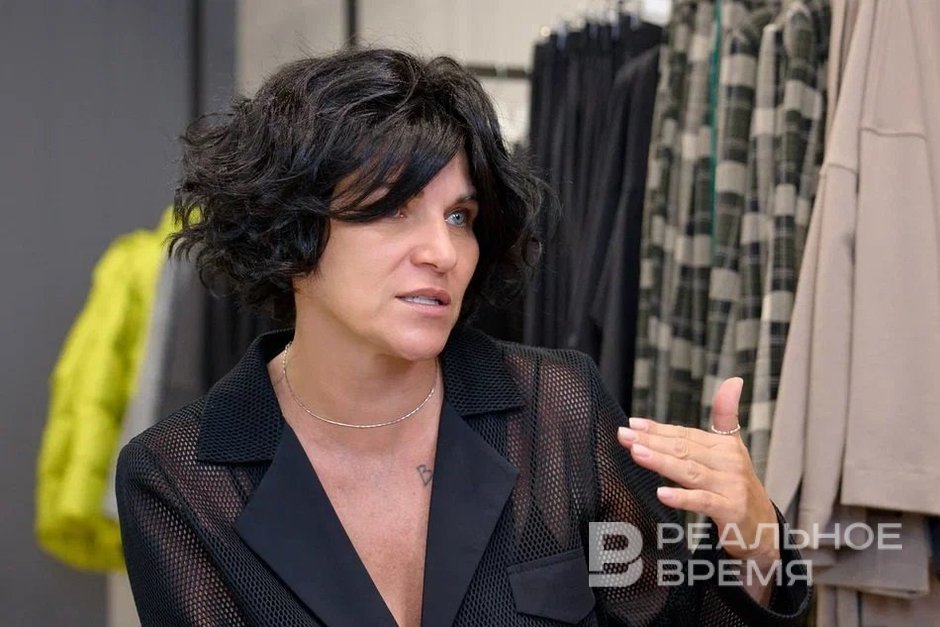
Of course, emotional purchases haven't been canceled, but then you'll want to come and return it to the store. So if we have some festive models, for example this skirt, it can be worn in both a dressy look and an everyday one.
“We've reached a certain level in Kazakhstan, above which we can't jump”
— Where is your company legally located?
— We currently have companies in Russia, Kazakhstan, and Belarus; they are part of the group and connected by contracts.
— Why did production in Belarus turn out to be more advantageous than in Kazakhstan?
— Kazakhstan is not the most convenient location for production. When we worked in Kyrgyzstan, we produced 15-20 thousand units per month. In Kazakhstan, I can't guarantee such production volume. It's very difficult to find seamstresses. The profession isn't prestigious; it's not popular. And we need not only to sew a lot and quickly, but also with high quality. And it turned out that we reached a certain production volume, above which we can't jump.
When many foreign brands started leaving the market, there was a surge in domestic production here. Everyone thought being Zara was very simple...
Last year, we participated in all the Moscow exhibitions, collected a ton of orders, and couldn't fulfill them without leaving our own stores empty. So here I have demand, but I can't meet it. And that was the last straw in deciding we needed to change the production site.
— Why not Russia?
— It seemed to me that Russia also has somewhat of a personnel problem, because when many foreign brands started leaving the market, there was a surge in domestic production here. Everyone thought being Zara was very simple...
So why, in conditions of a shortage of skilled labor and overloaded production facilities, would I enter Russia, only to face the same problem as in Kazakhstan? And in Belarus, there are a huge number of sewing factories! There are just so many of them. We traveled around, looked, got acquainted. We liked their attitude to work, like in the Soviet Union when there were GOST standards. They don't chase quantity; quality comes first. That's cool, really cool! And that's why we chose Belarus.
“For Kazakhstan, this tax reform will kill business to a greater extent”
— The world is such now: every morning you wake up — you have new input data that you have to adapt to. I think we did the right thing, but who knows what will happen in six months.
— You're a resident of three countries; can you compare the legislation, especially taxation?
— Tax-wise, our situation is more or less similar. Especially since you also had a tax reform this year. But judging by the Russian news feeds, you have much less anxiety on this topic than we do. For Kazakhstan, according to many analysts, this tax reform puts businesses at risk. Things are already not simple in terms of purchasing power — it's falling, while inflation is rising.
— Is organizing production difficult?
— Creating a factory from scratch is hard. The easiest part is buying equipment. But it takes time to set it all up technologically. For the conveyor to work well, plus you need a cohesive team: a cutter, a master, a seamstress, and quality control. So that later there's no: “It's not my defect, it's her defect.”
“It's hardest for companies that have planning horizons”
— Why Kazan?
— I'm originally from Kazakhstan, born and raised there. And I believe that Kazan and Almaty have a lot in common, a very similar mentality. Every time I've been here, I've had this feeling that I'm somehow in Almaty, only the language sounds a little different and there are no mountains visible.
Next in line is Ufa. But I don't know and I'm not speculating how things will go further. In some interview they asked: “What's your planning horizon?” What the hell kind of horizon is there in our times? It seems to me that it's hardest for companies that have these planning horizons — it's hard to readjust, and flexibility is needed now. That's why I'm for companies with a small staff. The smaller the staff, the more mobile and flexible you are.
An entrepreneur must have some kind of intuition. If all businesses started with market analysis and forecasts, up to 70% of projects wouldn't happen at all.
— How do you research the market?
— We don't conduct any marketing research. And it's my conviction that if all businesses started with market analysis and forecasts, up to 70% of projects wouldn't happen at all. An entrepreneur must have some kind of intuition that, despite all the marketing research, focus groups, and surveys, you understand and feel that this will be a hit. Well, if it isn't, then maybe next time.
In the year 2000, there was a demographic decline in Kazakhstan — it was happening in all CIS countries then. I gave birth to my first daughter and went for an internship in America. When I returned to Kazakhstan, I decided we needed to make a magazine for pregnant women. Everyone twirled their finger at their temple: a demographic decline, what magazine, who needs it? In the end, the magazine “Kangaroo” was profitable from the very first issue and existed exactly until the moment when print publications in general ceased to be in demand. So, if I had ordered market research or some analytics at that time, what would the results have been? Don't need it, it's not the time, the market isn't ready, a strange niche, demographic decline.
I couldn't close this magazine for a long time because of an emotional connection, which eventually drove me into hellish debt.
— Is business like a child?
— Not anymore. It was precisely then that I came to understand that business must be treated as a project — it's not your child, and you shouldn't have an emotional connection with it, because it will always play a nasty trick on you. I couldn't close this magazine for a long time because of an emotional connection, which eventually drove me into hellish debt: to printing houses and employees. I spent a very long time cleaning up the mess, only because I couldn't make that decision in time.
“Throughout my pregnancy, I bought nothing, yet I was the most fashionable”
— How did you build your sales channels?
— Only social networks and word of mouth. Girls get asked: “What's that jacket, where did you buy it?” — and that works.
— What types of business do you have left?
— There used to be many: an advertising agency, five glossy magazines, sewing production. When I gave birth to my youngest daughter at 43 — that was the only joy of motherhood — I analyzed which businesses I would close because the energy expenditure was disproportionate — spending a lot, earning little.
The market is changing, crises one after another. By a firm decision, I closed everything that stopped bringing in the necessary income and only distracted from motherhood. I kept only the sewing direction. There's also a project on therapeutic fasting, “Doctor Hungry," but that's a hobby and a mission, and at least some opportunity to apply my medical education.

“It's extremely hard to call me a businessperson — I do it just for fun”
— By the way, why Free-DA-sagan?
— When the question of a new brand came up, I wrote on social media: girls, there will be a new brand, let's come up with a name. And I set the task that the name should be multilingual — Russian, English, and Kazakh, since we're from Kazakhstan. In the end, it turned out that “free” is freedom (a state — English), “DA” is affirmation (a declaration — Russian language), and “sagan” means “for you” (a belonging, the word “sagan” means “to you” — Kazakh). So, in one name, we encompassed three cultures.