“Tatar Lessons” at MOÑ: ironically about one's own, about the national
Timur Kulov and his basement of laughter
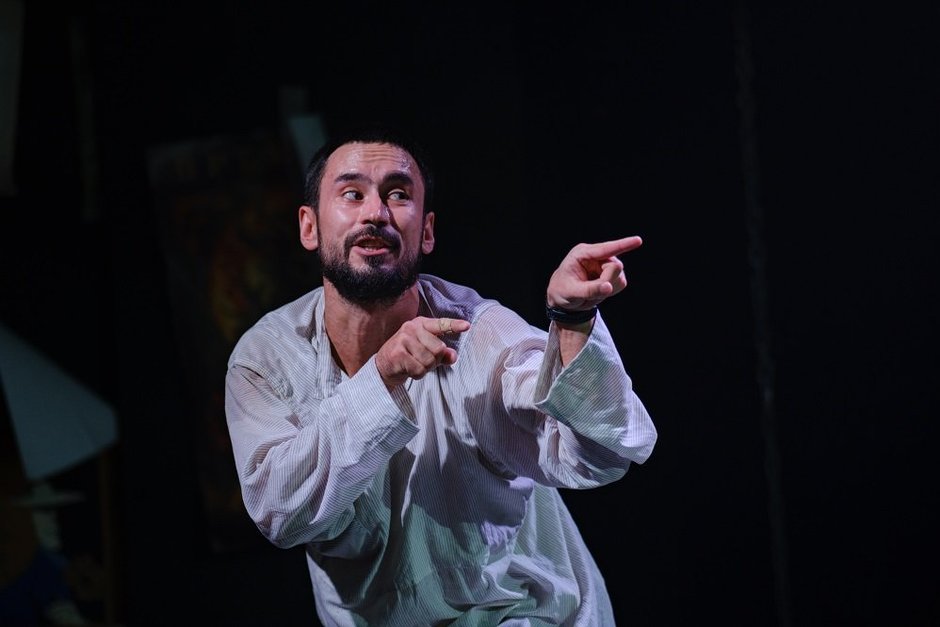
Timur Kulov staged at the MOÑ theater venue the performance “Tatar Lessons”/“Kyzikly shäkert” (16+) — an hour and a half of post-irony on the theme of visiting directors in Tatar theaters, Grotowski, Shurale and gubadia. Everything in this performance is not what it seems at first glance, including the promo video in which Nurbek Batulla portrays a native speaker (the tongue is long, carrying it is not easy). The project was created with the support of the Commission on Languages under the Rais of the Republic of Tatarstan. Details — in the material of “Real Time.”
We are in the underground
Timur Kulov is 39 years old; he was born in Naberezhnye Chelny, when the city was called Brezhnev. He studied under Yunona Kareva at the Kazan Theater College and under Leonid Kheyfets at the Shchukin Theater Institute. He was an actor at “Masterovye” and artistic director at the Kazan puppet theater “Pelican," worked for four years as a director of the Buinsk Drama Theater, and for the last two years his photo can be seen on the website of the St. Petersburg Theater of Young Spectators named after Bryantsev.
In that same 2024 his performance “The Adventures of Rustem” (12+) at the Kariyev Theater received a special prize of the “Golden Mask," and at the Pskov Drama Theater the festival “Kulov-fest” took place.
Kulov began staging “Tatar Lessons” on the second attempt — they say that the first time the acting cast did not come together. The performance deceives expectations even before it begins. Naturally, the novel “The Basement of My Culture," which Magina Bumagina (Maһinә Bumaһinә) wrote, does not exist. In the promo posts the SMM person of the venue reflects on Tatarness, as if we are now about to be shown a variation on the performance “Chyn Tatar” (16+) with monologues that it is not necessary to know Tatar to be a Tatar.
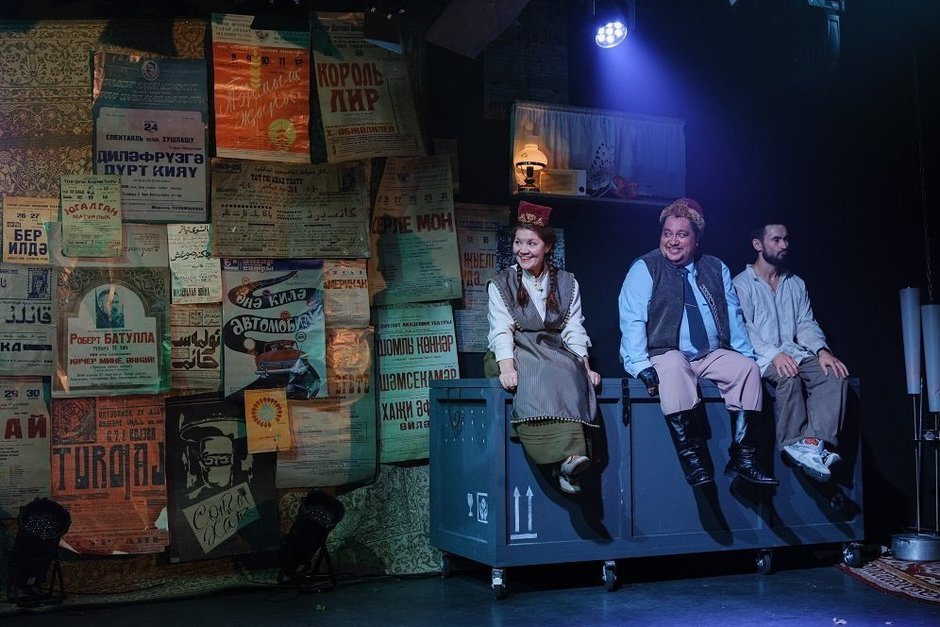
At MOÑ meanwhile a basement is being arranged — with a plank ceiling and many posters, among which stands out an announcement about the 500th showing of the performance “Forgive Me, Mother” (“Kicher mine әnkәy”) based on the play by Rabit Batulla.
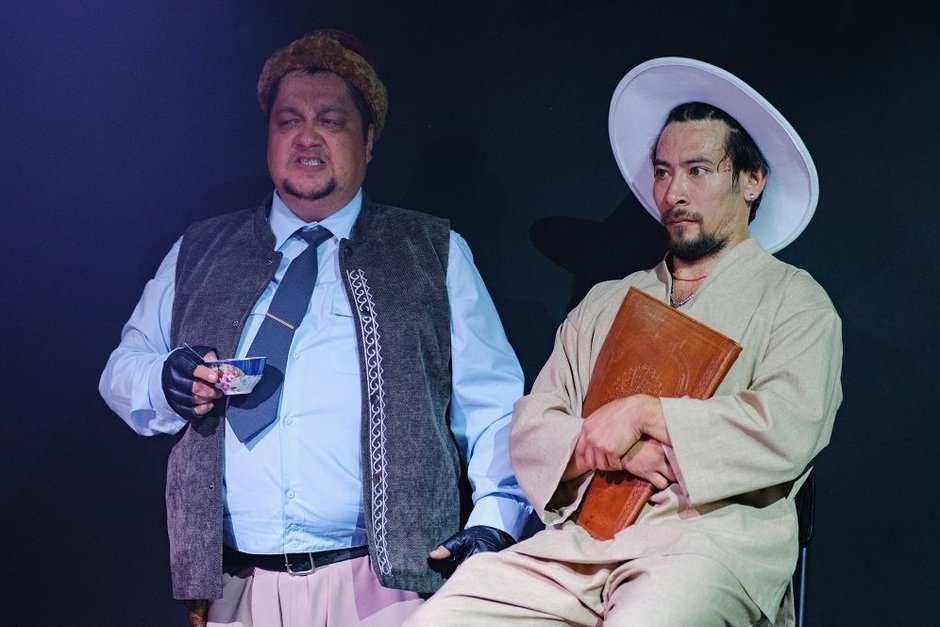
And here is Nurbek Batulla, dancing by the stove to the song “Zhiguli.” He is Faridt here (D — Derdmend, T — Tukai), who keeps a prisoner in the basement — the director Artur Ayakov (Ilnur Garifullin). Also on stage are Faridt's mother — the theater's costume designer Firaya (Milyausha Shaikhutdinova), and his uncle — the policeman Firzar (Rustem Gayzullin).
Tukai, Derdmend, Grotowski, Brecht
Ayakov stages endless remakes of classics, and recently decided to stage Shuralle and stated on the radio that he, not knowing his native language, does not want to sit “in the basement of his identity.” As a result he is in Faridt's basement, whose family reproaches him that in the productions “Milli rukh yuk," there is no, that means, national spirit. And he must stage “Shurale” so that milli rukh is present.
Kulov's performance is ironic, starting from the title, with its Russian greeting to Valentin Rasputin and Tatar one to Gabdulla Tukai. Sometimes these are jokes at the level of the text, like the pair Kulov-Ayakov (although it is clear that “Kul” is “slave," not “hand”).
Each actor plays himself. Garifullin — a director of the Menzelinsk Theater. Batulla — a characterful actor of MOÑ. Shaikhutdinova — an actress of the Kamalovsky. Gayzullin — a star of the Tinchurinsky with his love of musical comedy. He tells about himself in the “unclenching” scene, breaking the fourth wall twice — first as Firzar, then as Rustem, adding that he brought the policeman's costume from the production of “Politisioner” (16+) — it was staged by Tufan Imamutdinov, who is in the hall. And so Gayzullin came to MOÑ hoping for experiments — and again plays a cop. And this enrages him, because he can also play a romantic hero, because in life he knows how to love. Right opposite him in the hall sits his son Nursultan, a theater student. His mother Albina plays in “The Adventures of Rustem.”
And Batulla portrays a chicken that clucks the poem “At Dawn” by Sagit Ramiev — and how can one not recall that he made a soulful performance based on it at the Tat Cult Lab laboratory. Kulov, who does not speak Tatar, staged at the Youth Theater “Shurale. The Story of One Family” (12+), and here he plays it up in various formats. And Batulla carefully prompts him and the spectator that, supposedly, here we have Grotowski, and there — Bertolt Brecht... And, in general, one needs to move toward the intuitive, because that is what is Turkic.
We are in a box
Perhaps the best thing in this commotion happens when the director recalls his power and suddenly stops yet another rehearsal, after which time jumps forward 50 years, to Tukai's 190th anniversary and the gray-haired Garifullin in a mask. In his interpretation Shurale gets stuck in a box, in which the whole trio also ends up, after which the wooden crate already resembles a coffin, from which confident laughter is heard. From the basement the director drove the fairy tale into a box, which he then drags, like Sisyphus, beyond the spectator's view under a second serious monologue.
At this moment a fragment from Brian Eno's “Music for Airports” sounds, and Islam Valeev, who has tried himself during the evening as a composer of techno, music for lessons and ethno, yields place to the classic of ambient: “Sooner or later a person hears sounds. They are far away, in the heavens, they sound like a choir, the choir of the clan, which sings its melodies. Our parents, grandmothers and grandfathers — they are all there. Everything turns to dust, to decay, but their voices do not fall silent. You seek a connection with them. You find it — and there meaning enters life. A person finds meaning every day.”
In a certain sense “Tatar Lessons” continue the flagship sitcom of the MOÑ venue, where the heroes, members of a rock group, reflected on this mysterious word, and at the end arranged a nostalgically cheerful concert. Kulov and his comrades (and the text was clearly composed not only by Yoldyz Minnullina) go further, subjecting everything and everyone to the test of laughter, because, it seems, this is the simplest and most Tatar system of survival. After all, there is nothing more Tatar than laughter, right?