Creative economy gets a strategy — Tatarstan is already among the leaders
The government has approved a plan for the development of creative industries until 2036 — with the goal of raising the sector's share of GDP almost twofold. Experts assessed what is hindering growth and exports right now
Creative industries are growing almost four times faster than the rest of the economy, but 80% of added value is created in ten regions, and exports amount to a measly 1.2%. The state has decided to fix this — and has set ambitious goals. Experts throw up their hands: without access to payments, partners on the ground and a reduction in pressure, little will come of the ambitions. Details — in the material of “Real Time.”
The economy of impressions and creativity has been given an action plan for its development
The Russian government has approved a long-term strategy for the development of the creative economy — a document that should determine the fate of an entire industry for the coming decade.
Creative industries are a sector of the economy directly connected with the creation, promotion on the domestic and foreign markets, distribution and (or) sale of a creative product that possesses uniqueness and economic value.
The strategy of the emergence of the creative economy as an independent object of state policy is a comparatively new phenomenon for Russia. The law on creative industries was adopted recently, and the approved document becomes the first full-fledged strategic framework plan for the sector.
By the time the strategy was developed, the creative economy had already proven its dynamism. According to Rosstat data, for 2020—2025 the gross added value of creative industries grew by 55.8% — against 15.1% growth of GDP as a whole. It turns out that the creative sector is growing almost four times faster than the rest of the economy. It employs about 4.6 million people, or 6.2% of all employed. The contribution to GDP is 4.2%. The strategy sets the goal of raising this share to 7.7% by 2036. To reach 6% by 2030, an annual increase in the share of 0.36 percentage points will be required — against 0.2 p.p. in 2020—2025.
The main figures show the same players in the same regions
The main systemic barrier that the strategy records is colossal territorial concentration. In 2024, 56.1% of the added value of creative industries was produced in Moscow, and 79.8% — in ten regions of the country. Most subjects of the Russian Federation have unrealized potential. The goal is no fewer than 45 regions with operating support infrastructure (creative clusters, centers of creative industries). Currently there are significantly fewer.
The second problem is sectoral asymmetry. Five industries (software, advertising and PR, performing arts, architecture and urbanism, gastronomy) form 78.9% of all added value of the creative sector. The five bottom industries (fashion, folk crafts, video games, music, the art industry) account for only 1.8%.
At the same time, a significant part of the growth for 2020—2025 — about 47.2% — was provided by the software industry, primarily on the wave of import substitution. This means that the growth of the creative economy was largely the growth of the IT sector, and not of “creative” industries in the narrow sense. The strategy acknowledges this and provides for separate support measures for niche directions — from video games to folk crafts.
How things stand in the regions
The undisputed leader is Moscow — 10.5%. In turn, the share of gross added value of the creative economy in the gross regional product for the Volga Federal District is 2.4%.
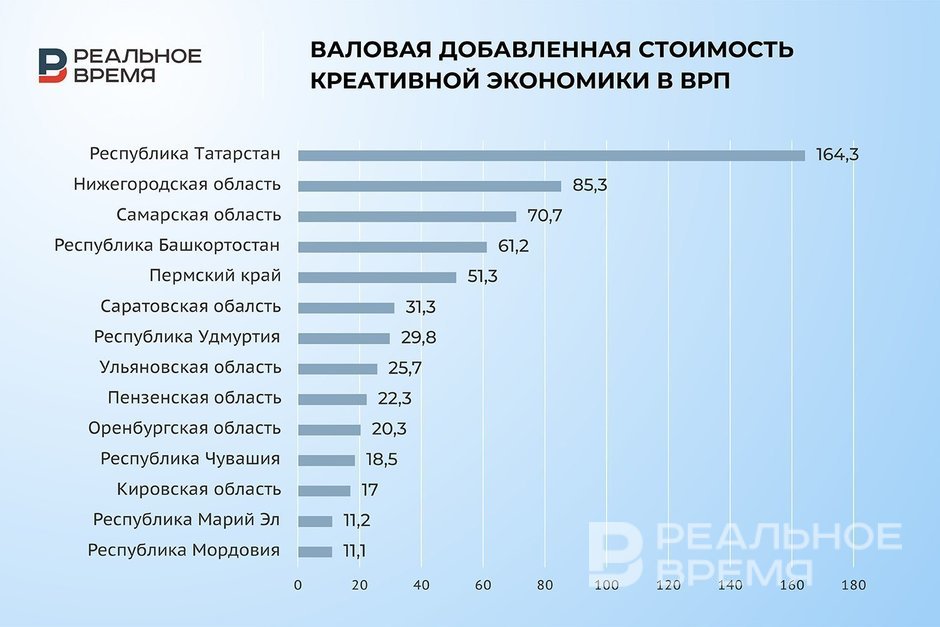
If we talk about specific regions, then among the leaders in gross added value of the creative economy in the gross regional product is the Republic of Tatarstan (164.3 billion rubles). In second place is Nizhny Novgorod Oblast (85.3 billion). The top three is closed by Samara Oblast (70.7 billion), neighboring Bashkiria is in fourth place (61.2 billion), and in fifth — Perm Krai (51.3 billion).
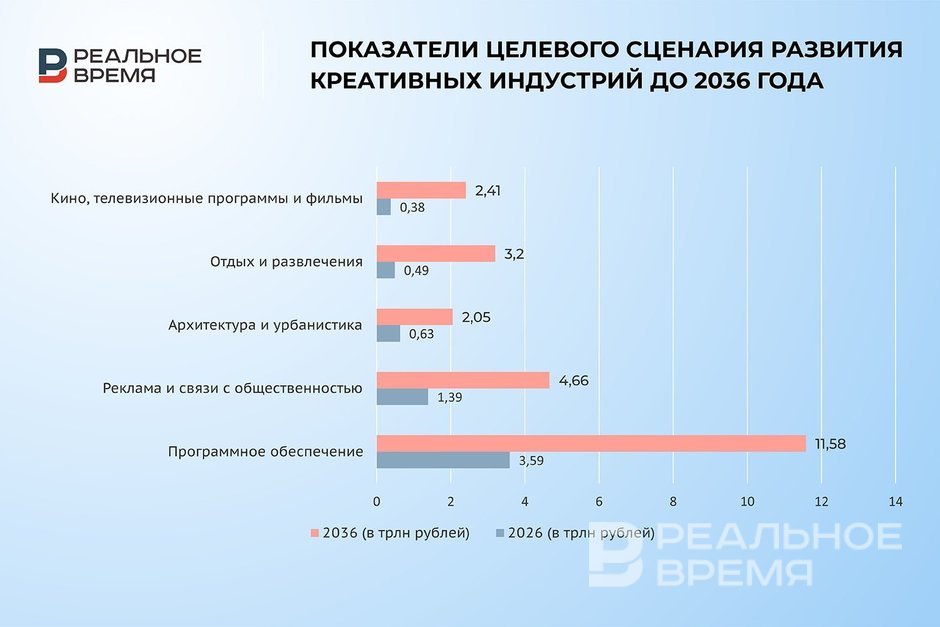
The most promising, according to the government, branches of the creative economy should be “Cinema, television programs and films," “Software," “Advertising and public relations," “Architecture and urbanism," as well as “Leisure and entertainment.” At the same time, the same spheres show the greatest growth in the share of gross added value. However, the fifth largest was taken by “Gastronomy” with a coefficient of 5.92. The latter, by the way, should grow by 2036 to 1.83 trillion rubles.
Russian brains want to be sent for export, but only to friendly countries
One of the weakest points of the Russian creative economy is export. According to estimates, this indicator in creative industries for 2023 amounted to $5.7 billion, or 1.2% of the country's total exports. For comparison: in Great Britain it equals 4.87%, in the USA — 7.99%, in China — 31.9%. The strategy sets the goal of doubling the share of exports of creative products to 4% by 2036. However, the barriers are serious: problems with patenting, difficulties of international payments, absence of partner ties. In these conditions the bet is placed on friendly countries and interstate associations — the SCO, the EAEU, ASEAN, BRICS. Priority export industries — audiovisual content (cinema, video games, music), fashion, architecture and software.
The strategy points to serious gaps in the training of personnel. Educational standards do not keep up with market changes, programs on entrepreneurship, intellectual property and digital analytics are insufficiently implemented. The list of creative professions has not been defined. There is an especially acute shortage of specialists with secondary vocational education — in video games, media, design. In order to offset this gap, by 2030 it is planned to create 89 colleges with a focus on creative industries.

The strategy lists risks, both internal and external. Among the internal ones: the unformed single contour of management, the risk of increased tax and administrative burden, low commercialization of intellectual property, personnel shortage, concentration in large agglomerations. Among the external ones: sanctions pressure, risks of discrediting Russia in the global information space, slowing of the economy and reduced demand for creative goods, technological risks.
And what do the players themselves think?
“Real Time," together with experts, sorted out the ambitions of the strategy, its vulnerable points and the realism of the stated goals. Ildar Nizameev from the company ILAR technology commented on the prospects of exporting Russian IT products within the framework of the new state program for the development of the creative economy.
— According to the program, the turnover of the creative economy should grow to 11 trillion rubles by 2026, and the IT sector is the most financially capacious part. One of the stated growth points is distribution to friendly countries: the SCO, BRICS, the UAE and others. Distribution exists — we ourselves are now entering Uzbekistan, Kazakhstan and other CIS countries. Russia remains number one in fintech: after 2022—2023 fintech teams dispersed around the world, but took their stack and developments with them. The former Tinkoff team in Mexico created one of the fastest-growing fintech startups, notes Nizameev.
According to him, export does not necessarily mean selling a finished product as a whole: “We do not take a whole product, but transmit individual solutions: online doctor appointments, an electronic diary, a delivery service, decoding of tests. Basic consumer needs around the world are the same, so this transfers to other markets much more easily. In essence, export is the export of a team and expertise, and not of a boxed product.”
The main problem, as the interlocutor notes, is the absence of access to payment infrastructure.
— There is not enough access to payment services. On the one hand, one cannot buy foreign IT tools under the hood. On the other — one cannot sell one's product: so that a person can come in and pay with a Visa or Mastercard card. One has to bypass sanctions through crypto or third-party services. When you develop a product for export, you should not think about how to build a financial model and where to connect payment. Besides, for sales in Kazakhstan or Uzbekistan one has to open a legal entity and an office there — only for the possibility of concluding contracts, the expert notes.
Speaking about the risk of personnel outflow, Nizameev notes that in 2022 some specialists left, but many returned within half a year to a year. Now he does not observe a mass wave, nevertheless the economy is contracting. The reason is simple — clients have less budget and demand, there is no access to advertising platforms.
Denis Suprunov, co-founder of the advertising agency “DrugMedia," commented on the prospects of export and import in the creative economy in light of the new state development program.
— The question is two-sided. On the one hand, companies from the BRICS, SCO and ASEAN countries are actively entering the Russian market — and all of them have one problem: they do not understand how to promote their products to the local audience. State support is needed — for example, a register of accredited advertising agencies that help foreign companies launch campaigns in Russia. This is not only about social networks like VK or “Odnoklassniki," but about agency service: bloggers, website creation, promotion in social networks and so on. On the other hand, Russian brands are also entering external markets — and they need training, partners on the ground and exchange of experience. Practice already exists: companies from China are already approaching our agency with a request to promote their goods on the Russian market. The request is very relevant, and the more such companies there are, the better for the Russian advertising agency market, the interlocutor notes.
Regina Faskheeva, creator of the SMM agency Fragency, believes that the best support for entrepreneurship in current realities is not to give something new, but at least to stop taking away.
— If the state helps agencies enter new markets more easily and at the same time makes work inside the country a little simpler, the market itself will figure out quite well where to grow. Asking something of the state now seems extremely naive. As for export as a strategic task — yes, if it is economically profitable for a specific business. But I would not make export an obligatory ideological task for every agency. The Russian market itself still has enormous potential for development, Faskheeva is sure.
According to her, Russian agencies possess quite competitive expertise. “We have a strong school of digital, we are used to quickly mastering new platforms, working in conditions of constantly changing algorithms and regulation, building content systems, working with a large number of channels and limited budgets. The last few years have generally taught our market incredible adaptability.”
— However, transferring the communication model one-to-one to foreign markets does not work. One cannot come to China, India or Indonesia and simply transfer the Russian model there. Different mentality, language, humor, norms, media consumption, their own platforms and influencers. I rather believe in a model where a Russian agency exports technology, strategy, processes and expertise, and works in partnership with a local team that understands the cultural context, the expert believes.
Let us recall that Tatarstan, despite leadership in the Volga Federal District with 164.3 billion rubles of added value, in 2025 sharply lost positions in the all-Russian HSE index — it collapsed from fifth place to fourteenth. As “Real Time” reported, experts named the absence of a single center for the development of the industry in the republic as the main reason — unlike Kaliningrad, Tyumen or Krasnoyarsk, where such institutions already operate.
The authorities reacted: by the end of 2025 the government of Tatarstan approved a regulation with six criteria for identifying priority directions — from IT to traditional art. The Ministry of Culture of the Republic of Tatarstan began creating a register of representatives of creative industries, and the republic has decided on the creation of a support center. At the same time, the Minister of Culture Irada Ayupova admits: without a clear system of benefits and preferences from the federal center, regional efforts may not give the expected effect. Against this background, the Russian government approved a long-term strategy for the development of the creative economy, which should determine the fate of the industry for the coming decade — and answer the question of how realistic the stated ambitions are.