Andalusian music and conversations about patriarchy
How “DärtFest” was held for the first time as an Islamic culture festival
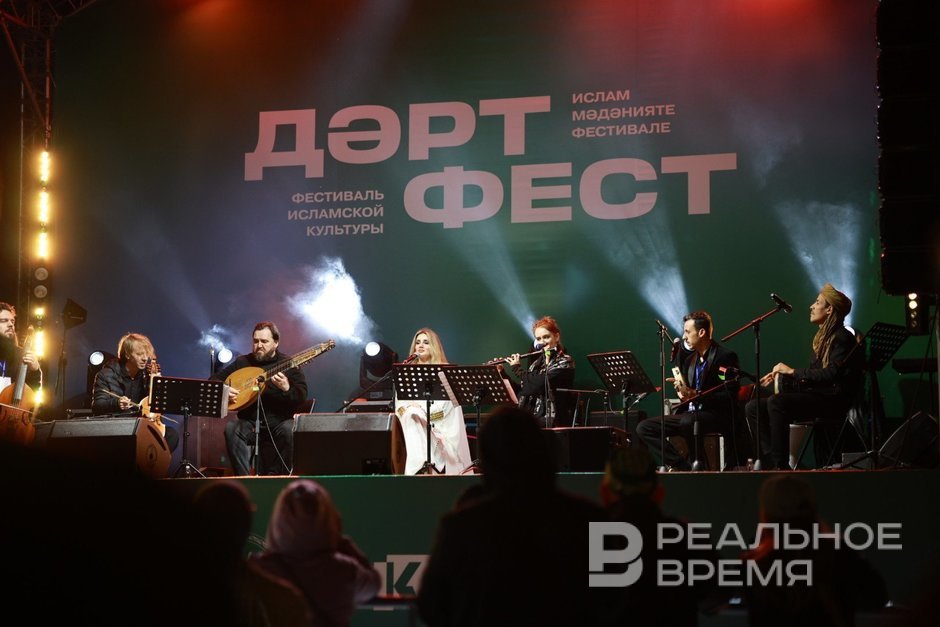
This year, “DärtFest” was held for the first time in a new format — as an Islamic culture festival. The venue was the same — the Kazan Kremlin, the courtyard of the Presence Chambers. But the content was fundamentally new: munajats and nasheeds, as well as samples of Maghreb music, were heard on stage, while experts debated upbringing in Muslim families. Has “DärtFest” changed or not?
How it all began and continued
The history of “DärtFest” began with the Tat Cult Fest festival in 2018. If there has been a global event in Tatar culture in recent times, it was this one-day event in the Kazan Kremlin: three music stages, multimedia, headliners — Zulya and The Children of the Underground, Enver Izmailov, Super Tatar, AIGEL, and Islam Satyrov.
After the Tat Cult Fest brand went into private hands, the festival became “DärtFest.” At the same time, the most regular participants of TCF were not one-day stars — musicians, artists, and choreographers could be seen at other events as well. Tatar-language culture was successfully integrated not only as the infamous “national component” but as a full-fledged part of the cultural program.
At the same time, the growing demand for music, calligraphy, Turkic instruments, and dance does not mean a sudden increase in the number of these artists; rather, it generates their demand and multiplies their budgets. Simply put, there are still not many concerts outside government programs — few artists dare to break out of the cozy Kazan cocoon and play a concert even in Ufa. It is still exotic.
This year, “DärtFest” is part of the “Kazan — Capital of the Islamic World” project. At the same time, some features of past festivals have been preserved. For example, its main participants are still young people.
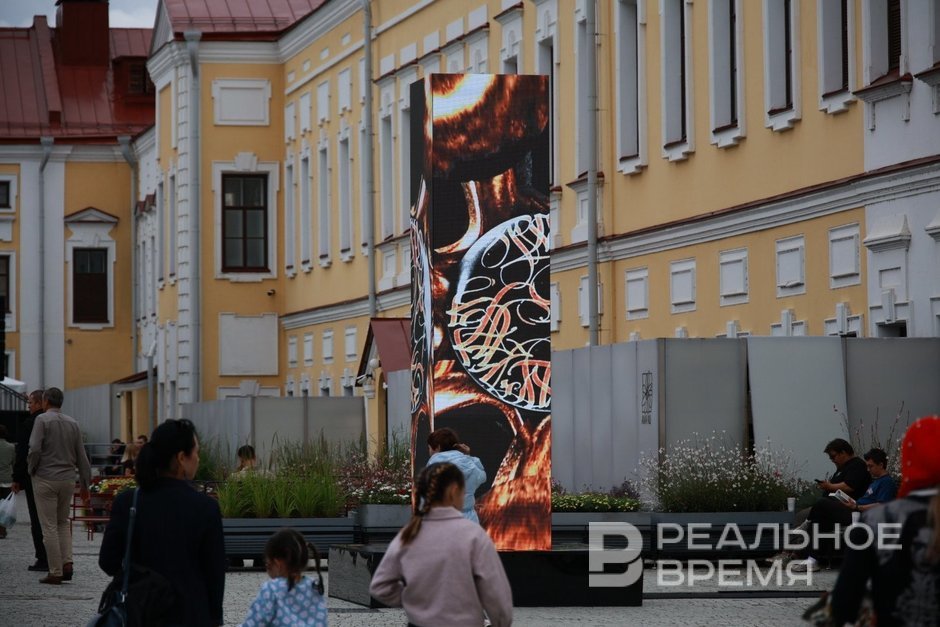
In the center of the courtyard of the Presence Chambers stands a multimedia installation by the studio formate, the initiators of the “Nur” festival. It is based on calligraphic content by the founder of “calligrafuturism," Pokras Lampas. On an impressive parallelepiped, “Koyash bayu — Tang atu — Zakat — Rassvet” (Sunset — Dawn — Sunset — Dawn) is displayed. In the context of the festival, this is interpreted as the wave-like development of a new urban Tatar culture with its ups and downs.
In the center is the obligatory design market and master classes. For the first time at “DärtFest” — a large-scale children's Tatar stage — featuring studios of kuraist players "Ällüki," the dance ensemble “Kazan," the national dance ensemble “Märjän” from Tatar Gymnasium No. 2, as well as artists from the children's philharmonic. From noon onwards, the venue was full, if only because the artists' relatives came to support them.
Why children retreat into gadgets
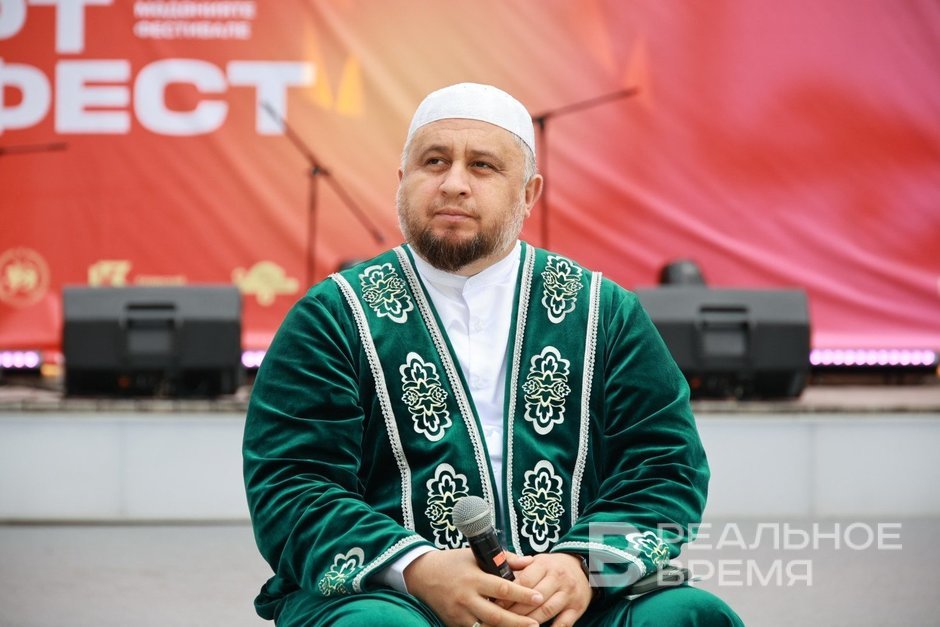
Someone might ask how Islamic this project is. But the young stars played and danced cheerfully and spiritedly; moreover, real Muslim experts also performed here — at the public talk “Raising Children — Questions of Muslim Ethics.” They managed to articulate their main thoughts before the deafening rain.
The first to speak was Rustam Hazrat Khairullin, imam-khatib of the “Gaila” mosque and author of the book “Family Lessons”:
— Our people have a saying: 'A man has not enough even 70 crafts.' In the case of family and children, we must learn and seek advice from knowledgeable people. But now everyone considers themselves a scholar. And if an emergency does not happen, they do not come, because children are now facing bullying. Parents are often afraid to turn to a psychologist, a mullah, a teacher — but Allah says in the Quran: communicate with each other, hold councils, and then there will be grace.
— Previously, they said: the father decides, the father is the head, the father is the breadwinner, the father punishes. Now they say: the child is the center of attention, — another Hazrat touched upon. — Now the heads of our families are our wives. My old phone becomes my son's phone, my old shoes become my son's shoes. I give them the best. But the father's authority is falling. And then we are surprised: why did this happen? Previously, all family affairs were done in the father's name. And if the father's authority grows, so does the mother's.
— If we respect ourselves and can stop the child and say: 'Now we are the ones in charge here,' then power distribution and hierarchy are established in the family, — added psychologist Gulnaz Akhmetzyanova. — If we talk about gadgets and bloggers, it's a question of how we build relationships with children. Do they want to sit with us, talk, or is another world interesting to them? It is important how tired we ourselves are of communicating with our children. Admit it, if you come home and it starts: 'Mom, Dad, Mom...' and you want to close yourself off and say: 'Oh, figure it out yourselves!' Then it is clear that they go where it is more accessible.
What brings us closer to Andalusian culture
Towards evening, the children's area turns into a choreographic one. Here, a physical theatre performance “Dör” by Marcel and Maria Nuriev, five-time Golden Mask nominees, takes place. Then comes the turn of the music stage.
Here, Sultan Safin, the founder of “Tyubetey," recites surahs from the Quran, Dinar Shaymardanov and the duo “Rukhi mon” sing — adepts of Tatar melody in spiritual music.
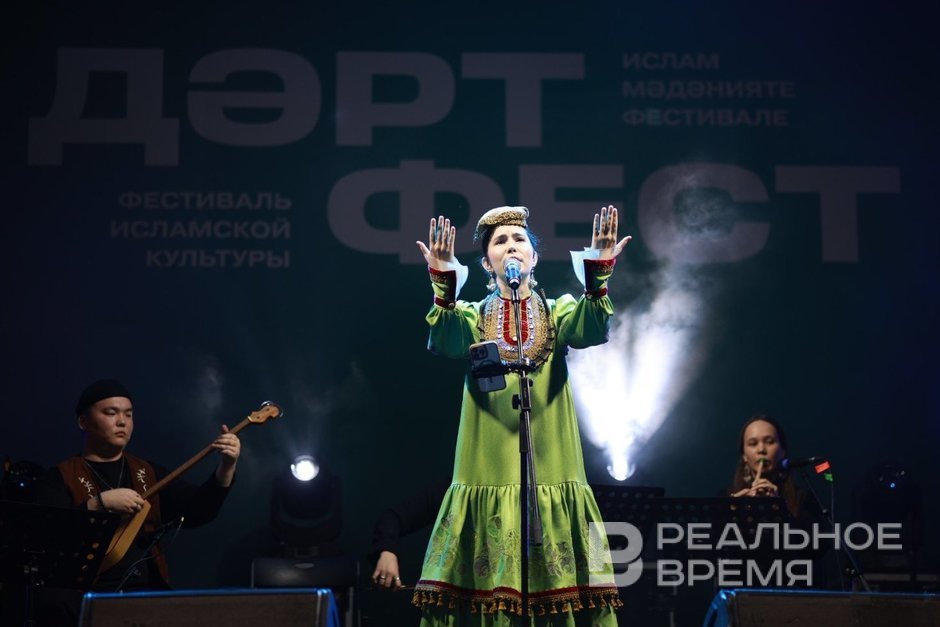
Saida Mukhametzyanova is experimenting again — she has teamed up with the “Dönya” project, which uses traditional Turkic instruments like the saz and kyl-kubyz. In their arrangement, baits and munajats sounded, on one hand, different, and on the other, elusively familiar. It is not yet known whether such a concert will be repeated.
Probably the greatest achievement for “DärtFest” was inviting the Moscow Andalusian Ensemble as the headliner. It features musicians from Algeria, Syria, and Russia, presenting research in the field of academic music from Arab countries, primarily the Maghreb.
— My interest in the music of the Maghreb arose about twenty years ago, or even more, in the early 2000s, — says the ensemble's driving force, Oleg Boyko. — Then a flock of songbirds from Algeria flew into Moscow, led by Hassan Belkacem Benalioua from the Andalusian school. He opened the floodgates and explained everything. Now we have this small joy that we can also touch the great Andalusian culture.
The gene of Andalusian culture exists in almost all cultures, Boyko notes, including Russian: it can be heard in Rachmaninoff, Glazunov, and Rimsky-Korsakov.
— Kazan is also, in a sense, an echo of Granada, Cordoba, Valencia, — Boyko concludes. — For now, our music is still exotic. But it seems to me that the mission is to at least introduce the Russian listener, the listeners of our 'camps,' to this amazing and unique culture. Because the world seems distant to us, but in reality it is very tight and close.
The ensemble's compositions certainly sounded exactly as one imagines court music — combining stateliness and passion — and in this recognition there was a special pleasure: it means that somewhere in our subconscious, we also remember that such songs once sounded on the territory of the Kazan Kremlin as well.