From “Butterfly catchers” to “Lama chess player”
Kazan reinterprets urban legends through sgraffito
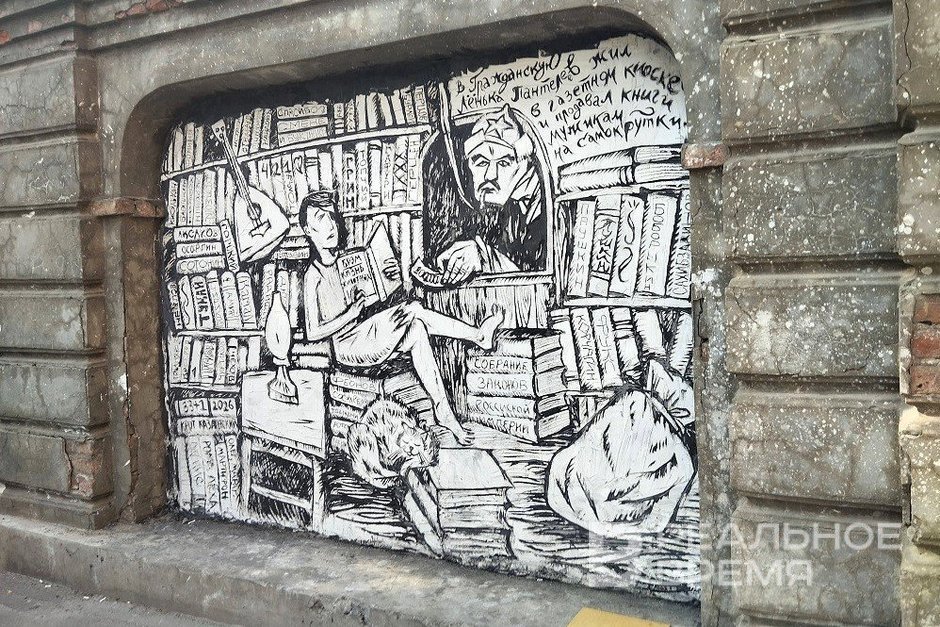
Eight new sgraffito have appeared in Kazan. “Inhabitants of Kazan” is a joint project by Pyotr Rabotnik from the art community “33+1” and the media project “Krot Kazansky.” The implementation took two weeks, including four days of work until late at night. Each sgraffito is inspired by local stories; they can be used for walking tours or included in excursion routes. As part of the “Everything” music festival, historian and editor-in-chief of “Krot Kazansky” Ivan Rotov led a tour for anyone interested to all the artworks, and a correspondent of Realnoe Vremya joined the group.
What can be created in four days
Pyotr Rabotnik — that is what Pavel Shugurov asked to be called. He has twice worked as the chief artist of Vladivostok and also held the same position in Yuzhno-Sakhalinsk. He is also part of “33+1," a community of thirty-three artists from different Russian cities. Many of their works, understandably, are in Vladivostok. As for Kazan, Shugurov has similar works in the series “Bulgakov's Moscow," “Ryazan Inhabitants," and “Characters of Yekaterinburg.” These are essentially sgraffito, based on cement and pigment.
At “Krot Kazansky," he received a wealth of material that materialized into eight new art objects. The “Krot's” work did not end there: they not only gathered the stories but also chose the locations and walls, participated in creating sketches, handled approvals, organized logistics and construction work, purchased materials, and coordinated volunteers. The process of creating the artworks took four days, with the last one finished an hour before Shugurov's departure from Kazan. Many people participated in the project, and even residents of some houses provided financial help. By the way, permission was asked for the work, so, Rotov laments, they were unable to bring to life the story about General Korné's gardener named Maxim Gorky.
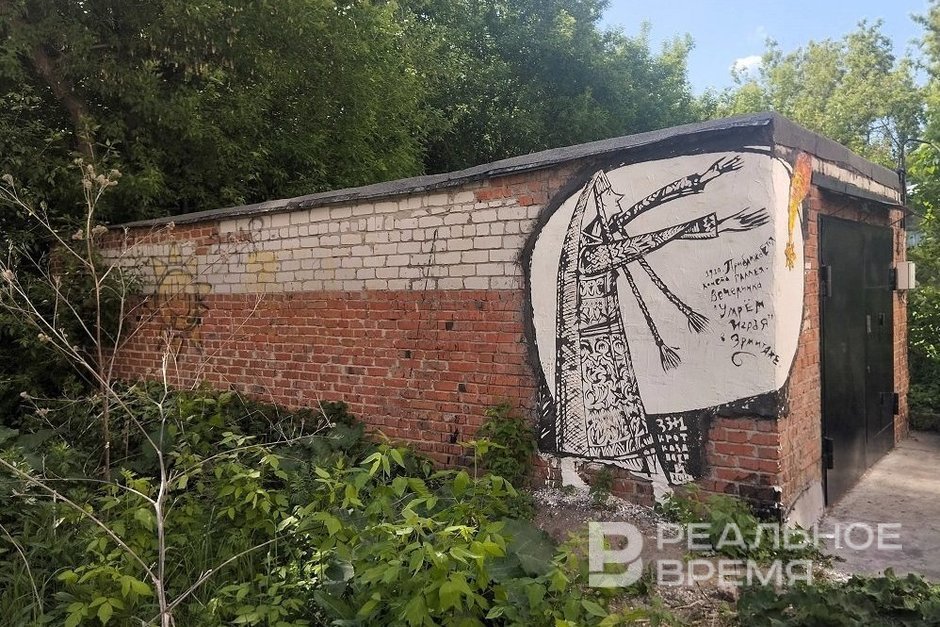
We begin our journey at the most distant panel, “Butterfly Catchers.”
— It's a kind of reminder that earlier, beyond Butlerov Street, the city ended and the Arsk Field began — 'Switzerland,' an area for walks and dachas. In its time, Aksakov caught butterflies here, and a century later, Khlebnikov caught birds. Aksakov, in his texts, described this wild and somewhat empty Kazan of the early 19th century, — says Rotov. — Khlebnikov's head here is triangular because many of Khlebnikov's ideas as a futurist (and as an esotericist) grew out of lectures by Professor Vasilyev on Lobachevsky's non-Euclidean geometry. In general, much in the spiritual culture of the Russian Empire became possible after Lobachevsky's non-Euclidean geometry: thinking about what cannot be seen with the eyes, what does not exist in this world at all, using reason to explore other spaces.
If you dig deep, Rotov notes, Khlebnikov learned about geometry from mathematician Alexander Vasilyev. His son, Nikolai Vasilyev, was a patient in the District Psychiatric Hospital.
— It's not a fact that Misha was thinking in this direction when they created the sketch, — the historian adds. — But I like to think so.
In general, there is no escaping irony in art, as demonstrated by the next panel, “Waiting for the End of the World.” You need to walk along Butlerov, exit onto Mushtari, cut through the courtyards past the Chernyarov office onto Mayakovsky Street, hear the story about the seedy past of Nekrasovskaya Street, and reach the garages near the Hermitage Garden.
Rotov reminds us that the garden used to be a noisy place. There was a velodrome. A chess club with gambling. The “Alhambra” restaurant serving Caucasian cuisine. It hosted a party dedicated to the “end of the world” in 1910, when Halley's Comet was flying past Earth.
According to one version, it was supposed to hit the planet with its tail. In honor of this, illegal card games were organized at the Alhambra — reasoning that we would all die anyway.
The comet is already adorned with a mosaic by Guzel Fayzrakhmanova. The girl on the panel is Bibi-Maryam-Banu Shamil, in whose house the Tukay Museum is located. Of course, she had already left Kazan by that time. But she definitely loved to walk in the Hermitage.
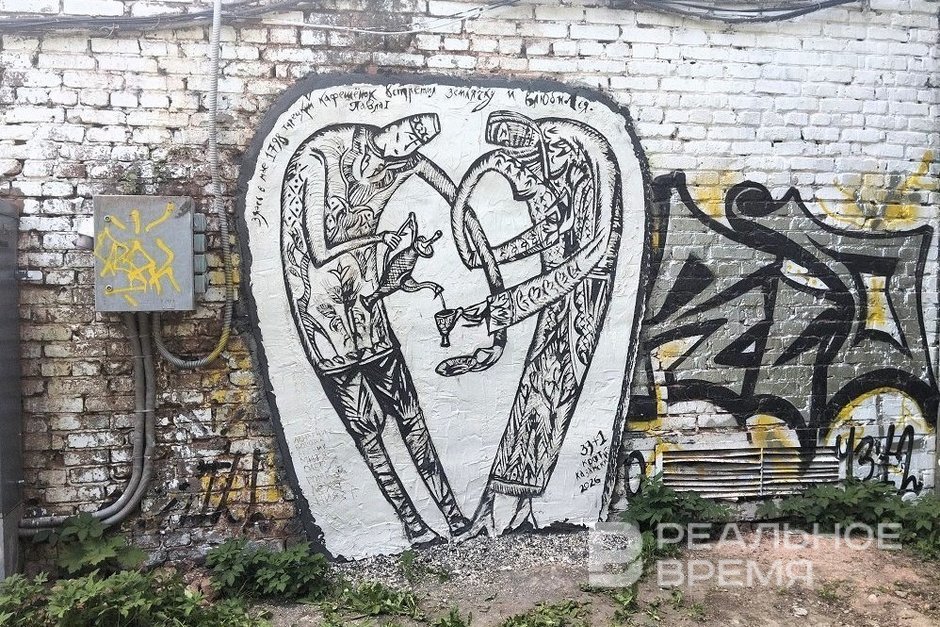
A new photo spot for newlyweds
Near the panel “The In Love Café Waiter” on the wall behind “Marusovka," newlyweds are already having their photos taken. This story was suggested to the authors by local historian Ekaterina Khabarova, who uncovered the tale of how Major General Alexei Letskov (Letskoy) received Paul I. The emperor brought with him his “barista," a baptized Turk. There he met a Turkish servant girl of the Bulygin nobles; the Tsar blessed their marriage and gave them 2,000 rubles.
— We believe in this panel the most, — says Rotov. — The most competent people in construction worked here. By the way, we used tile adhesive for the panel. This material is vandal-resistant.
The fourth panel, “Frog Catchers," is located behind the Vasily Aksyonov Museum — in his story “Redhead from the Other Yard," he recounted how he communicated in childhood with Rustem Kutuy, a poet and son of writer Adel Kutuy. Moreover, in the story, first Vasya and Red fight against Kutuy and his comrades, and then they together meet the boys from Podluzhnaya. The local residents approved of the sgraffito — and even helped the authors financially.
— This is a person who, in a style close to us, describes the landscapes of Kazan in the 1930s and 1940s, — Rotov expresses respect for Aksyonov, adding that back then, children really did catch frogs — and even sold them to Kazan University.
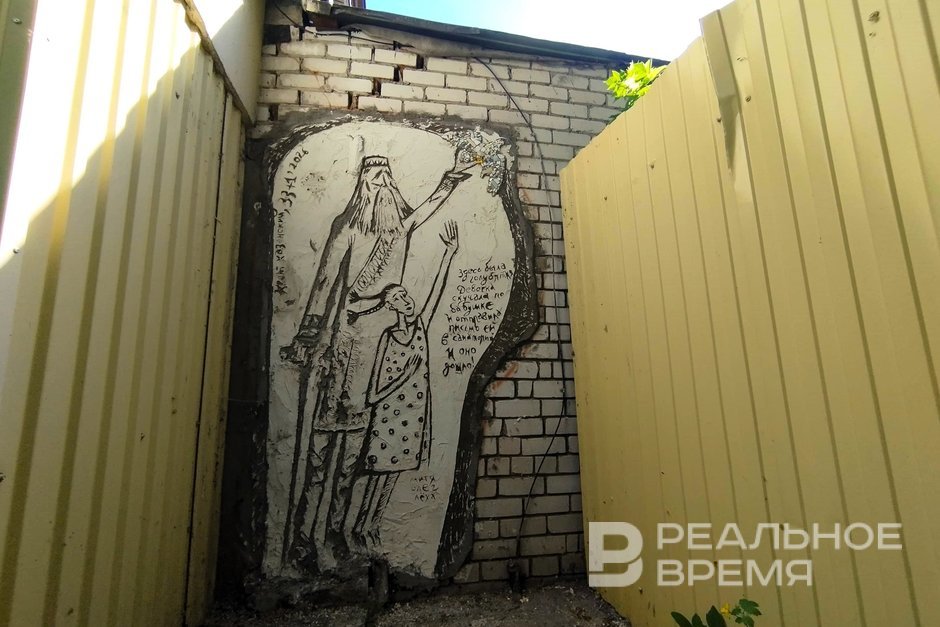
The story of the panel “Carrier Pigeon” comes not from books — it is located behind the second house of “Para," in the area where “Krot Kazansky” works (and which it studies in detail). A local resident, Yulia Person, told how there used to be a dovecote here. When Julia was a little girl, her grandmother was staying for a long time at a sanatorium in Borovoe Matyushino. And the owner of the dovecote volunteered to send her a letter.
The panel “Young Bibliophile” has already caused outrage online — why spoil ancient ruins? Rotov points out that it is a capitalist unfinished construction that looks like something ancient.
The panel's plot is inspired by the book “Lenka Panteleev” by Alexei Yeremeyev, the author of “Republic of ShKID.” It is known that he was a homeless child and was nicknamed Panteleev after a famous bandit. In his autobiographical story, he recounted how in 1919 he was sailing on a steamboat that was taken over by the military, who disembarked everyone somewhere near Kazan. On the way, Panteleev came across a burned-out estate, where he gathered books, which he later sold in Kazan from an abandoned kiosk. The last one, Brehm's “The Life of Animals” in German, he sold to a German shoemaker.
Where Tolstoy got a hold of himself
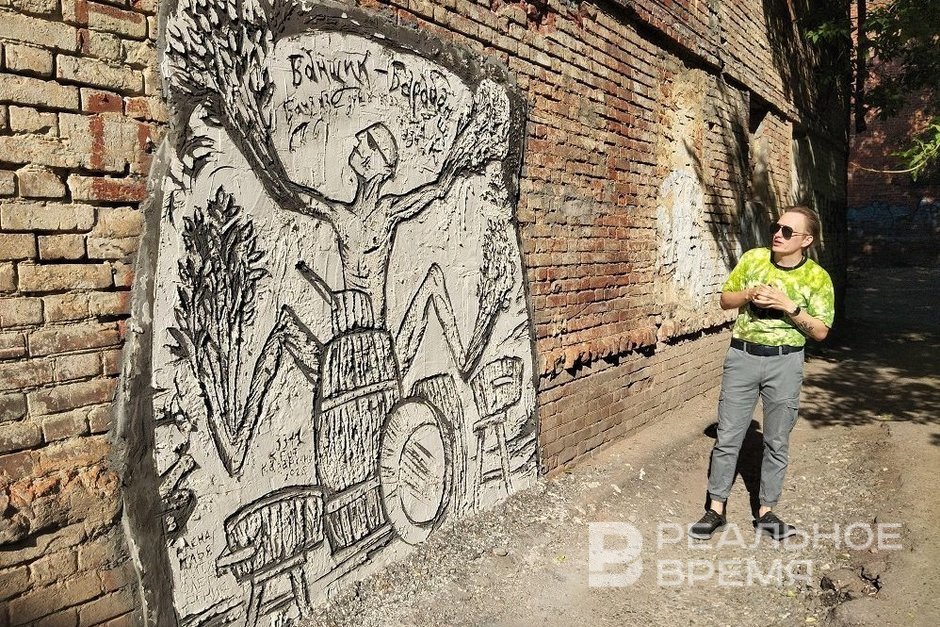
The penultimate panel, “Bath Attendant-Drummer," is also inspired by a modern story. It is known that since 1874, there were first the Danilovsky Baths, then Soviet Bathhouse No. 3. Here, both merchants and many cultural figures washed, such as Kadi Taktash and Marsele Salimzhanov. Nowadays, a significant part of the bathhouse is occupied by studios and rehearsal spaces, with lots of different music, from the band Gauga to the band “Tramvay.” And the panel depicts, in a fantasy version, Marat “Martifon” Mukhametzyanov.
“Lama Chess Player.” Our walk ends near the building of the Higher School of Journalism and Media Communications. Long ago, there was a hospital here, where, for example, Leo Tolstoy received treatment. In his room lay a Buddhist lama who, according to Rotov, had been shot in the face somewhere near Kazan. The lama and Tolstoy played chess; the Buddhist won.
— I like to think that this was the key event after which Tolstoy thought about non-violence, — Rotov says of this meeting. He adds that the game depicted on the panel is Polugaevsky vs. Nezhmetdinov, 1958, Sochi. Our great Kazan chess player sacrificed his queen back then.
A leisurely walk between the panels takes about two hours, and along the way, you can add many interesting buildings, characters, and stories. The historian-guide notes that he hopes more such sgraffito might appear; if anyone wants, you can contact these newly minted specialists!