“The emphasis is still on prevention”: how the “language law” is being implemented in Tatarstan
Will law 168-FZ affect signage and information in the Tatar language in Kazan?

Since the beginning of the year, Rospotrebnadzor has received 10 letters from businesses and consumers requesting clarification on amendments to the Consumer Protection Law that came into force on March 1, requiring information on signage to be in Russian. A exception is made for registered trademarks. Regarding informational plaques, city authorities in Kazan approve them in two languages.
Emphasis on prevention
Rospotrebnadzor is currently focusing on preventing violations of the new requirements of Article 10.1 of the Russian Federation Law No. 2300-1 of February 7, 1992 “On the Protection of Consumer Rights," the agency's press service told Realnoe Vremya.
“We are informing business entities. If signs of violations are detected, warnings will be issued about the inadmissibility of violating mandatory requirements," Rospotrebnadzor's statement said.
The amendments to the Consumer Protection Law stipulating that information intended for public display and not constituting advertising, placed on signs, pointers, informational plaques, and other media (excluding advertising structures), must be in Russian, came into force on March 1 of this year.
However, as the agency noted, the prohibition does not apply to trademarks, service marks, and brand names registered in a foreign language in the established order.
Liability for violating a consumer's right to receive necessary and reliable information is established by Part 1 of Article 14.8 of the Administrative Code. The sanction provides for a warning or the imposition of an administrative fine on officials ranging from 500 to 1,000 rubles; on legal entities — from 5,000 to 10,000 rubles. Since the beginning of the year, Rospotrebnadzor has received 10 appeals from businesses and consumers.
Detailed explanations can be found on Rospotrebnadzor's website.
Commenting on the new law to RIA Novosti, Vladimir Koshelev, First Deputy Chairman of the State Duma Committee on Construction and Housing and Utilities, noted: “There is no direct fine specifically for a 'foreign word' in the Administrative Code of the Russian Federation. However, if a sign misleads a consumer due to a language barrier, this could be considered a violation of the right to information. In such a case, the fine for citizens and self-employed individuals would be from 1,500 to 2,000 rubles, for individual entrepreneurs — from 3,000 to 40,000 rubles, for legal entities — from 30,000 to 40,000 rubles.”
The legislative changes specifically address information about the nature of the establishment
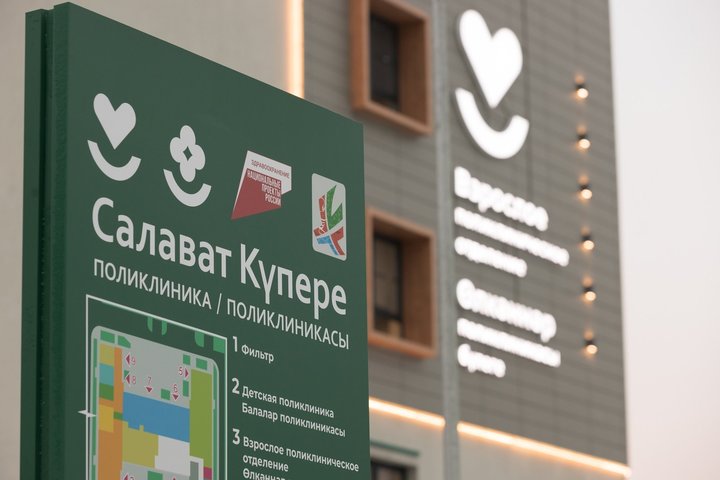
The Kazan Executive Committee told Realnoe Vremya that approval of sign passports is carried out according to the approved Rules for the Improvement of the City of Kazan. These rules previously established requirements to display information about the nature of the establishment in the state languages of the Republic of Tatarstan (Russian and Tatar).
“First and foremost, it's important to distinguish between a brand name and an informational sign (plaque) about the type of activity. The legislative changes specifically concern information about the establishment's profile and do not affect brand names, which are established commercial designations and can be used in the language chosen by the owner," said Zhanna Belitskaya, Deputy Head of the Kazan Executive Committee's Department of Architecture and Urban Planning.
In this case, the applicant must provide a trademark registration document, an extract from the Unified State Register of Legal Entities, or an international agreement.
“If the above conditions are not met, the new rules clarify that, for example, instead of 'store,' 'magazine' should be written. The same principle applies to pharmacies, restaurants, coffee shops, and other establishments: the type of activity must be displayed in Russian," noted Belitskaya.
Most entrepreneurs interviewed by Realnoe Vremya have already registered their brand names, and the new requirements have affected them only minimally.
“There are trademarks with wordplay embedded in the name. That's exactly our case — our restaurants are called P.Love. If we translated it, we would lose our uniqueness. It's good that lawmakers took this into account and registered trademarks don't need to be translated. We've already changed the navigation signs inside our establishments — our restrooms were marked as WC. These are very minor expenses, hardly worth mentioning," said Nurislam Sharifulin, owner of the P.Love restaurant chain and Vice-President of the Russian Federation of Restaurateurs and Hoteliers, to Realnoe Vremya.
Translate all communication
Yuri Lukin, a lecturer at the Faculty of Law of KFU and Chairman of the “Law and Facts” Bar Association, says lawyers also had questions about the Tatar language following the adoption of the law, and he notes a nuance here:
— But first and foremost, this applies to information published or distributed in public spaces. The name of a product is not exactly the type of information this law is aimed at; the product name could be in Tatar, but the generic name must be in Russian. For example, “candy," “pastille”... This is permissible.
The same applies to signs, notes Lukin: if the main word is in Russian, such as “coffee shop," there is no need to translate the actual name, as the consumer receives the necessary generic information in Russian.

Could Tatarstan have its own rules?
Designers working at the Center of Unique Masters, planned to open on April 26, were told: if you use English names, change them to Russian. Those who already have Tatar names were allowed to keep them, with the stipulation that in regions with a second state language, signs in that language can be used.
— Yes, this idea is voiced by some commentators, but I only hear it in Tatarstan. At the federal level, I haven't encountered such an interpretation, — doubts Aidar Mullanurov, Managing Partner of the Barrister judicial agency. — I believe the law could contribute to the marginalization of any language other than Russian, creating restrictions on their use. Even languages that are state languages in the republics (such as Tatar, Bashkir) cannot be used on signs, price tags, labels, and the like without duplication in Russian. Based on our clients' experience, we can assume that few will duplicate information in local languages because this creates significant additional costs for businesses. And there is little practical benefit — people instinctively read only what is written first, which is the Russian text.

“Business operates at its own peril and risk”
It should be added that although the law is interpreted primarily regarding signs, it concerns any form of communication with the client. For example, Aidar Mullanurov cites this personal observation about the consequences of the law's adoption:
— The other day, we couldn't buy caps with the inscriptions UFA and ӨФӨ at souvenir shops, nor did we find a T-shirt with the word “Home” and an outline of the republic.
A “Home” cap was eventually bought virtually “under the counter.”
— We are all waiting and wondering who will be fined first. Businesses operate at their own peril and risk, — says Diana Basyrova, Chair of the Souvenir Products and Goods Committee at the Chamber of Commerce and Industry of Tatarstan, noting that a huge number of entrepreneurs are currently rushing to register trademarks to protect their businesses.
— One should rely on the fact that Russian should come first. The law provides for two exceptions: trademarks and brand names, — says Basyrova. — It must be understood that a filed trademark application is not a guarantee; you need to obtain the coveted document — the certificate.
There's also a loophole for legal entities — brand names. Additionally, amendments can be made to the constituent documents to add names in the languages of Russia's indigenous peoples. This is clearly cheaper and faster than trademark registration. Of course, this doesn't help self-employed individuals or individual entrepreneurs. Based on experience, I can say that over 70% of entrepreneurs, at the idea stage and the start of commercial activity, haven't even conducted basic free research to find out if the name they want to use is available.