‘A mockery of screening’, a shortage of medical staff, space, and funding: what oncologists in Tatarstan are complaining about
Tatarstan’s doctors, at a meeting with State Duma deputies, spoke about the changes they expect in the sector
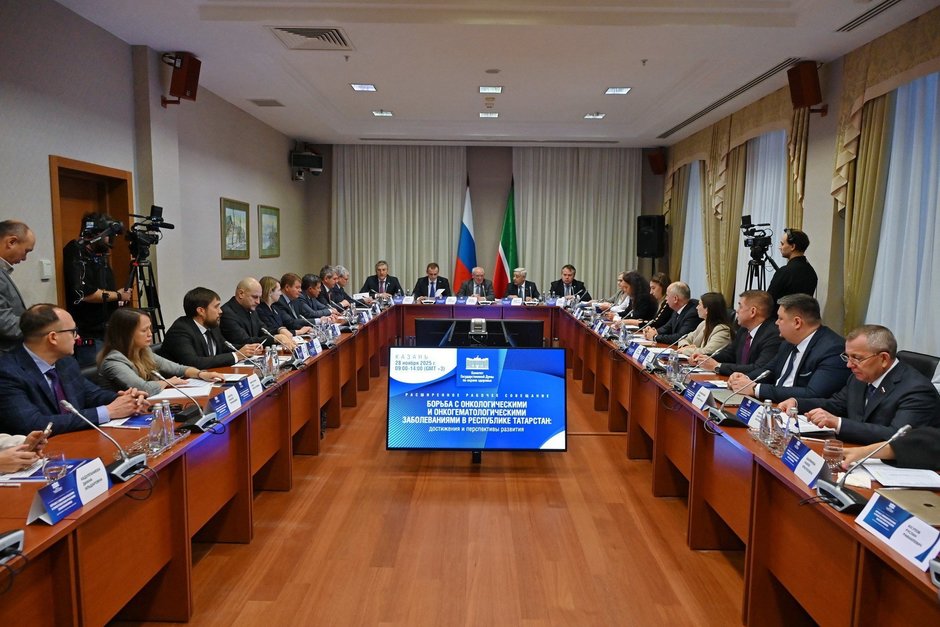
Every 32nd resident of Tatarstan is registered with a malignant tumour. Diagnostic accuracy is increasing, and spending on high-tech treatment and chemotherapy is rising. But the healthcare system still faces a whole series of problems. In the structure of overall mortality, oncology consistently ranks second, officials reported today at an expanded meeting in the republic’s State Council. What changes oncologists asked State Duma deputies to introduce is the subject of Realnoe Vremya’s report.
Hidden shortage of doctors and a threefold excess in workload
An expanded meeting was held today in the State Council to discuss the development of the oncology service in the republic. Chairman of the State Duma Committee on Health Protection Sergey Leonov, president of the Rogachev National Medical Research Centre for Paediatric Haematology, Oncology and Immunology Aleksandr Rumyantsev, and State Duma deputy from Tatarstan Ayrat Farrakhov arrived to hear the views of Tatarstan’s experts.
As the chief physician of the Republican Clinical Oncology Centre (RKOD), Ilgiz Khidiyatov, told them, a three-tier system of specialised oncological care is functioning in Tatarstan. In 2024, more than 335,000 patients were referred to primary oncology offices with suspected diseases.
“In almost 64% of referred patients, a diagnosis of malignant neoplasm (MN) was confirmed. Compared with 2020, the number of patients with suspected MN increased by 148.2%. At the same time, diagnostic accuracy improved by 32%, and diagnosis confirmation by 12.3%,” Khidiyatov reported.
The shortage of medical personnel remains extremely relevant, he said. Oncologists are present at all structures of the first and second levels, but often they work part-time: internally (24% of cases) and externally (16%). This indicates a hidden staffing shortage.
The capacity of the polyclinic at the main institution in Kazan is 329 daily visits. In practice, the number of patients arriving to see doctors is three times greater — more than 1,000.
“To increase the availability of oncological care, the polyclinic operates in two shifts. Nevertheless, the problem of insufficient space is acutely felt, and despite organisational measures already taken, the need for a new polyclinic building for 1,500 visits per shift remains extremely urgent, taking into account the projected growth in morbidity,” the RKOD chief physician noted.
It should be recalled that Nizhnekamsk is anxiously awaiting the creation of a branch of the Republican Oncology Dispensary — the issue was discussed yesterday at a State Council meeting. The need for the institution was raised more than ten years ago, but the matter has still not advanced. Residents of Nizhnekamsk are forced to undergo examinations and treatment in Almetyevsk, which requires travelling 110 kilometres (about two hours one way).
Funding has multiplied, but has not covered the “acute need”
Khidiyatov emphasised that all types of specialised surgical departments, except neurosurgery, are available in Kazan. In particular, it is home to the country’s only emergency oncology department. However, resources for this area are insufficient, and the flow of patients overloads departments providing scheduled care.
Funding for drug therapy has increased almost eightfold compared with 2018, while regional benefits have risen more than tenfold over two years, the speaker said. According to him, this has significantly expanded treatment possibilities.
Nevertheless, a problem remains in the mismatch between financial support and the clinical guidelines approved and mandatory for implementation. The number and life expectancy of oncology patients are increasing, and even with multiple increases in funding, there is an acute need for its further growth.
“In addition, I believe it is necessary to establish at the federal legislative level that, already at the stage of forming clinical guidelines, a financial and economic justification must be mandatory, with determination of the amount and state financing guarantees. And approval of clinical guidelines should take place only after the funding source and volume have been confirmed. All already approved clinical guidelines must also be subjected, as soon as possible, to a financial and economic analysis of their provision with funding,” the RKOD chief physician stated.
“This is simply a mockery of screening”
Screening helps detect malignant tumours in people without symptoms. Today this mechanism needs improvement, believes the chief external oncologist of Tatarstan, Eduard Nagumanov:
“In our view, there is an urgent need to synchronise the age groups of the population involved in screening measures, as well as to fine-tune the existing system, increase the frequency of examinations, and expand or, on the contrary, reduce age groups.”
According to him, examinations should be carried out at least once every two years. There is a risk of so-called interval cancer, which develops between screenings. If the intervals are too long, the tumour has time to reach advanced forms. Nevertheless, there is an examination that is conducted only once in 45 years. “In essence, this is simply a mockery of screening,” Nagumanov concluded. At the end of his report, he asked Sergey Leonov to include the proposals in the list of issues discussed by the State Duma Health Committee.
At the same time, the level of medicine does not stand still. In the near future, treatment of patients using personalised mRNA cancer vaccines may begin in Russia.
“We would like Tatarstan to become the first region in the country to implement the most advanced technologies. We will do everything to ensure that additional financial resources are allocated at the federal level and that these technologies are implemented in the regions of Russia. In essence, today State Duma deputies came to hear the regions’ views on various areas,” Ayrat Farrakhov stressed in a conversation with journalists.