Kazan hosts talks on myth-making and missing works of Tatarstan artists
In the city, there are about fifty sculptures of mythical creatures, and as for Zilants — there are as many as three

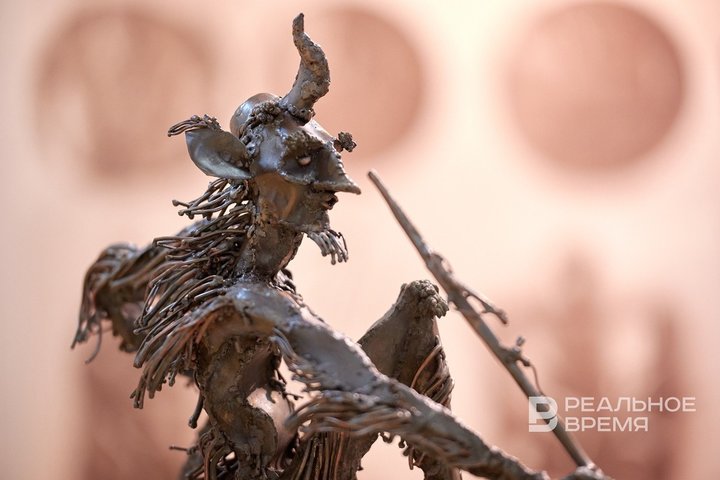
Promoting the exhibition Tau by Alfiz Sabirov, the Gallery of Contemporary Art at the State Museum of Fine Arts of Tatarstan devised a number of events: from a competition to create new myths to lectures on “chthonic monsters of the foothills.” A round table discussion was also held here on the theme “The Mythological Line in Contemporary Sculpture.” The discussion went beyond cultural studies: experts asked themselves the question — where, in fact, do some of the works exhibited in the urban space disappear?
How Metshin consulted Alfiz Sabirov
On social media, Alfiz Sabirov recounted that the story with the Zilant began at the exhibition Urman. A Mythical Land at Elina Safarova’s ES Gallery, where among the works was this very dragon. At the beginning of 2025, Sabirov started working on a sculpture for installation at the beginning of Mislavsky Street, which has now also been named “Zilant Lane.” Earlier, he had published cryptic posts about a certain “Zilant the Guardian”: “Presumably 1208–1300. From the collection of the National Museum of China. We indulged in fantasy.”
As the artist-sculptor explained to Realnoe Vremya, he created the dragon while staying in constant contact with Kazan Mayor Ilsur Metshin, to whom he presented his ideas for approval. In particular, the author decided that his Zilant — which, incidentally, was cast in China — should not be some kind of old dragon, but rather appear young, energetic, and always ready to take flight:
“This is the Zilant that is ready to protect Kazan. Alongside the well-known myths, I also added several of my own,” Sabirov explained.

A new book on Tatar myths under development
At the Gallery of Contemporary Art, the baton from the Perm artist was taken up by Ilnaz Fazlutdinov, Deputy Dean for Educational and Social Work at the Higher School of Journalism and Media Communications. Together with his academic supervisor, Ilseyar Zakirova, he has prepared for the series Myths from A to Z. Russia by the publishing house Myth a book titled Myths of the Tatars: From the Supreme Tengri and Kudai to Sabantuy and the Ice Farewell. The idea, incidentally, came from Moscow. The book is expected to be released in November or early December.

This publication is not academic. For scholars, back in 2008–2011, the Head of the Department of Folk Art at the Institute of Language, Literature and Art of the Academy of Sciences of Tatarstan, Fatikh Urmancheev, prepared a three-volume work in the Tatar language, Tatar Mythology: An Encyclopedic Dictionary, as Rauza Sultanova, Head of the Center for Art Studies at Galimjan Ibragimov Institute of Language, Literature and Art, reminded.
Fazlutdinov noted that the book includes not only images familiar to residents of the Volga region, but also more specific ones, such as the “spirits of ice,” since materials from Siberia, Bashkortostan, Tatarstan, and the Urals were studied. To provide illustrations for the book, he toured Kazan in search of mythological sculptures. In some cases, he even had to negotiate with the owners of private courtyards to photograph them. As a result, Fazlutdinov calculated, there are about 40–50 sculptures in Kazan connected with myths.
The figure, it must be said, astonished those present. Could there really be so many? But this number also includes figurines at Tugan Avylym, as well as Igor Bashmakov’s Su Anasy on Bauman Street. And also the works of Dashi Namdakov near the “Chasha,” which at one time provoked fierce debate.
Why doesn’t Khorriyat move?
On the same list is the bird Khorriyat on the stele at the National Library of Tatarstan. Leading Researcher at the Center for Art Studies Olga Ulemnova recalled that this work by Kadim Zamitov used to be mobile.
“It is a kinetic sculpture, the first and, it seems, the only one in Kazan. But now it has frozen,” Ulemnova noted, pointing out that, in general, myths began to appear in sculpture during the post-Soviet period, because previously this art form was associated with civic and patriotic themes. There is a great deal of mythology in villages: for example, in Malye Shirdany in the Zelenodolsk district, a local self-taught artist created an entire park.
The foundation was laid by Ildar Khanov with his debut work in Chelny, The Motherland Calls, in 1975, which, Sultanova reminded, embodied in his own way the phoenix and the traditions of megaliths.

According to her, Alfia Ilyasova, Khamza Sharipov, Ilgizar Khasanov, and Ildar Khanov have always engaged in myth-making, synthesizing traditions, schools, techniques, and personal memories.
“Their works are the artist’s imagination, which refers back to ancient archetypes. In Alfiz’s case, there is also an intellectual play with forms. He deliberately deforms the works, misrepresents anatomy, thereby creating new forms based on mythological images.”

Art scholars also pointed out that problems with monuments are not limited to the immobilized Khorriyat; sometimes they simply disappear. For a long time, an exhibition of the sculpture symposium Melody of Stone could be seen in the Kazan Kremlin. The works of Tagir Subhankulov and Asiya Minnullina have vanished. Minnullina, incidentally, is the author of the composition Riddles of Shurale near the old building of the Kamal Theatre.
“We say that we do not have garden and park sculpture. But even what we do have, we do not preserve,” Sultanova noted, pointing out that round tables on such topics should be held more often at the Gallery of Contemporary Art, inviting both government bodies and entrepreneurs.
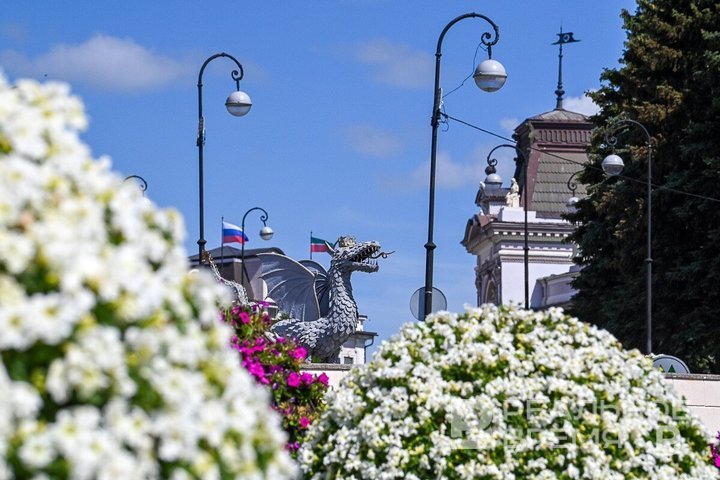
In this respect, one is reminded of the story of Marat Gubaidullin’s first Zilant. In 2023, the original was put up for sale. At that time, the artist’s family explained that a copy of the sculpture stands above the entrance to the Kremlyovskaya metro station.
This was because the Zilant installed in 2005 had been damaged by Spartak fans. Gubaidullin restored it and took it back to his workshop, placing a copy at the metro instead. The original now stands at the entrance to the headquarters of the Fix Group on Telmana Street.