Mo Yan in Russia: the Nobel laureate follows in the footsteps of Dostoevsky, Sholokhov, and Tolstoy
Where he was, what he saw, and what inspired the Chinese writer during his journey through Russia's literary sites
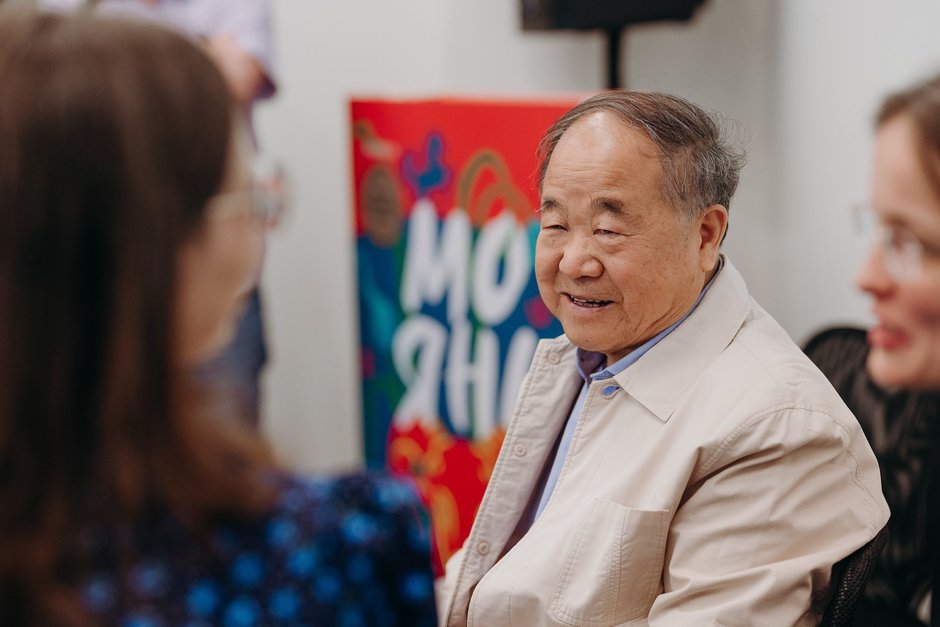
Nobel Literature laureate Mo Yan made a major journey through Russia for the first time in many years. Over the course of several days, the Chinese writer managed to walk along the banks of the Neva, see the places where “And Quiet Flows the Don” was created, visit Yasnaya Polyana, meet with hundreds of readers, and watch Russian stage adaptations of his own novels. The literary critic of Realnoe Vremya, Ekaterina Petrova, tells how Mo Yan's visit to Russia went.
A queue from dawn and a scuffle in Petersburg
The meeting with readers on June 5 in St. Petersburg became the first stop of Mo Yan's fourth visit to Russia. The Nobel laureate has long been familiar with the country and has come here for the fourth time. At a press conference in Moscow, the writer said that he first visited Russia back in 1995, traveling through cities bordering China. Later, he traveled through Siberia and the Far East, visiting Irkutsk and Lake Baikal, Blagoveshchensk, and Vladivostok.
These trips grew out of his reader's interest in Russian literature. Mo Yan recalled that he had read Valentin Rasputin, Viktor Astafyev, and Anton Chekhov for many years and wanted to see the places associated with their books. During his current visit, he also reached St. Petersburg. “I was in St. Petersburg, admired the Neva and walked along its banks, saw the cruiser Aurora, visited Dostoevsky's places," the writer said.
The reason for his visit was not only the literary program. Two theatrical productions based on his novels are currently running simultaneously in Russia — “Frogs” and “Tired of Being Born and Dying.” Mo Yan came specifically for the premiere of the play “Tired of Being Born and Dying” in St. Petersburg. The writer highly praised the work of the young Chinese production team and the Russian actors. He noted that the creators of the play were able to bring the complex story of the protagonist's constant transformations to the stage. According to the author, his novels received theatrical life in Russia earlier than in China.
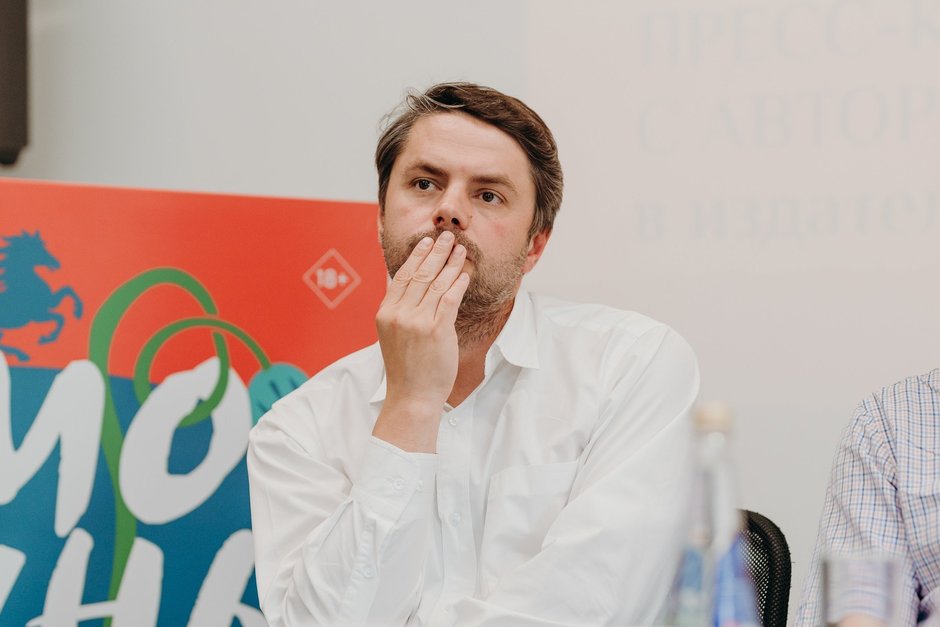
The artistic director of the Alexandrinsky Theatre, Nikita Kobelev, explained the interest in Mo Yan's prose by the scale of these stories and the combination of everyday reality with elements of magical realism. While working on the productions, the team studied Chinese daily life in the 1970s–1980s and discovered much similarity with Soviet everyday life. Kobelev emphasized that the theatre sought to show the Russian audience not exoticism, but stories in which they could see reflections of their own problems and experiences.
The owner of the bookshop “Podpisnye Izdaniya," Mikhail Ivanov, said that the idea to invite Mo Yan arose after a call from the director of the Alexandrinsky Theatre, Alexander Malich. “We are bringing Mo Yan, are you in?” Ivanov recalled his words. The answer followed immediately: “That's not even a question.”
The scale of interest could be seen on the day of the meeting with readers. The first visitors came to the shop at 6:30 in the morning, although the event was only scheduled for noon. By the time the shop opened, the queue had reached about a hundred people; in total, according to organizers' estimates, about a thousand people passed through it. Among them were several dozen Chinese readers who came specifically to see the writer. During the wait, a conflict broke out between two visitors. The argument started over the queue; the participants exchanged accusations and shoves. In the commotion, a light panel with the meeting announcement was knocked, but it was quickly repaired. Ivanov emphasized at the press conference that what happened did not affect the atmosphere of the event, and most participants behaved respectfully.
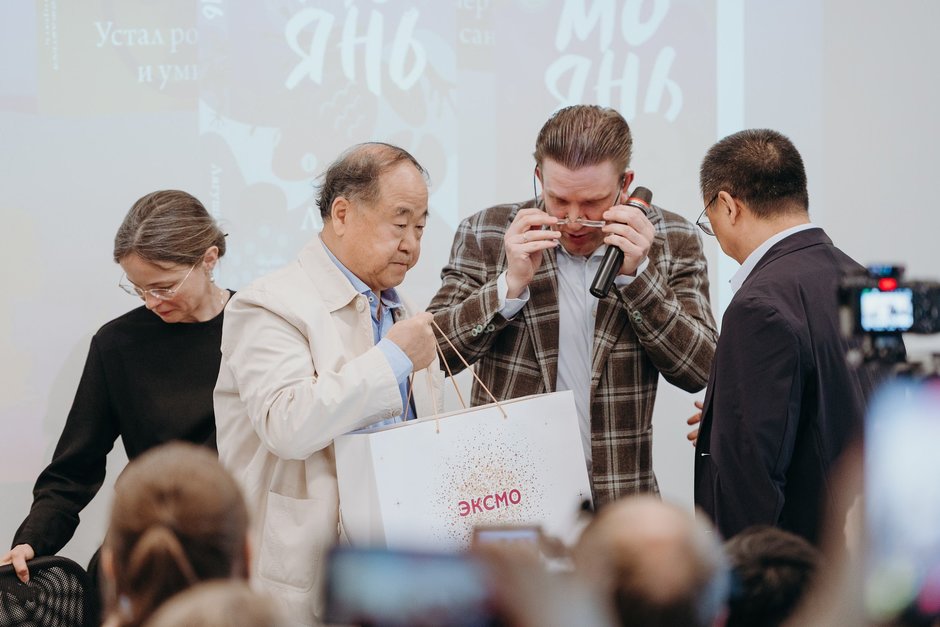
Mo Yan himself spoke to readers primarily about literature. St. Petersburg seemed familiar to him even before his arrival through Dostoevsky's books. At the meeting with readers at “Podpisnye Izdaniya," the writer said that he had read “The Idiot” and “White Nights” many years ago and therefore perceived the city through literary images. He noted that he hoped to visit as many places as possible connected to the history of Russian literature. According to him, books help to get to know another country, and the opportunity to see the houses, hotels, and streets where writers lived creates a special connection between the modern reader and authors of the past.
The autograph session at “Podpisnye Izdaniya” lasted about three hours. During this time, Mo Yan signed roughly five hundred books. After the meeting, the shop continued to receive messages from readers for a long time, trying to find copies with the author's autograph.
The sacred river
One of the main novels of Russian literature constantly lies on Mo Yan's desk. At the press conference in Moscow, the writer said that he regularly returns to Fyodor Dostoevsky's “The Brothers Karamazov” and often rereads Ivan Turgenev. Mikhail Bulgakov also holds a special place in his reader's biography. According to Mo Yan, the novel “The Master and Margarita” greatly influenced both Chinese writers and Chinese readers.
Mo Yan emphasized that Russian literature continues to play an important role in China. “One could say that Russian classics greatly influenced the formation of Chinese writers. Three generations of readers from China are under the strong influence of Russian classics. New authors come to our market, but classical Russian literature will not be replaced by anything," he said. The general director of the Eksmo publishing house, Evgeny Kapiev, confirmed this interest. During a trip to Beijing, he was struck that Russian classics occupy the best places in Chinese bookstores.
Among Russian authors, Mo Yan particularly singles out Mikhail Sholokhov. When the conversation turned to literary influences, the writer immediately remembered “And Quiet Flows the Don.” “Let us recall Sholokhov, 'And Quiet Flows the Don,' its silence, its peace, those boundless fields," he said. Mo Yan noted that the description of nature in his own books is largely connected with the impression of Sholokhov's prose. According to him, the author of “And Quiet Flows the Don” could convey the smells and sounds of the surrounding world so accurately that the reader literally felt them. “He sensed different smells, because they are conveyed in the pictures described in 'And Quiet Flows the Don.' I probably inherited this sensitivity to smells and sounds from my father as well," the writer said.
Therefore, one of the points of his current visit to Russia was a trip to the Don. Mo Yan traveled to places connected with Sholokhov's life and work. The main Sholokhov locations are in the Rostov region and neighboring areas of the Volgograd region. Among them are the village of Veshenskaya, where the writer lived and worked on “And Quiet Flows the Don," as well as the village of Bukanovskaya in the Volgograd region, where he began work on the novel. The Chinese delegation was accompanied through these places by the writer's grandson, Alexander Sholokhov.
This trip made one of the strongest impressions on Mo Yan during his entire Russian itinerary. “Finally, I saw the great Don with my own eyes. I stood in the places where the film 'And Quiet Flows the Don' was shot. I have read Mikhail Sholokhov's book many times. I can say that the Don River is sacred to me," he said. Alexander Sholokhov showed the guests the places where the famous novel was created and the house where his grandfather worked.
Mo Yan admitted that this meeting was particularly important to him. “It even seemed to us that during the conversation we met Sholokhov. Sholokhov's grandson is much younger than me, but he carefully preserves the memory and legacy of his grandfather. It seems to me that their voices are very similar, so in the grandson I saw the grandfather," the writer said.
Mo Yan has already decided to turn his impressions into new texts. “The trip to the banks of the Don will, of course, also be reflected in my subsequent stories," the writer said. He said that after trips he regularly publishes travel notes for a Chinese audience. According to him, such texts are already read by more than one hundred thousand people. Mo Yan hopes that the stories about the trip will bring new guests from China to the Don. “I think that among these one hundred thousand people, there will certainly be travelers who will come to the banks of the Don next year to see this with their own eyes," he said.
Visiting Leo Tolstoy
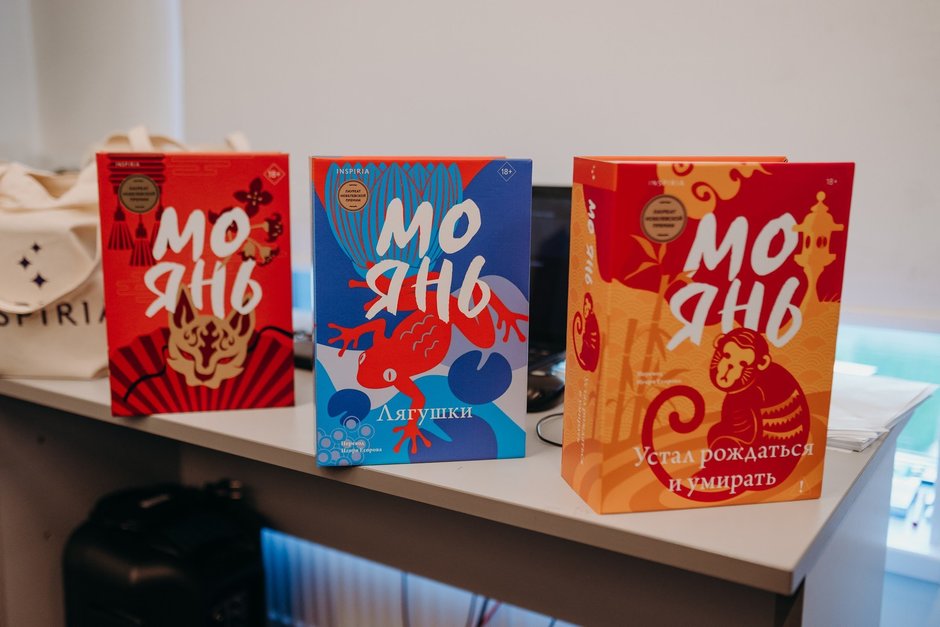
In 2025, Mo Yan's novel “Death Smells of Sandalwood” was awarded the Yasnaya Polyana Prize in the “Foreign Literature” nomination. At the press conference in Moscow, Evgeny Kapiev recalled that this book remains the best-selling work by Mo Yan in the Inspiria publishing house catalog.
The writer himself admitted that he considers the novel one of the most important in his career. "'Death Smells of Sandalwood' is one of my favorite novels in my portfolio. The writing method of this novel is special for me. It echoes folk plays and folk tales that are very popular in China. The entire novel is written using rhymed lines. Many of the characters in this book are characters from Chinese folk opera. By the way, this novel was adapted for opera in China," he said.
A member of the jury and writer Pavel Basinsky noted that Mo Yan's works have attracted the attention of Yasnaya Polyana more than once, but it was “Death Smells of Sandalwood” that made a particular impression on the experts. According to Basinsky, the novel combines a complex modernist form with deep roots in Chinese culture. “If you want to taste China, hear China — read Mo Yan. You will physically feel the presence of the Chinese deep spirit: pain, joy, smells, tastes, the physical, the spiritual — all of it is felt together there," he said.

During his trip to Russia, Mo Yan visited Yasnaya Polyana — the ancestral estate of Leo Tolstoy in the Tula region. Here Tolstoy was born, lived most of his life, wrote “War and Peace” and “Anna Karenina," and today the estate grounds house the writer's memorial house, historic gardens, parks, and a museum complex. “I visited Yasnaya Polyana. I am awarded the Yasnaya Polyana Prize, and it is a great honor for me," Mo Yan said.
The trip to the estate logically continued the conversation about the Russian writer who has long occupied an important place in the Chinese author's reader's biography. When the conversation turned to the influence of Russian literature on his work, Mo Yan recalled Tolstoy and one of the most famous novels of the 19th century. “Leo Tolstoy's book 'War and Peace' greatly influenced my novel 'Red Sorghum,' on the scenes of the Chinese people's resistance to the Japanese invaders. Here, perhaps, one can find echoes of the battlefields and the Battle of Austerlitz," he said.
Talking about the Nobel Prize, literature, and frogs
After trips to St. Petersburg, Yasnaya Polyana, and Sholokhov's places on the Don, Mo Yan arrived in Moscow on June 10. The capital became the final point of his fourth visit to Russia. The writer has long-standing memories connected with this city. He first came here in 2007 for the Moscow International Book Fair. It was then that Moscow made one of the most unusual impressions on him. “My most vivid impression was that the metro in Moscow is indeed very deep underground. It seemed to me that going up the escalator from the bottom to the top took an eternity," Mo Yan recalled. Since then, almost two decades have passed. “Over the 19 years I was away from Moscow, enormous changes have taken place. I want to say a lot, but there is so little time," the writer noted.
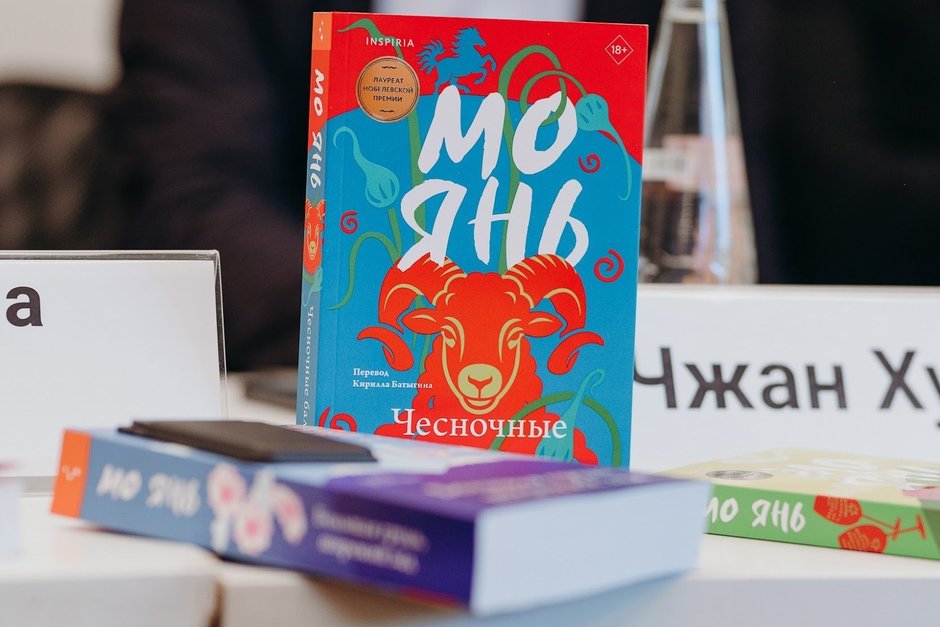
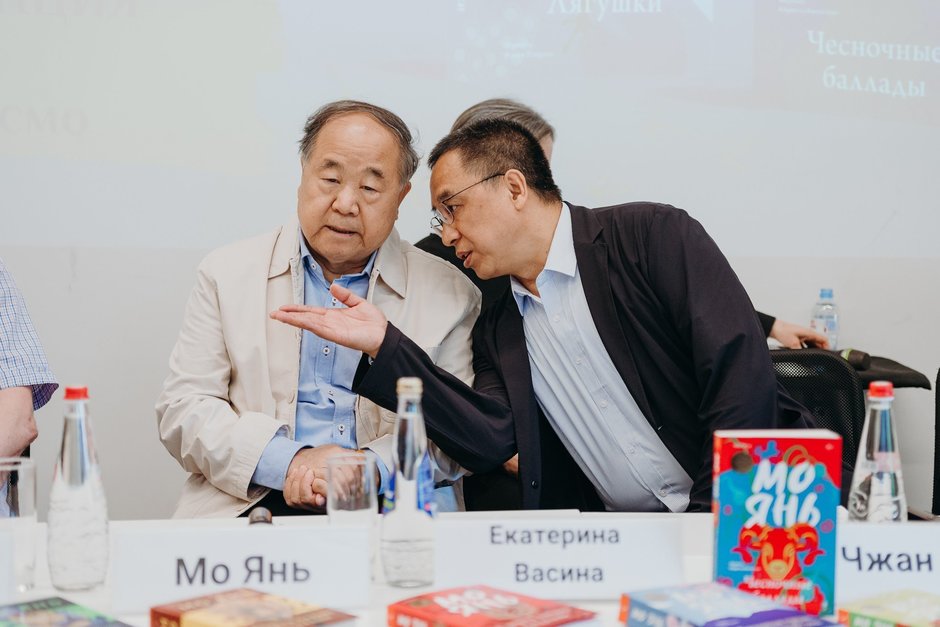
At the press conference, Evgeny Kapiev recalled that on May 29, “Garlic Ballads” was released in Russia — Mo Yan's second novel, which the author wrote in just 35 days. Kapiev also spoke about the new collection of autobiographical stories “The Man," published in China last year. Answering a question about what had changed between these books, Mo Yan spoke not only about his literary evolution but also about life after the Nobel Prize.
“When 'Garlic Ballads' was published, I was a beginner, young, desperate 32-year-old. Now I am already 71, and life experience makes itself felt. The turning point in my creative biography was 2012, when I was awarded the Nobel Prize in Literature. Then life was divided into before and after," he said.
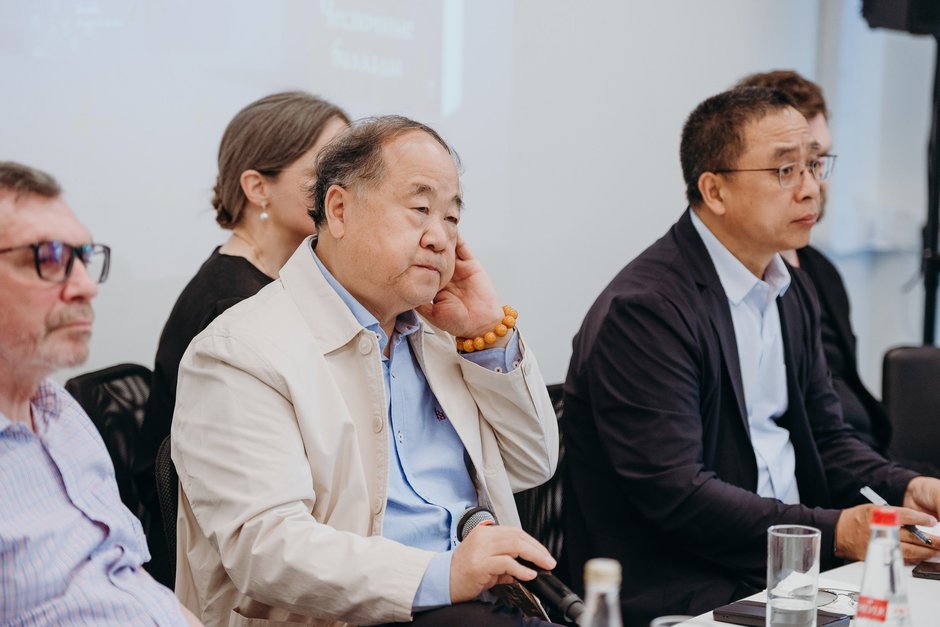
According to the writer, before receiving the prize he was well known in China, but after 2012, attention to him grew sharply. “My books on the shelves became more and more numerous, and the attention became even greater. It became very intense. For a long time I could not adapt to this new reality," Mo Yan admitted. Later, he learned to separate himself from others' assessments and criticism. “I realized that perhaps their words concern me, but that is not me," the writer explained.
He also said that after the Nobel Prize he began actively writing plays and took a fresh look at his own work. “If I do not use the time I have left now, I probably will not have time to say everything I want to say," he added.
During the press conference, journalists also recalled the meaning of Mo Yan's literary pseudonym, which can be translated as “don't speak” or “be silent.” One question concerned the contradiction between this name and his literary activity. The writer replied with a smile: “If you translate my pseudonym literally, then there is indeed a contradiction here. Even those who do not like me say: since you are called that, be silent. But if I had come to a press conference today and not spoken, everyone would probably have been very upset.”
After the meeting with journalists, the Moscow program continued outside the city center. Mo Yan went to Peredelkino, where he met with readers and visited the Boris Pasternak House-Museum. Another important event was the play “Frogs," directed by Nikita Kobelev. The Pskov Academic Drama Theatre showed it as part of its tour on the stage of the Taganka Theatre. This production became the first stage version of Mo Yan's novel of the same name in the world.
After the performance, the writer took the stage and thanked the actors and audience. “I am very excited now. I watched such a wonderful performance. Not long ago I was on the banks of the Don and heard frogs croaking in nature. Today I heard frogs croaking again, but in a theatre. This sound evokes many associations in me. I remember my native land, my loved ones, and the feelings associated with writing the novel," he said. Mo Yan noted that many of the book's characters have real prototypes. For example, Aunt Wan Xin grew out of the image of his own relative, who worked as a midwife and gynecologist in a Chinese village.
Speaking about the novel, the writer emphasized that he considers it primarily a human story. “In some ways it may seem that this novel is devoted to the topic of birth control policy in China, but in fact it is first and foremost a human story," he noted. Mo Yan also recalled Dostoevsky as an author who set an example of deep exploration of human psychology.
Summing up the evening, he thanked the production team for their attentive attitude to the book. “It seems to me that this production highlights the strongest, most vivid elements of my novel. And this is, essentially, the soul of a person," the writer said. Thus ended the visit to Russia of the 2012 Nobel Literature laureate, Mo Yan.
Ekaterina Petrova — literary critic for the online newspaper Realnoe Vremya, host of the Telegram channel «Булочки с маком».