What to read about Greenland: a seal hunter, a crow boy, the colonization of the island, and the sense of snow
Experience of colonization, violence, survival, and adaptation to a changing world. Seven books to help you understand Greenland.
This week, Greenland is one of the main topics in the news. Another round of discussions about its purchase or even annexation arose after Donald Trump’s statements. And in this rhetoric, the main thing is almost inaudible: people live on the island with their own history, memory, and very specific experience of colonization, violence, survival, and adaptation to a changing world. To understand what Greenland is beyond geopolitical headlines, «Real Time» turned to books. Literary reviewer Ekaterina Petrova has selected seven texts — from noir and biography to folklore and children's fairy tales — that help to see how life on the island is organized and how Greenlanders see themselves.
Mads Nordbo. «The Girl Without Skin», «Foliant» (18+)

This is an Arctic noir and at the same time a harsh social novel about Greenland, its past and present, with violence, memory, and politics at the center of the plot. Journalist Matt comes to Nuuk after a personal disaster: his pregnant wife died in Denmark. He is running from the past and almost immediately gets into a story he can’t turn away from. A mummy is found on the glacier. Perhaps it’s a Viking. But the photos taken disappear, and the mummy is gone. The police officer guarding the find is found murdered: he wasn’t just stabbed, but skinned like prey on a hunt. This is already a series of crimes strangely similar to the unsolved murders of 1973. Further on, there are two time layers and two investigations. The diary of a missing policeman from the 70s. Traces of systemic violence, pedophilia, corruption, and political silence. A small society where everyone knows everything, but prefers to remain silent. Greenland here is a closed environment without roads, with a difficult history of colonization and people who were forced into concrete boxes instead of living on the land.
There is a separate line — Tupaarнак. A shaven, tattooed seal hunter who served 12 years for killing a family, with a knife, a rifle, and a reputation as a savage. She is the main suspect and the only ally of Matt. Their connection is a forced partnership of people who have nowhere to retreat. In «The Girl Without Skin», the investigation is conducted by a journalist and a woman no one believes. Violence is not aestheticized. Blood is part of everyday life. Murder is a continuation of old decisions made by the state and society. Mads Nordbo worked as a journalist and screenwriter for many years, and the novel grew out of his interest in real scandals around child abuse in Greenland and the role of the Danish authorities. The book opened a series of «Greenlandic» thrillers by the author and became an international hit. It has been translated into more than 15 languages.
Kurt Frederiksen. «The King of Thule. The Biography of Knud Rasmussen», «Paulsen» (12+)
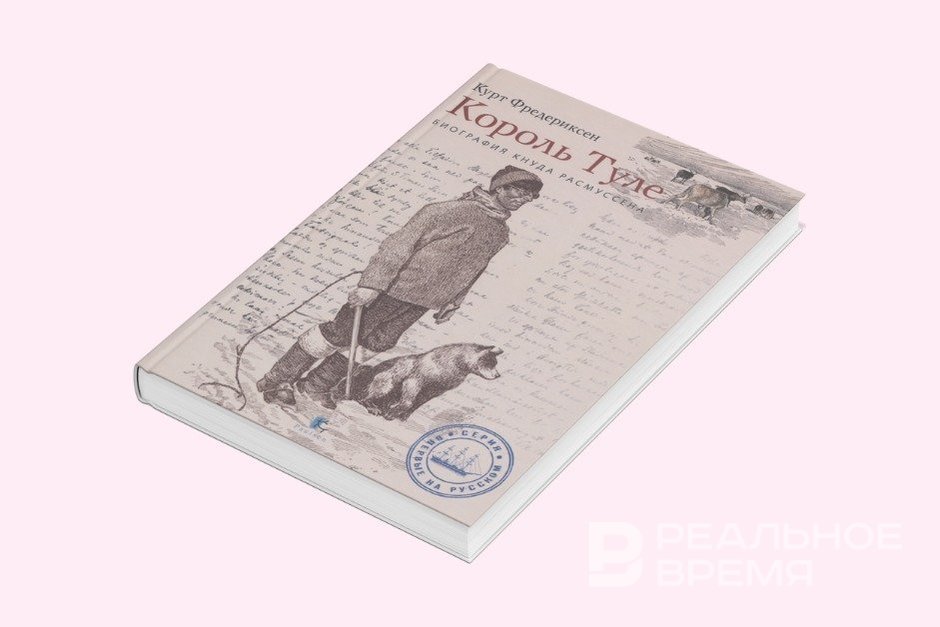
This book is an analysis of a figure without which it is impossible to understand modern Greenland. Knud Rasmussen is a Dane with Eskimo roots, who grew up in Greenland, spoke the Inuit language fluently, and spent his whole life balancing between the Arctic and Copenhagen. He organized seven expeditions, traveled about 18 thousand kilometers from Greenland to Alaska on dog sleds, collected myths and sagas of peoples that neither missionaries nor scientists had reached before him. On the island, he was called the «King of Thule». Dozens of geographical points on the map of Greenland are named after Rasmussen. The author of the book, Kurt Frederiksen, makes an important move: he removes the halo of an impeccable discoverer. He shows a complex, contradictory, uncomfortable person. Rasmussen is not an armchair scientist, but a practitioner. He collected a lot of material, but did not strive to systematize it according to academic standards. He was interested in people, their language, ways of survival, migration routes. He sincerely respected Inuit culture and at the same time represented the colonial power. Moreover, it was his expeditions that played a key role in securing Danish sovereignty over East Greenland.
The book contains a lot of specifics: how sled expeditions worked, how decisions were made in conditions of hunger and cold, how the Arctic changed with the advent of aviation and newsreels, how politics was born from the romance of big travels. Frederiksen shows Rasmussen as a mediator — a person who tried to make the clash of the traditional world with civilization less traumatic, although he understood that it was impossible to stop this process. «The King of Thule» is the third, revised version of the biography. It includes new archival details, including the story of Rasmussen’s illegitimate daughter, whose existence was unknown for a long time. This changes the perspective on his early years and the motives for fleeing to expeditions. The book is important not only as a biography. It is a text about the price of progress, the role of an individual in colonial policy, and how Greenland was formed, with which the world is now having a tough conversation again.
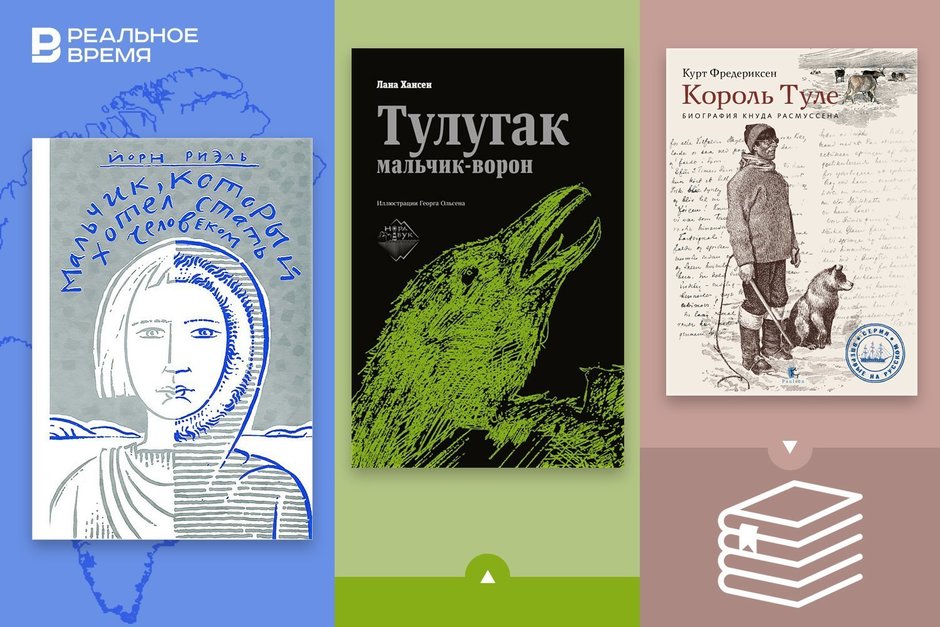
Jorn Riel. «The Boy Who Wanted to Be a Man», «Samokat» (18+)

This book is a harsh, textured story of growing up against the backdrop of real Greenland in the 10th century. The time of the Vikings. Violence, blood, revenge — these are the norm here. Young Icelander Leif vows to avenge his killed father, secretly boards the enemy’s ship, and ends up in Greenland with him. The shipwreck cuts off the old plot. Then another one begins. The Inuits pick up Leif. The stranger is feared, tested, tolerated. He learns to live by their rules: to hunt, to build snow houses, to share everything he has, not to take too much from nature, and not to consider violence a universal answer. Riel shows this process without smoothing. There is a lot of hunger, cold, danger. There are pirates, slavery, fights, a polar bear, and a drifting ice floe. But the main thing is the change of optics. The Viking logic of power is gradually cracking. Another understanding of a person and his responsibility comes in its place. Greenland in the book is shown through everyday life, hunting, boats, myths, language, and the structure of the community. All this is analyzed in detail and accurately.
Jorn Riel lived in Greenland for sixteen years and wrote like an ethnographer, not a tourist. Many chapters read like a field diary embedded in an adventure plot. The key idea of the book is simple: «Inuit» means «man». To become a man is about choice. About measure. About the ability to live in a system where survival is only possible together.
Charlotte McConaghie. «Migrations», NoAge (18+)

In the world of the near future, almost all wild animals have disappeared. There are only a few species left. Arctic terns are among the last. Biologist Franny Stone flies to Greenland to track their flight from the Arctic to Antarctica. Perhaps the last flight in the history of the species. She persuades the crew of a fishing vessel to change the route and follows the birds further and further from the shore, safety, and common sense. Storms, an exhausted ocean, disappearing fauna, tired sailors who continue to fish because they have no other way to live. On board, there is a conflict of interests: an ecologist versus fishermen, an ideal versus reality, the future versus habit. McConaghie does not take sides. She shows a system that is falling apart at the seams. At the same time, Franny’s story is revealed. Traumatic childhood, running away instead of attachment, a marriage she couldn’t hold together, a crime, prison.
«Migrations» is not a classic dystopia. The world is recognizable. Cities stand. Ships sail. People work. It’s just that there are almost no animals left. This makes the novel especially unpleasant: it’s not about «if», but about «when». The disappearance of species here is a structural element of the plot. The ban on commercial fishing, empty oceans, national parks without animals — all this is built into the everyday life of the characters. Greenland in the book is a starting point and a symbol. The edge from where the journey begins, behind which there is almost nothing left. It is no coincidence that it is from here that the terns fly away — birds with the longest migration on the planet. «Migrations» is Charlotte McConaghie’s first novel for an adult audience. Before that, she wrote young adult books and worked as a screenwriter. She started this novel after a trip along the Irish coast, when she became seriously involved with the topic of species extinction. The novel became one of the most notable texts in the climate fiction genre and brought McConaghie into the international literary league.
Gunvor Bjerre. «The One-Eyed Giant», Publishing House «Gorodets» (12+)

This is a collection of Greenlandic folklore. The book contains 35 short stories of the Inuit about survival, strength, fear, hunger, and cunning. About orphans who no one protects. About hunting, on which life depends. About revenge, which is sometimes considered normal and even a just ending. There are talking animals, flying shamans, one-eyed giants, men who can carry a whale, and children who grow up too early. These texts are not built as a single epic. Each story is a quick snapshot of a world where a mistake costs a life and luck is a matter of observation and character. Many plots end abruptly. Someone was saved — and that’s it. Someone wasn’t saved — and that’s it too. No morality, just the logic of the environment. Unsuccessful hunting means hunger. Weakness means death. Courage and ingenuity sometimes give a second chance. The book is important precisely for its content. It shows the mentality of a society where there is no idea of accumulation, but there is a close connection with nature. Where a woman is obliged to be able to hunt no worse than a man. Where animals, weather, and spirits are full participants in the events. Bjerre carefully preserves Inuit words and ideas without turning them into an ethnographic museum. These are living, sometimes strange, sometimes cruel stories that are not like familiar European folklore.
Gunvor Bjerre is not a folklorist by training, but a journalist and television personality. In Denmark, she is known as the voice and face of children’s programs, worked on adaptations of Astrid Lindgren’s works, and wrote songs for children’s TV. «The One-Eyed Giant» is the result of her many years of trips to Greenland and work with sources going back to field recordings of myths from the early 20th century.
Peter Høeg. «Smilla and Her Sense of Snow», «Simposium» (16+)

This novel is often called a detective story, but in fact, it is an exploration of how power, science, and colonial relations are structured. Formally, everything starts with an accident. In Copenhagen, a six-year-old Greenlandic boy, Isaiah, falls from the roof of a house. The police close the case. Smilla Jaspersen, his neighbor, a glaciologist, half-Greenlander, looks at the footprints in the snow and realizes: the boy was being chased. This is enough for her not to believe the official version and to start her own investigation. Smilla reads the tracks, the ice edge, the behavior of the water as accurately as others read reports. Then there are hospitals, classified autopsies, biopsy data, corporate interests, an old Arctic expedition, a ship in the ice, and an island off the coast of Greenland where a dangerous find has been hidden for decades. Høeg shows how a private death turns into an element of a larger scheme where business, the state, and science intersect. And how people from Greenland in this system turn out to be expendable.
Høeg came up with the novel after a dream about polar bear tracks in Greenland and wrote it in extremely poor conditions — without a table, sitting with a baby in a one-room apartment. The book became a worldwide bestseller, won many awards, and фактически opened the mass reader to Scandinavian noir long before its commercial boom. In Denmark itself, the novel was long considered not «great literature», but a successful project. Time has shown the opposite.
Lana Hansen. «Tulugak — the Crow Boy», Publishing House «Gorodets» (6+)
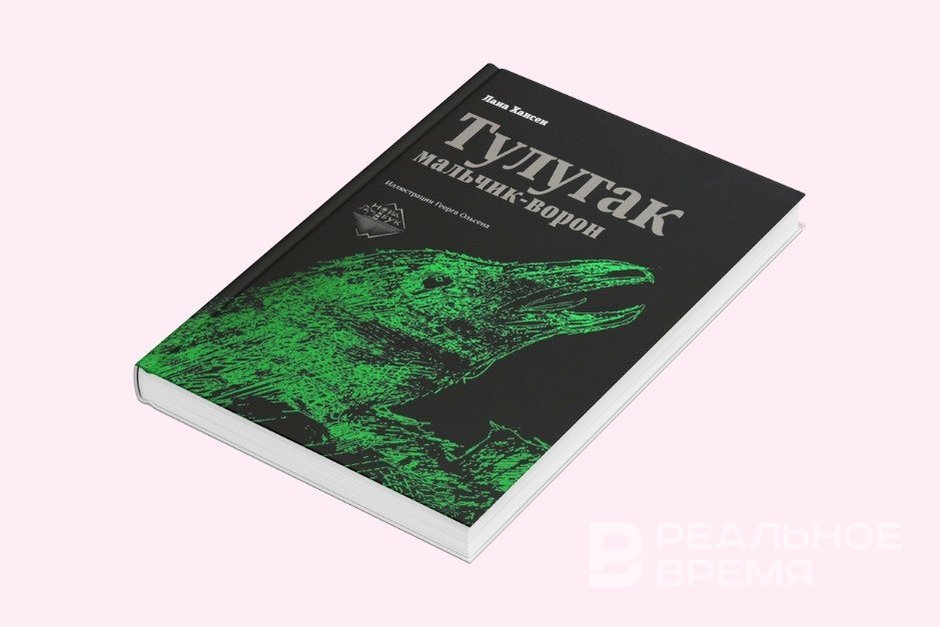
This is a modern fairy tale that has a hero, a mission, a threat to the world, and a clear logic of where this threat comes from. Nine-year-old Tulugak lives in Greenland, goes to school, is in love, conflicts with a classmate, and at the same time can turn into a crow and fly. When the Spirit of Ice tells him that the climate is out of balance and the world is heading towards disaster, it is Tulugak who gets the task: to find the Mother of the Seas and stop the trouble. Flight, journey by water and land, encounters with animals: a polar bear, a deer, a whale, birds. There is also an antagonist — an envious crow who hinders the mission. There is also an ancient mythological mechanism: if people are greedy and destroy nature, animals leave, hunting stops, and famine begins. And this is a direct explanation of how the Arctic lives. The book talks about climate change. Melting glaciers are not an abstraction, but a direct threat to the way of life. It is no coincidence that the original title of the book is «Sila». In the Greenlandic language, this word simultaneously means «weather», «mind», and «universe». Hansen uses this meaning literally: the loss of balance in nature is the loss of reason.
It is also important how the book is structured. The real school world is constantly rhymed with the mythological one. Spirits, a journey to the bottom of the sea, the Mother of the Seas, and at the same time an ordinary classroom, ordinary children, ordinary jealousy, and fear. The ending leaves space for double reading: was it an adventure or a dream? The answer is not принципиален. The main thing is the result. «Tulugak — the Crow Boy» is the first translation of a fiction work from Greenlandic into Russian. The author, Lana Hansen, is not only a writer but also an environmental activist. In 2009, she participated in climate projects and presented an art installation at a UN conference. The book was nominated for the West Scandinavian Council Award and translated into many languages.
Ekaterina Petrova is a literary reviewer for the online newspaper «Real Time» and the host of the Telegram channel «Macaroon Buns».