Showcases, Coffins, and Lemonade: Kamalov Staged «The Museum of Innocence»
At the Kaban Theatre, they are attempting for the second time to tackle Orhan Pamuk's work.
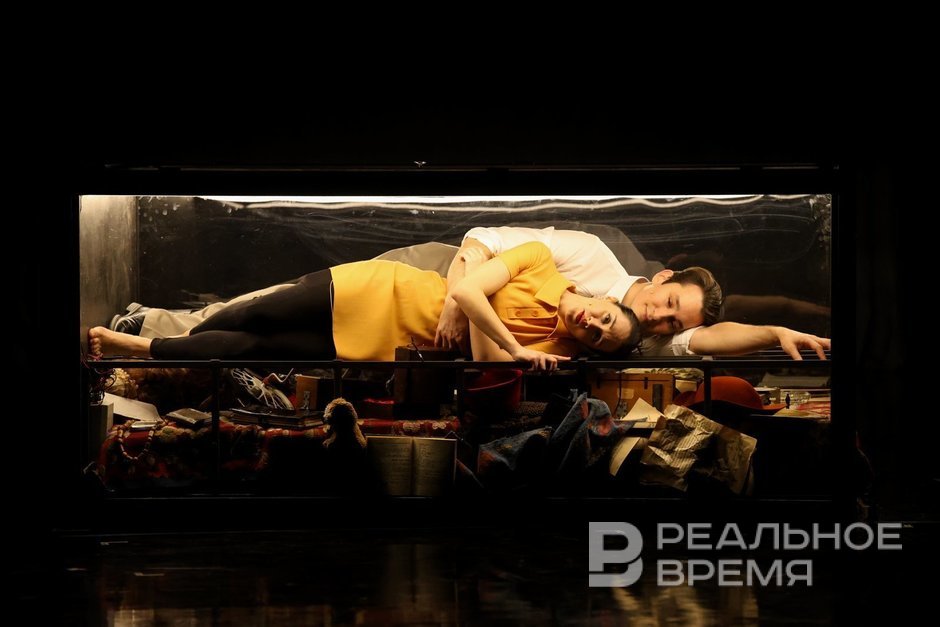
The most ambitious production of the Kamalov Theatre this year is «Saflyk muzeyi» («The Museum of Innocence», 18+) based on Orhan Pamuk's novel of the same name. Did the artistic director of the Alexandrinsky Theatre, Nikita Kobelev, manage to convey the Nobel laureate's text in Tatar translation? If you like Turkish dramas, the answer is yes.
Memories of Istanbul
Orhan Pamuk's works are not often staged. For example, the novel «My Name Is Red» was turned into an opera in Poland. In 2014, Maxim Kalsin, then the chief director of the Magnitogorsk Drama Theatre, staged it at the Kamalov Theatre. The stage adaptation was written by Yaroslava Pulinovich. The performance ran for two seasons and impressed with its scale — there was a huge pedestal of stairs on the stage, and two large projectors were placed in the wall at the back. However, the story of how the miniaturist Zarif was killed because he was preparing a book with illustrations in the European style did not become a hit.
So it was understandable that some actors were worried when Nikita Kobelev, the artistic director of the Alexandrinsky Theatre and a native of Naberezhnye Chelny, also decided to take on Pamuk. For example, Ilnur Zakirov, Ildus Gabdrakhmanov, and Radik Bariyev, who are involved in the new production, also starred in «The Red».
In «The Museum of Innocence», Rishat Akhmadullin plays the main role of Kemal, as well as a narrator. Following a new tradition, the director himself became the adapter — the Tatar translation was done by Rustem Galiullin, the current head of «Tatgiz». What did he bring to the stage?
The Russian edition of «The Museum of Innocence» was published in 2009, the year after the original publication. The translator, Apollinaria Avrutina, is listed as a consultant for the production. The writer initially wanted to create a museum with everyday objects and write a catalogue for it, which later turned into a novel. The museum opened in 2012, and the audience in the play can see photographs of items from it. The catalogue was eventually written.
Pamuk's novel is not just a love story; it is his memories of Istanbul in the 1970s and 1980s, a city where East and West meet. His characters listen to American music and drink Coca-Cola, wear jeans and skirts, but issues of Islamic morality are still important to them. On the one hand, Pamuk is quite detailed in his erotic scenes, but he emphasizes that such a step was not common at the time — it was a serious step for a girl, followed either by marriage or tragedy.
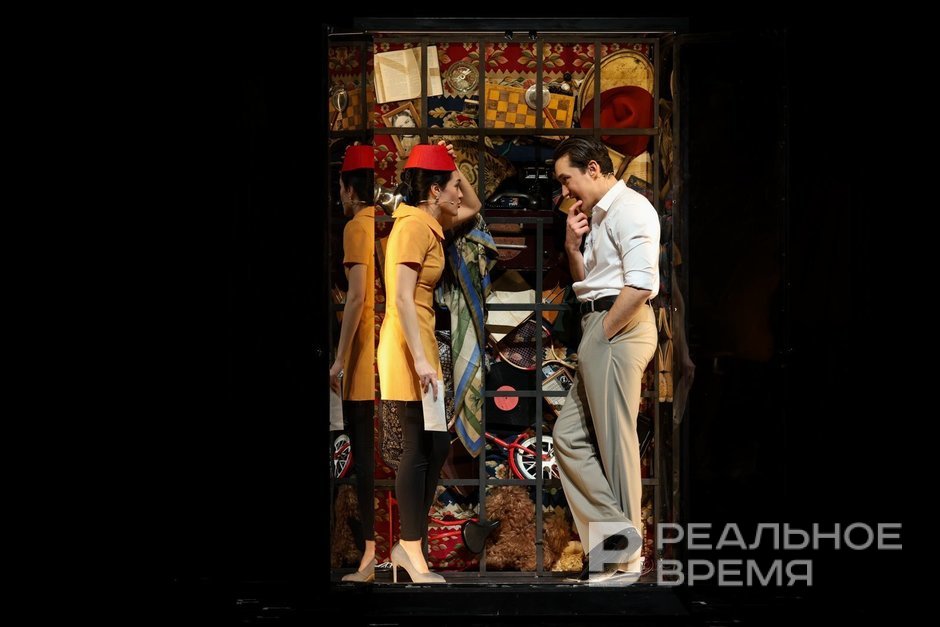
Symbolic Wardrobe Turning into a Bed
Nikita Kobelev describes the main plot of the novel. Kemal (Rishat Akhmadullin), a 30-year-old general director of a textile company, is preparing for an engagement to the beautiful Sibel (Alina Mudarisova). In a store, he decides to buy a bag for her, and there he meets his distant 18-year-old relative from a poor family, Fusun (Leysan Gataullina). Kemal lures the girl to his mother's empty apartment, and they become lovers.
The engagement to Sibel does not progress further, Kemal cannot find Fusun for a long time, and then he finds out that she has married the screenwriter Faridun (Fannur Mukhametzyanov). He dreams of making «European» films with his wife in the lead role. Together with Kemal, they open a film company. For many years, the main character visits Fusun's family, and in the end, it seems that luck smiles on him.
The main part of Pamuk's novel is about the anguish of waiting, everyday life, endless meetings, and a description of life in Istanbul 50 years ago through things. Pamuk writes about what he knows and loves.
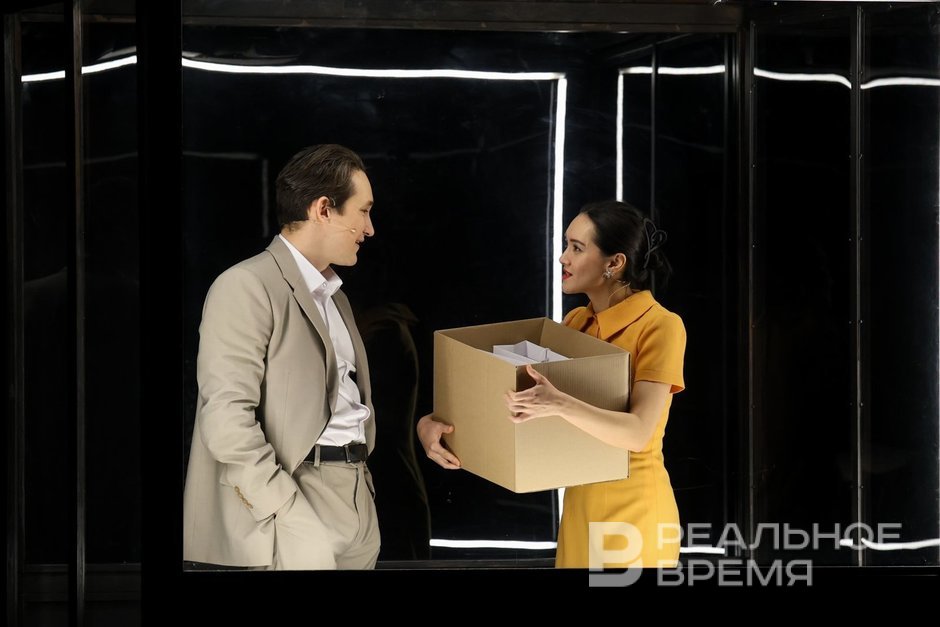
Of course, the text, full of lyrical digressions and reflections, is adapted for the stage with significant cuts. At the same time, there are quite a few characters in the play. They appear, sometimes with some explanation from Kemal, disappear, and reappear, having little impact on the plot.
We can say that, in addition to the main characters, the audience will understand the parents best in Kobelev's version. These are Kemal's father, Mumtaz (Radik Bariyev), who has his own sins on the love front. His wife, Vedjikhe (Alsu Kayumova), who, of course, knows her husband's secrets and tries to warn Kemal. Fusun's mother, Nesibe (Lyutsiya Khamitova), who both respects the wealthy relative and understands that he almost ruined her. Fusun's father, Taryk Bey, played by Ildus Gabdrakhmanov, does not go far from the stereotype of lost men not averse to alcohol (a timeless role for the actor), but is also симпатичен. Finally, Sibel's mother (Leysan Rakhimova) turns into the real Turkish singer, the «diva of the republic» Muzeyen Senar, twice and sings accompanied by a violin and a saz.
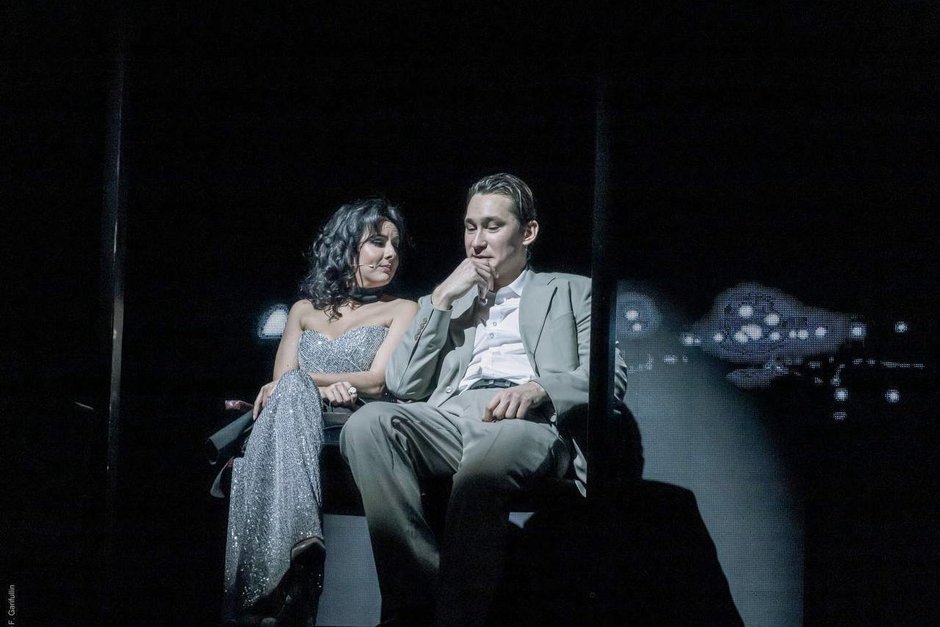
And Many More Characters
There are also characters who are the same age as Kemal, but their role is rather to voice some funny phrases and create small intrigues. For example, the entrepreneur Zaim (it is amusing how often Ilnur Zakirov plays foreign businessmen) introduces his friends to the German model Inge (Aygul Shakurova), who is advertising Turkish lemonade. Kemal chats with her in English for a couple of minutes, and after that, the audience does not see her. After Shakurova, she plays Nurjikhan, who has arrived from France in search of a husband, and for some time the audience listens to comments about how she should be with a certain Mehmed (Elvir Salimov). Kemal has a brother, Osman (Adel Ravilov), and his wife is Berrin (one of the three roles of Leysan Fayzullina). The stage adaptation also includes a detailed scene of the funeral of a fallen woman.
But there is no, for example, meeting with one of Fusun's past suitors, who was not striving for chastity and kissed in cars: «Actually, I really like kissing» — but yielded to requests only with Kemal. The main character in the novel is so jealous that he breaks the contract. Or there is no important, probably, meeting with Sibel after 31 years. Or a long conversation with the driver about the nature of Kurban Bayram.
But in the finale, there is Orhan Pamuk (played by Bariyev), to whom the main character says that he has lived a very happy life.
Set designer Anastasia Yudina fills the stage with platforms — how can one not remember something similar from «Resurrection»! Some of them are whole rooms, others are lockers, and still others are showcases. Sometimes they are almost «crystal coffins» with the dead lying beautifully in them.
Video artist Ilya Starilov shows photographs of the mentioned items in the background, and the image of Istanbul occasionally flashes, but the main innovation in terms of media is an homage to Turkish cinema. Sometimes the characters, instead of speaking themselves, озвучивают a silent film using microphones, matching the movement of their lips. In general, in a play where a lot is said about the intimate, one wants close-ups. It is worth noting that the love scenes are sensual but restrained (the choreographer of the play is Salima Aminova).
On the other hand, the Tatar theatrical language has been enriched with the expression «mäxäbbät belän şögeллänu» — «making love».

Jealousy and Manipulation
As in the novel, the main character of the play is Kemal. And the main tangible feeling is jealousy. Rishat Akhmadullin's character suffers very organically from uncertainty, comes up with schemes against other men, and collects things. It seems that in the finale we should have been surrounded by a museum with exhibits.
But we see Fusun in the showcase. We know little about the main character for most of the play because, according to the author, she does little on her own. She is seduced. She is danced with. She is married off. «Because of you, I couldn't live the way I wanted, Kemal!» — she shouts from the screen towards the end.
As for reflections on purity, on the fact that a girl should preserve herself until marriage, on «traditions» (probably, the word «traditions» triggers many Tatars, as it sounds different in their native language), these are the reflections of the Turk Orhan Pamuk, with an eye on the 1970s. Not to be confused with Tatarstan, but Kazan in 2025 is not Istanbul in 1974.
As befits a Turkish drama, the play lasts almost four hours and, it seems, could do without many unnecessary exotic details. And tell the story of love, how a young man ruined a young girl and turned her, in fact, into a thing. And then forced a talented writer to write such a novel that it now seems to us a modern version of Romeo and Juliet.