Self-employed taxi drivers set to 'bypass' localisation as alternative bill heads for State Duma
Three months before the taxi localisation law comes into force, news has emerged about the development of a new document

“On a purely human level, I’d like to look at the daredevil who would manage to persuade a driver of a Toyota Prius to switch to a Lada Granta. If the localisation law takes effect in its current form, 90% of part-time drivers and more than 15% of full-time drivers will leave the taxi sector. The industry will lose 289 billion roubles in revenue,” predicted the consequences Ivan Litvinov, head of the “Union of Self-Employed of Russia”, during a civil society discussion in the State Duma. As a protective measure, he proposed a radical move — excluding self-employed drivers from the scope of the new rules through a separate bill. Lawmakers themselves, however, are inclined to settle on amendments that would grant regions a 25% quota. Read more details in the report by Realnoe Vremya.
The main risk: hundreds of thousands of taxi drivers going underground
In the State Duma, debates have flared up once again around the high-profile law “On the Organisation of Passenger and Luggage Transport by Light Taxis in the Russian Federation”, to which localisation amendments were introduced in May this year. Under these rules, from 1 March 2026 taxi drivers will be barred from using foreign cars — only domestic vehicles or those assembled in Russia under special investment contracts (SPIC) will be permitted.
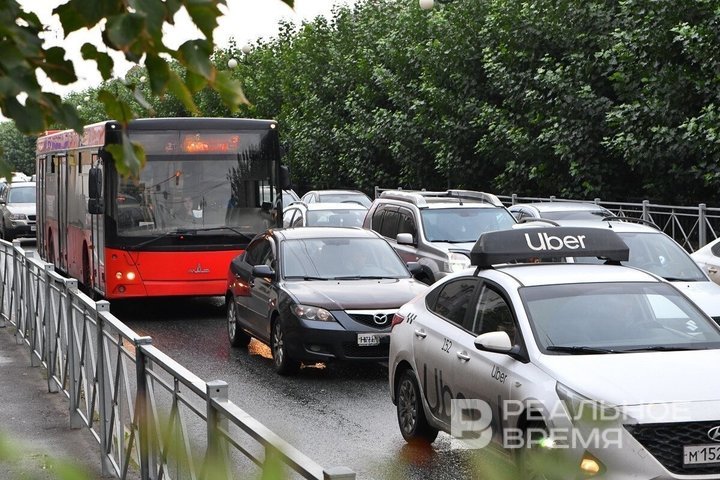
Businesses are still reeling from the shock, as the price of a new Lada Granta starts from 2 million roubles, while the annual income threshold for the self-employed is 2.4 million roubles. And it is the self-employed who provide the bulk of taxi services.
Criticism has been, as the saying goes, pouring from every direction — and it did not go unnoticed. A round-table in parliament today brought together representatives of civil society organisations advocating legislative support for self-employed taxi drivers. “Various alarming signals have repeatedly appeared in the media. The main risk is hundreds of thousands of drivers moving into the shadow economy if strict requirements remain in place,” said MP Nikolai Leonov. “Our goal is to extend the exemptions to the self-employed and preserve tax revenues.”
“Various sectoral lobbyists are trying to hold on to the rigid framework adopted during the initial discussions,” added MP Stanislav Naumov.
According to him, MPs are ready to introduce new amendments taking into account feedback from the regions. They express deep concern about the tough requirements, given that taxis play an important role in small towns where public transport does not always operate consistently. “A taxi is not just a chequered sign. It carries the interests of different groups,” the MP observed philosophically.
Only AvtoVAZ, UAZ and Moskvich: taxi drivers expect an expanded vehicle list
“The localisation law was adopted hastily, without discussion with the taxi sector. It was passed from a rather one-sided perspective,” said Andrey Kapitan, head of the Public Council for the Development of Taxis in Moscow. “Previously, mainly European and Korean brands were used. Then Chinese brands entered taxi fleets en masse. They have proved reliable and economical.”
What are the shortcomings of domestic vehicles? According to the speaker, taxis cover 100,000 km per year, and a Lada has a lifespan of no more than 120,000 km before requiring a major overhaul.
Moscow taxi fleets are waiting for an expanded list of vehicles to be approved for use from 1 March 2026. The preliminary list includes only AvtoVAZ, UAZ and Moskvich. The Ministry of Industry and Trade has promised to publish the list at the end of 2025.
Russian Transport Ministry: a 25% quota is sufficient
“Vehicles included in the registry before 1 March 2026 will be allowed to operate,” said Alexander Vasilchenko, head of the Department of State Policy in Road and Passenger Transport at the Transport Ministry.
Localisation is one of the most contentious issues of the day, he acknowledged, pointing out that regions will be given quotas of 25% for foreign vehicles, within which self-employed drivers will be allowed to work.
“To avoid a sharp reduction in the number of carriers, we propose softening localisation requirements in certain cases. In particular, we will introduce quotas for self-employed carriers to ensure a smoother transition to domestic products,” he said.
Participants in the discussion agreed that the quota could mitigate the consequences of the law. If it is not adopted, more than half of taxi drivers will leave the market, noted Alexander Apykhtin, representing taxi aggregators. “That’s around 500,000 people, and in financial terms, 25 billion roubles in losses for regional budgets,” he said.
Only in the service of an aggregator?
Aggregators believe that regulation for the self-employed should be strictly targeted, unlike for taxi fleets, as self-employed drivers provide services using their own vehicles.
“A private driver cannot and should not spend as much as a taxi fleet on complying with the law,” said Ivan Litvinov, head of the “Union of Self-Employed of Russia”, supporting this position.
He noted that today two models of passenger transport by light taxi effectively exist in Russia.
“The first is professional taxi fleets and private entrepreneurs. This is a business — it has investment, profit margins, access to preferential leasing to renew its fleet,” he said. It is reasonable to apply the localisation law to them.

The second is transport provided by private self-employed drivers using their own cars. They operate in small towns and rural settlements. Their incomes are lower and their financial capacities naturally limited. Despite the differences, the law regulates them identically and has effectively equated private self-employed drivers with a transport enterprise.
To eliminate this imbalance, work is already under way in the State Duma on a bill that takes into account the specifics of the economic activity of self-employed drivers using their own cars, Litvinov said. What does it propose? First, mandatory registration as self-employed, with the aggregator acting as a tax agent for transferring taxes. Working with one's own car must be confirmed by compulsory car insurance (OSAGO). Orders will be accepted only through an aggregator.
Self-Employed drivers contributed billions of rubles to regional budgets
Closing the discussion on the controversial taxi localisation law, Alexey Katyaev, head of Interregional Inspectorate No. 7 of the Federal Tax Service for Large Taxpayers, reported substantial tax revenues from taxi drivers in Russia. Current tax receipts from self-employed taxi drivers (relative to 2023) have grown more than fivefold as a result of active efforts to bring the market out of the shadows. These funds are allocated to regional budgets and are of great importance to them, Katyaev emphasised.

Earlier, representatives of Yandex Taxi told Vedomosti that the service intends to transfer 30 billion roubles in taxes for self-employed drivers to the Federal Tax Service by the end of 2025.
Last year, the tax service carried out extensive work to legalise the incomes of taxi drivers, achieving their transition to self-employment status. Nearly 80% of drivers now work under this regime, Katyaev noted.
The Federal Tax Service shares concerns about private drivers going underground. As part of the “Legalisation of the Taxi Industry in the Tax Sphere” project, Katyaev visited nearly 40 regions, speaking directly with drivers and fleet representatives. He expressed concern that drivers do not want to pay taxes, as they cannot be fully transparent to the state due to the impossibility of fully complying with transport legislation.