‘If the experiment has not been closed but extended, it means there is an understanding of its importance’
VEB.RF is preparing a bond issue (sukuk) worth 4 billion rubles, while the St. Petersburg International Mercantile Exchange wants to start selling halal products

“The Islamic state bank of Iran, Mir Business Bank, provided our companies Tubetey and Itle with resources to purchase equipment (under the conditions of interest-free ijara leasing — editor's note). Demand for their products turned out to be so great that the subsidiary bank had to undergo recapitalisation," said Taliya Minullina, head of the Investment Development Agency of Tatarstan, giving specific examples of the benefits of Islamic products for local businesses. The Islamic ecosystem in the republic may also be supplemented by a subsidiary bank from Malaysia, while the international auditor in the field of Islamic finance, AAOIFI, has already expressed readiness to open a Russian office in Kazan. With these results, the republic enters a new three-year cycle of the federal experiment on partnership financing. What barriers hinder the growth of deals in the regions — read the report of Realnoe Vremya.
“Of course, not all business proposals were taken into account”
The federal experiment on partnership financing has been extended for the next three years — until 1 September 2028. Behind are two years during which the instruments of Islamic banking were tested in the business environment of four regions, while the Central Bank patiently observed what amount of money would be accumulated. “3.1 billion rubles. This is very little! Although the potential of this direction is enormous," summed up Anatoly Aksakov, Chairman of the State Duma Committee on the Financial Market, speaking at the panel session of KazanForum 2025 in May.
To make it permanent, as is hoped for in the Muslim world, “worthy results” are needed, said Taliya Minullina, head of the Investment Development Agency, as she opened today’s annual meeting with key players in Islamic banking in Kazan. Representatives of all four regions participating in the experiment attended this mini-summit. Fresh figures on the volume of deals were not presented, as the Central Bank’s representative was unable to attend due to observing a silence period ahead of the meeting on the key rate.
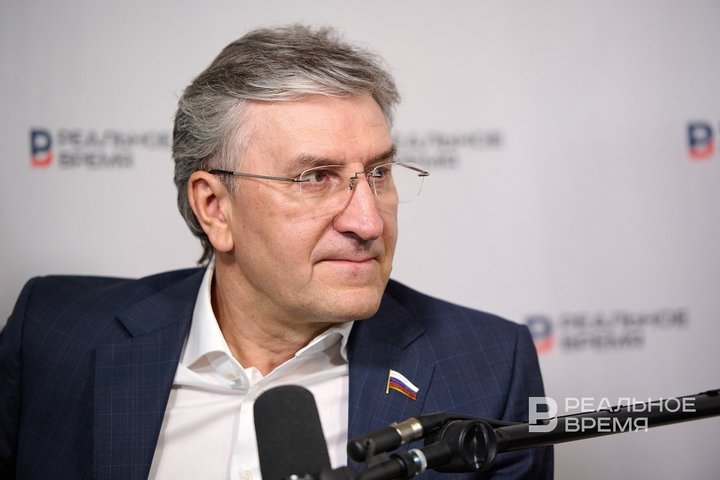
State Duma deputy from Tatarstan Ayrat Farrakhov sent a video message in which he lamented that “not all business proposals were taken into account," but noted that the very fact of the experiment’s extension is an important step forward.
“In the new law, additional regulation has been established. Of course, it was not possible to take into account all the business proposals, which continue to come in even now. But I am confident that by 2028 we will return to this issue," he assured.
Ayrat Farrakhov does not rule out that the republic may put forward a new draft law to amend its provisions. He did not specify what exactly is to be corrected. But earlier businesses complained about the unfair double taxation of Islamic banking transactions and the absence of legislative regulation for insurance of operations. In short, the field of work is vast.
Decent fashion show at KazanForum 2025 breaks viewership record
What has been achieved? The main accomplishment, according to Taliya Minullina, lies in the significant expansion of Islamic banking products. Whereas previously banks were limited to basic services — issuing payroll cards or opening current accounts according to halal standards—there are now more complex offerings: “Sukuk” (bond placement) and “Ijara” (interest-free equipment leasing). Thus, ABB has developed 12 products and this year opened an office in Dagestan in addition to its “windows” in Kazan and Ufa. Sberbank has an even wider presence, having launched 16 products. According to Iskander Khakimov, head of Sberbank’s Islamic office, 20,700 transactions were concluded in the country last year. In Tatarstan, the number tripled, with a total volume of 615.1 million rubles. The most popular service is the interest-free equipment leasing, Ijara.

But in the global world of Islamic banking, Russia is still not very visible, and Arab media do not write about it, noted the head of the Investment Development Agency. Although the market itself shows high growth rates — up to $2.3 trillion by 2024. “Tatarstan received notable mention in Arab media, but only in connection with the decent fashion show held during KazanForum 2025," she shared.
Incidentally, the event broke the viewership record. This year, the Investment Development Agency plans to repeat the success and invite a new director to film the fashion show.
Central Bank needs an English version, while Muslim developers require maternity capital
The general information vacuum around this topic is due to the Arab world not receiving fresh data about Russia in English. “The Central Bank does not have an English version, so there is no interest from Muslim countries," she believes.
A barrier to the growth of mortgage transactions remains the inability of Islamic organisations to accept maternity capital as a down payment, said Rustam Shafigullin, director of Zhilischnye Traditcii ZNK. “We have made requests regarding maternity capital more than once, but so far this has not led to success," Taliya Minullina added later.
The Scientific Secretary of the Council of Ulema of the Muslim Spiritual Board of Tatarstan, Bulat khazrat Mubarakov, identified three problems in issuing fatwas on Islamic products.
According to him, unified principles for product certification, consistent rules for Sharia supervision, and standards in expert training are needed.
AAOIFI in Kazan, Malaysian subsidiary bank awaited
Despite legislative gaps, the Islamic banking market in Tatarstan is becoming more mature. According to sources, a 4 billion ruble Sukuk issue is currently being prepared together with VEB.RF, and in the autumn, the St. Petersburg International Mercantile Exchange may begin selling halal products.
The Islamic financial ecosystem in Tatarstan may be supplemented by a subsidiary bank from Malaysia. “Which specific bank from Malaysia intends to open a subsidiary is not yet determined. During negotiations with the King of Bahrain, the republic’s head suggested establishing one. Through it, operations for selling halal products could be conducted," Minullina told journalists.
The Malaysian bank could operate on the model of Iran’s state bank. “The Islamic state bank of Iran, Mir Business Bank, provided our companies Tybetey and Itle with resources to purchase equipment (under the conditions of interest-free Ijara leasing — editor's note). Demand for their products was so high that the subsidiary bank had to undergo recapitalisation," Taliya Minullina cited specific examples of the benefits of Islamic products for local businesses.
The arrival of the international auditor AAOIFI in Kazan will noticeably strengthen confidence in Islamic finance. The Russian office of AAOIFI, the main regulator of Islamic banking, may open next year. Authorities in Tatarstan are conducting corresponding negotiations with representatives of the respected Arab organisation in the field of accounting and auditing of Islamic financial institutions, Minullina said.
“This year at KazanForum, we held an AAOIFI conference, and now discussions are underway to open an AAOIFI office in Kazan so that we can continue to advance on this topic," the head of the Investment Development Agency said.
It is recalled that the head of Tatarstan, Rustam Minnikhanov, met with the King of Bahrain, Hamad bin Isa Al Khalifa, in Moscow in May this year.

The negotiations were preceded by ongoing contacts with AAOIFI experts. “We have begun working more closely with AAOIFI. Previously, we simply translated their standards and went to consult and seek advice, but now we hold joint events with them," Minullina said.
The AAOIFI office may open by the start of the Russia — Islamic World: KazanForum International Economic Forum next year. “If the experiment has not been closed but extended, it means there is an understanding of what is needed. Three years were not enough to fully create an institutional environment," she concluded.
Someone has to provide a guarantee
Meanwhile, in other regions, distrust of these products persists, so the volume of money in transactions remains small. As Emil Gantsev, head of the Association of Muslim Entrepreneurs of Bashkortostan, told Realnoe Vremya, “the Islamic finance market is such that someone has to promise that this person will return the money. Someone has to provide a guarantee.”
According to him, people lend to each other independently. “The banking law requires setting an interest rate — any rate, because the rate cannot be zero under the banking law. But Islam rejects any markup. And that creates difficulties," he explained. “We are promised that this money will not be involved in haram, we are promised it will be kept in a closed account, and we understand that, but there will still be mixing, there will still be co-investment, and that is where the distrust comes from.”