Denis Kapustin: “Starting from 2026, there will be Ultimate World Championships”
Kazan coach, mentor of the Indian national team — about new international starts in athletics
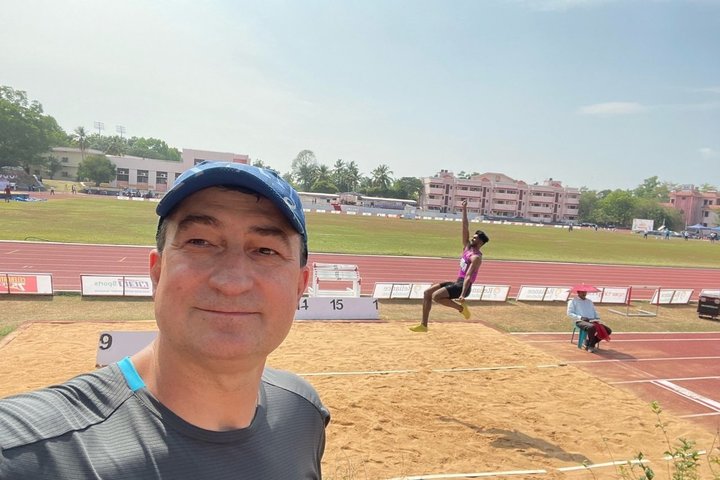
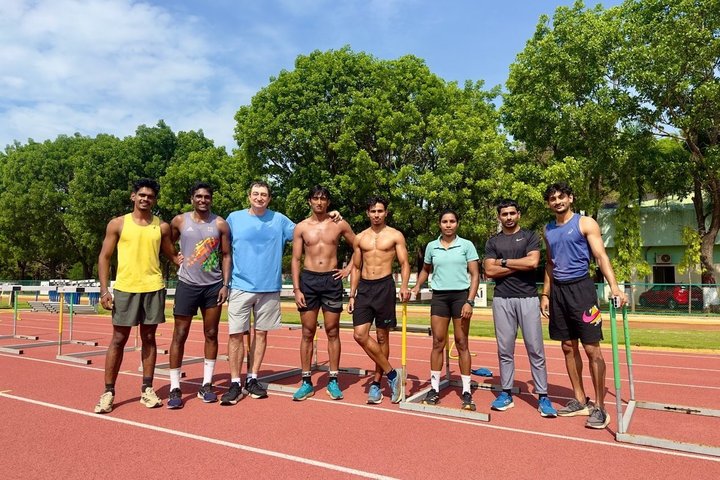
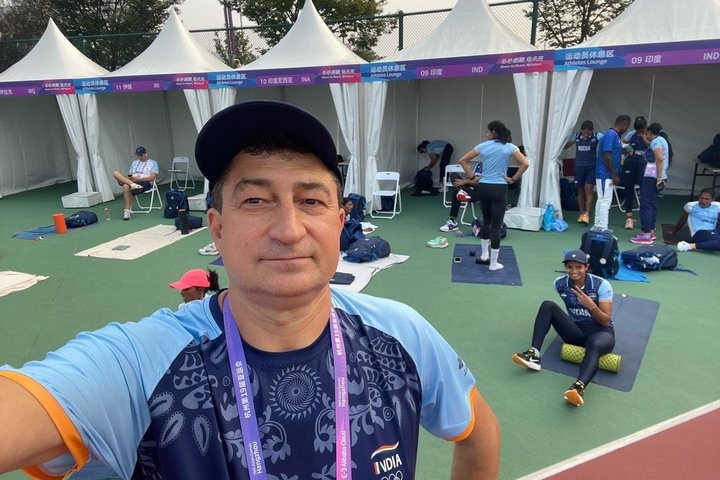
This week, the Russian Athletics Championship started at the Central Stadium in Kazan. In September, the best athletes in the world will gather in Tokyo for the World Championships, where there will be no Russian athletes. In the past, lacking international practice, our athletes were helped by match competitions against US rivals. Olympic bronze medalist in triple jump and now one of the coaches of the Indian national team Denis Kapustin spoke about this in detail in an interview with “Realnoe Vremya.”
“I cut out that frame sequence, glued it together, and hung it above my bed”
— Denis, the recently finished World Aquatics Championships in Singapore became the 22nd edition. The upcoming World Athletics Championships in Tokyo will be the 20th. The “water sports” have competed at Worlds only since 1973, while athletes made their debut later, in 1983. Do you remember that championship?
— Yes, but not very clearly. I started athletics at age 11, in 1981. By 1983, my interest in competitions was limited to school, sports school, district, or at most the city championships. The media wasn’t so developed then, and I would only get tiny notes in the newspaper “Pravda," which my father subscribed to. Only closer to the 1990s did I get more information about my favorite sport.
From my past memories, only the triple jump competitions stand out, which Bulgarian Khristo Markov won. I remember how he missed the world record by just 5 centimeters — the US athlete Willie Banks had set 17.92 meters. I liked Markov's technique, and later in “Athletics” magazine, his jump phases were shown across two pages in detailed frames. I cut out that frame sequence, glued it together, and hung it above my bed, where it stayed for about 10 years.
— Interesting, what would he say if he found out about this?
— It so happened that we met Khristo and even celebrated Easter together. I told him about that frame sequence, which moved him deeply. Khristo became the leader in jumps after replacing our champions Viktor Saneev and Jaak Uudmäe, and later he himself was replaced by American Mike Conley.
Now I begin to understand why in the past there were popular match meetings of the strongest athletics powers, like the USSR and USA, which then were akin to world championships with world records being set.
“We trained at the Kuts stadium, with a hard track where I bruised my heel”
— Such matches, starting in 1958, allowed the strongest athletes to keep in shape. There were 20 planned in total. The last was held in Tokyo, where this year’s World Championships will take place.
— The 1991 World Championships in Tokyo is the first such competition I clearly remember. It was well televised; I was rooting for Leonid Voloshin, who lost by only three centimeters to Kenny Harrison of the USA. The Conley I mentioned was third, and fourth was our jumper Vasily Sokov. At the next World Championships in Stuttgart in 1993, I competed myself. What I remember is that before the championship, we trained at Vladimir Kuts Stadium in Moscow, which was old and had a hard track surface where I bruised my heel. It was very painful, and I couldn’t train fully for three weeks and jumped at the World Championships with that injured heel.
Thanks to a successful final qualification attempt, I reached the final but again hurt my heel and finished sixth, not fully realizing my potential. The same happened at the 1995 World Championships, when I again competed with an injury caused by the hard track—this time at the Lokomotiv Stadium.
— At the 1997 World Championships in Athens, you took fourth place.
— That has its own story. Greece had a modern Mondo surface, which is “fast," and I was not used to it. I was training on our “slow” surface. As a result, I stepped on the board and overstepped multiple times. Even running slowly deliberately didn’t help. Eventually, I decided to take off a meter before the board and succeeded in reaching the final. There, I adjusted my takeoff further. On the familiar Regupol surface, I felt each step and didn’t come closer than three centimeters to stepping over, but Mondo is fast and carries you forward—you have to adapt. I lost the second place by just 10 centimeters, a place I could have taken.
In general, I was unlucky with World Championships. Preparation often involved commercial competitions, which required support staff—like a masseur who could help during the event. All my rivals had such support except me. Before the 1999 World Championships, I competed with Jonathan Edwards from England, the strongest jumper at that time and future Olympic champion. We exchanged leads during commercial meets in Lausanne. I got excited and pulled a hamstring. At the World Championships in Seville, I wasn’t fully prepared, spent more time recovering, and finished ninth.
“European Championships status is declining”
— Your fourth place at the World Championships would now be seen as a huge success.
— By the way, from 2026, the international athletics federation will hold the Absolute World Athletics Championships. The first is planned for Budapest, Hungary's capital. This competition will be held every two years. In technical events, finals will include eight participants straight away, while running events will have 16 participants with semi-finals and finals. Only the highest-class athletes will compete, without emphasis on mass participation. This so-called Ultimate Championship will replace World Cups, filling gaps in the international calendar when only stars compete.
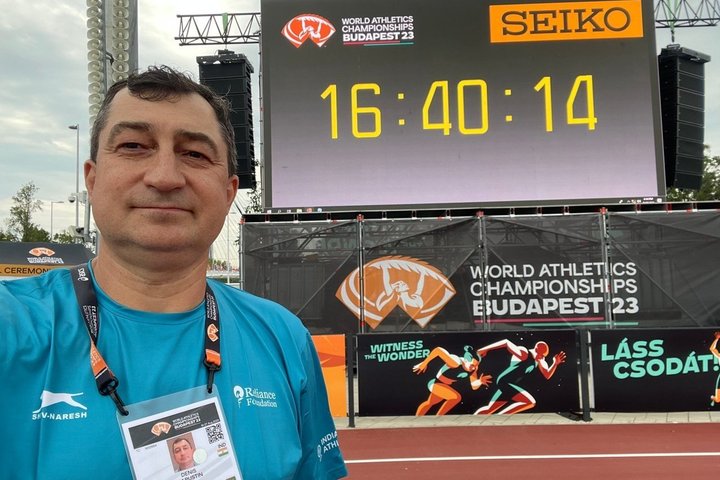
— This tournament will compete with European Championships and continental competitions in Asia, America, etc., lowering their status.
— The decline had already started when the European Championships frequency was shortened from four to two years, as it was during my career. I remember winning the 1994 European Championships in Helsinki and holding the status of Europe’s best jumper until the 1998 Budapest event. Now, European Championships are every two years, and one of those times overlaps with the Olympic year, when the championship’s status decreases.