Jurassic forest, robot Olympics, cancer vaccine
Interesting science news of the week
NASA is launching a new telescope into orbit to “hunt” for exoplanets and search for dark matter. A melanoma vaccine developed by Moderna prevents cancer recurrence. Mexico became the first country in the world to approve the use of an RNA-based fungicide. For a Netflix series, paleontologists conducted a large-scale study of what the Jurassic forest sounded like. China hosted the Humanoid Robot Games, where human records in sprinting and jumping were broken. For more details on the science news of the past week, see the review by Realnoe Vremya.
NASA's new space telescope is 100 times “more sharp-eyed” than Hubble
NASA is preparing to launch a new space observatory, Nancy Grace Roman. This optical telescope has a field of view 100 times larger than Hubble's, with a mirror diameter of 2.4 meters. The development and assembly of the telescope cost the US space agency $4.3 billion; it will be launched into orbit on August 30.
“Nancy” will work in tandem with the giant infrared observatory JWST: the telescope will detect a huge number of objects, while JWST will study them in more detail.
In its first five years of operation, the new telescope will focus on three major studies: one focused on supernovae, the second on cosmology, and the third on exoplanets. The first two projects aim to search for dark energy — the mysterious factor that scientists believe is “accelerating” the expansion of the universe.

Scientists hope to gain a wealth of additional information from the cosmological survey: to map a billion galaxies and study the effect of dark energy on galaxy clusters over millions of years. They also plan to study the distortion of galaxy shapes caused by the gravitational pull of dark matter — the invisible cosmic component that scientists believe makes up most of the universe's mass. By studying galaxy shapes, astronomers hope to calculate the locations of dark matter concentrations and, with them, the influence of dark energy.
Another task of the new telescope is a “census” of exoplanets. It is expected that Nancy Grace Roman will add about 100,000 to the 6,000 already discovered distant worlds. The reason is that this telescope will use not the transit method (where a planet's presence is detected when it passes in front of its star and blocks its light) but the microlensing method (where a star's light is magnified by the gravity of a more distant star). This is a more precise and subtle method.
Like other modern survey telescopes, Roman is designed to detect unexpected phenomena. Each time it re-surveys a patch of sky, the software automatically tracks any changes and quickly alerts astronomers worldwide — a scheme similar to that used on the Vera Rubin Telescope. Scientists hope the telescope will detect everything from binary star mergers to pair-instability supernovae — a type of stellar explosion thought to occur only with the earliest stars in the universe.
Cancer vaccine prevents melanoma recurrence: what's next?
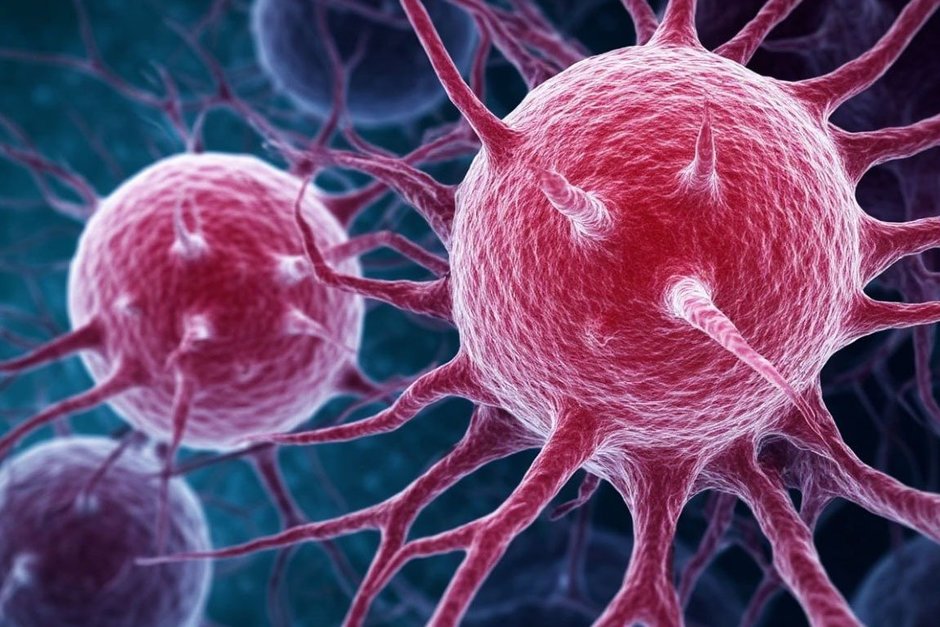
Biotech giant Moderna announced that in Phase III clinical trials, its personalized mRNA melanoma vaccine significantly reduced the risk of cancer recurrence. This is the first mRNA drug to show success in a late-stage trial for cancer treatment.
The vaccine is called intismeran. It is personalized: to create it, a tumor sample is taken from the patient, and mutations are identified that cause the cell to produce abnormal proteins — neoantigens. These serve as targets for the immune system. The mRNA vaccine, tailored specifically to each patient's neoantigens, prompts the immune system to fight the tumor precisely. That is, each patient receives their own custom-made vaccine.
The drug does not work to prevent cancer but to prevent recurrence during treatment. The study involved 1,100 patients with advanced melanoma that had been completely removed surgically. One group received the vaccine in combination with pembrolizumab (an immunotherapeutic drug), and the other received only pembrolizumab. The study showed that patients who received combination therapy had a longer recurrence-free survival period than those who received only pembrolizumab. To determine how much longer intismeran extends life after melanoma treatment, further observation of the study participants is needed.
The result obtained by Moderna brings the vaccine closer to regulatory approval for wider use. Moreover, this study proves that personalized cancer vaccines are fundamentally effective. This means that similar drugs can be developed against other types of cancer in the future.
And work on their creation is already underway: Merck and Moderna are trying the same approach to develop personalized vaccines for pancreatic, stomach, and lung cancers — Phase I clinical trials are underway. BioNTech is already testing its vaccines against colorectal cancer, pancreatic cancer, and triple-negative breast cancer. China's Chenzhen Xinhe Biomedical is testing a personalized vaccine against stomach and liver cancer.
Not only vaccines: for the first time in the world, an RNA fungicide begins to work
But RNA-based biotechnology is not limited to vaccines. Mexico has approved the use of a fungicide that uses RNA molecules to kill the fungus that causes grape powdery mildew. This is the world's first approval for commercial sale of such a biofungicide.
The drug was developed by the American company GreenLight Biosciences. In it, RNA molecules suppress genes necessary for the survival of the fungus Erysiphe necator. The fungus stops reproducing and quickly dies.

Scientists have been developing drugs to combat plant pests and infections using RNA interference for about a decade. Back in 2023, the same company released a drug to combat the Colorado potato beetle: RNA blocks the gene encoding a key protein in the beetle's body.
Such drugs are advantageous because they are “tuned” only to the organism of a specific pest or pathogen. The fungicide approved in Mexico does not harm butterflies, bees, or earthworms. It does not affect soil microflora or vertebrates. However, it could affect other (beneficial) fungi — at least, biologists honestly admit that the probability, though low, is not zero.
Next in line for approval in Mexico is an RNA drug against spider mites. Mexican authorities hope that new technologies will replace aggressive chemical pesticides and herbicides with environmentally safe biological compounds.
For a new series, scientists reconstructed the Jurassic forest chorus
In the documentary mini-series “Dinosaurs," released last year, there are sounds of the forest: chirping, trills, buzzing, rustling leaves. Not all of this is the product of Hollywood sound designers' imagination. Some of these sounds were recreated by real paleontologists based on fossilized insect wings 165 million years old.
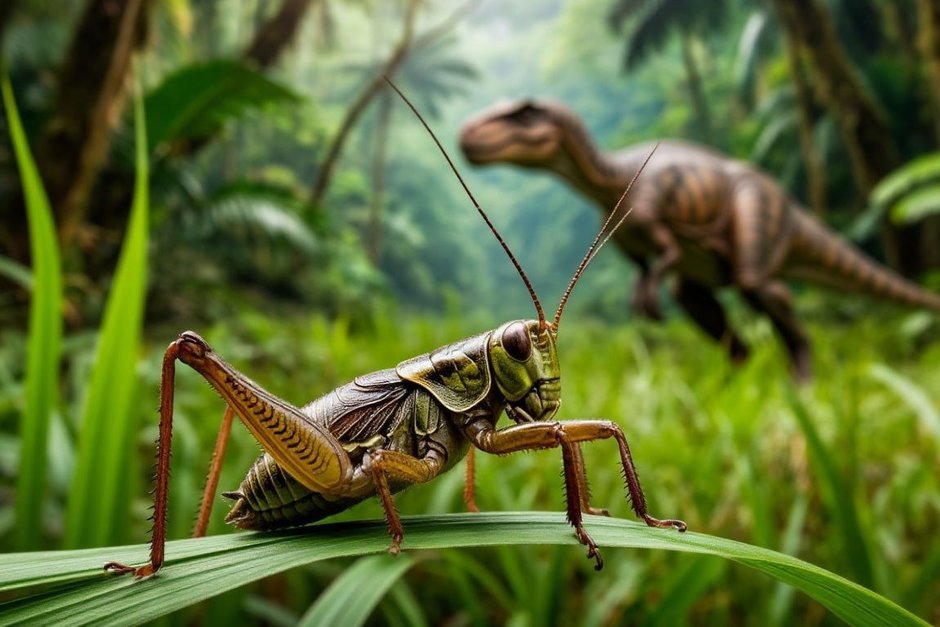
And this week, the results of the research behind this soundtrack were published. No, sound itself cannot fossilize. But some anatomical structures responsible for sound production in crickets or grasshoppers can. The “file” on the front wing of such insects is covered with tiny teeth. On the opposite wing is a tiny “scraper.” When it passes over the teeth, parts of the wing vibrate and produce sound. The pitch and structure of this sound can be reconstructed by measuring the length of the teeth, the distance between them, and the size of the vibrating area of the wing.
Scientists reconstructed a partial soundscape of Jurassic forests by studying 20 fossilized wings belonging to 9 extinct insect species that coexisted in what is now Inner Mongolia. They then conducted experiments on modern insects, performed computer modeling, and used machine learning. The biomechanical models were tested on live crickets and grasshoppers, using lasers to measure wing vibration. The result was a “chorus” that resonated in Jurassic forests and delighted dinosaur ears.
Most Jurassic crickets produced low-frequency trills similar to those we hear from their modern relatives. There were also pure, “musical” tones that sound to the human ear like whistling or chirping. Paleontologists suggest that such sounds helped insects communicate in the night forest without being detected by predators (which, by the way, could include our insectivorous ancestors — Jurassic mammals).
We cannot hear ultrasound, but modern grasshoppers produce it. One of their ancestors apparently used it too. If this reconstruction is correct, we have found one of the insect sounds that is the oldest known evidence of ultrasonic communication in animals — 100 million years before bats and their echolocation evolved.
Unfortunately, the reconstruction has limitations: the anatomy of fossilized wings reveals the pitch and type of the primary sound insects make. But the rhythm and “number of verses” of such a song cannot be accurately recreated. Because this is controlled by the nervous system and wing movement — structures that simply could not be preserved.
Humanoid robots break records in sprinting but cannot hammer nails
The second Humanoid Robot Games, held in Beijing from August 22 to 26, showed both rapid progress and flaws. Robots are breaking human sports records: for example, a robot ran 100 meters a second faster than Usain Bolt. Another android jumped 3.4 meters high, higher than the human record. A third won a table tennis match against an Olympic champion. They perform backflips and sprints along programmed trajectories. This year's Games showed that humanoid robots are developing very quickly, using AI for learning, planning, and performing actions in the real world.
But at the same time, it is clear that before people can use them for numerous practical tasks, machines have a long way to go. This was evident in what happened at the Games: robots crashed into walls, tripped, dropped barbells, and caught fire at the finish line.

Furthermore, androids still struggle with tasks requiring dexterity. Imitating the strength and coordination of the human hand is still a difficult task. It is particularly hard for robots to use tools — for example, hammering nails. Because their grippers find it difficult to maintain sufficient contact with the tool.
At the Robot Olympics, more than 600 teams competed — mostly representing Chinese universities, research institutes, and robotics companies. This year, the program was expanded: it included not only sprinting and jumping but also practical tasks — arranging books on shelves and making beds. These “scenario competitions” included both remotely controlled robots and androids performing tasks autonomously. This part of the competition is crucial for the development of helper robots. Androids should not be toys but part of everyday life, human helpers. For example, in the future, a robotic maid could make beds, and a robotic engineer could work in high-radiation environments.
However, humanoid robots still make too many errors to be widely used in real-world conditions. Additionally, they are still very expensive — the human economy is far from making them household helpers. Advanced models today cost over $100,000.