Cigarette butts in bird nests, a marker of biological age, a new antibiotic against helicobacter
Interesting science news of the week
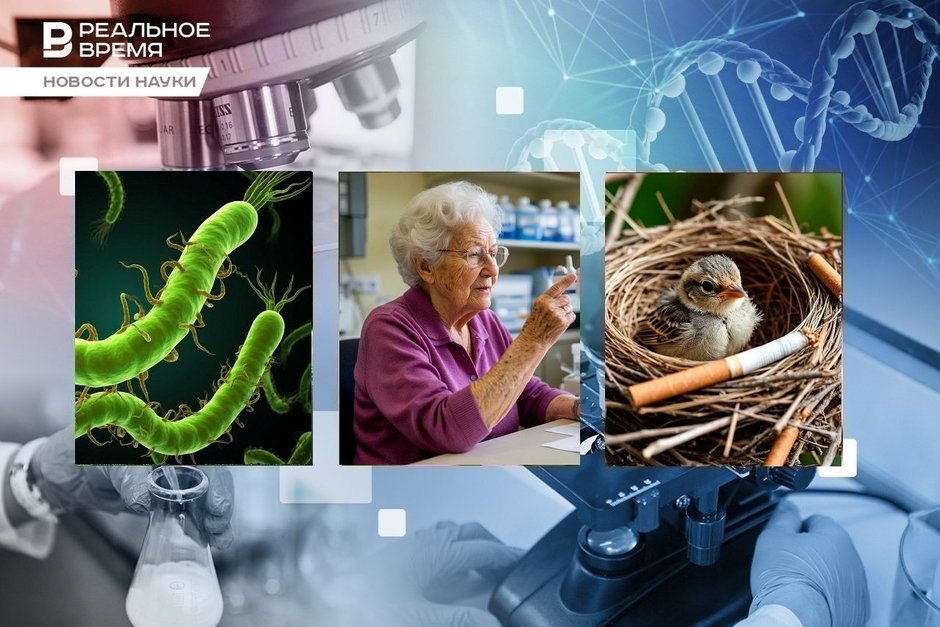
Urban birds add cigarette butts to their nests to reduce insect parasitism on chicks. Ancient fears — such as fear of heights or snakes — are hardwired by evolution into the human subconscious, unlike fear of weapons or infection. Scientists have created a modified antibiotic that is 60 times more effective than the original drug against the bacterium that causes stomach cancer. Ozempic-based drugs have reduced the risk of developing depression in diabetic patients by one and a half times. From 362 human blood parameters, 10 have been identified that best indicate a person's biological age. More details in this report by Realnoe Vremya.
Birds protect chicks from parasites with cigarette butts
Birds living in urban parks — tits, sparrows, song thrushes, finches — often use cigarette butts as nesting material. This has been observed in various countries around the world, from Mexico to the Galapagos and New Zealand. British sparrows even build nests directly in outdoor ashtrays. Ornithologists from the University of Łódź (Poland) decided to find out why they make such a strange choice.
The scientists studied the behavior of the Eurasian blue tit, a common urban bird from the tit family. It is known that blue tits build nests in enclosed, warm spaces. In such conditions, parasites — flies and mites — actively reproduce, attacking adult birds and chicks. The ornithologists began observing 99 blue tit chicks that lived in several dozen nests. These nests were divided into three types:
- Control nests: built by the birds themselves from twigs, down, and other natural materials.
- Sterile nests: the scientists placed sterilized cotton wool and artificial moss in them to avoid introducing parasite larvae and eggs.
- Tobacco nests: two cigarette butts were added to these nests.
Blood samples were analyzed from 13-day-old chicks hatched in these nests. It turned out that hemoglobin and hematocrit levels in chicks from the tobacco and sterile nests were noticeably better than in chicks from the control nests.

After the birds grew up and fledged, the scientists collected and counted the number of parasites in the empty nests. The most flies, mites, and larvae were found in the control nests. There were almost none in the sterile nests. The nests with butts had an intermediate number.
All evidence suggests that birds use cigarette butts as a means of disinfecting their nests: after all, cigarette butts contain a cocktail of toxic substances. In Mexico, birds don't just use butts for nest construction; they shred them into fibers — thus increasing the “treatment” surface area. Moreover, Mexican ornithologists found that sparrows bring an average of 10 butts per nest. And when scientists introduced mites into the nests, the female sparrows added even more butts.
This would be all well and good, except for one thing. Chicks are indeed protected from parasites that cannot withstand the toxic effects. However, signs of genetic damage have been found in the chicks' own cells. The consequences are unpredictable.
Humans are more afraid of heights and snakes than weapons and infections
There is a theory that, on a physiological level, humans are more afraid of natural threats than those posed by technological progress or acquired knowledge. According to this theory, unconscious, ancient mechanisms developed over hundreds of thousands of years of primate evolution are at play. An experiment at Charles University (Czech Republic) was conducted to test this.
119 volunteers were shown pictures divided into four categories: snakes and heights (as ancient, evolutionarily conditioned threats), and weapons and airborne infections (as modern reasons for fear). The physiological response was recorded using galvanic skin response. This reaction reflects the activity of the sympathetic nervous system: even unconscious arousal automatically activates sweat glands, moistening the skin. This, in turn, reduces the electrical resistance of the skin's surface — a phenomenon the device detects.

Afterwards, the experiment participants also consciously rated each threat on a seven-point scale.
The result confirmed the theory: people reacted most strongly and frequently to images of heights. Slightly less often, but no less intensely, subjects reacted to pictures of snakes. Modern threats elicited a weaker reaction. However, subjective reactions yielded interesting results. People consciously rated heights, weapons, and infections about the same as their unconscious galvanic response indicated. But snakes elicited an equally strong physiological response, even when the person said the picture was not at all frightening.
The study authors explain the results by suggesting that different types of threats are processed by the brain in different ways. People react to snakes unconsciously, literally feeling this ancient fear in their skin. Heights evoke both conscious and unconscious fear. However, threats like weapons or infection can evoke conscious fear, but we lack ancient subcortical pathways to process this information.
An antibiotic created against a bacterium that potentially causes stomach cancer
Nearly half of humanity is infected with the bacterium Helicobacter pylori — a microorganism that colonizes the stomach, can lead to chronic inflammation of the mucosa, and then to ulcers and cancer. It has been proven that H. pylori is one of the key risk factors for developing stomach cancer. Therapy for patients with H. pylori is most often based on metronidazole, but the bacterium has developed resistance to it, requiring constantly increasing doses of metronidazole or combining it with other drugs.
Researchers at the Technical University of Munich (Germany) studied the mechanisms of action of metronidazole and found that it not only causes oxidative stress in bacteria but also additionally blocks two of H. pylori's main protective proteins. One of these neutralizes oxidative damage, while the other repairs damaged proteins.
Having identified these mechanisms, the German biochemists “tweaked” the metronidazole molecule, modifying it to bind even more effectively to its target proteins. As a result, H. pylori loses its resistance to oxidative stress and (with luck) dies.

Laboratory experiments on H. pylori cultures showed that the modified metronidazole is 60 times more effective than the standard drug against standard bacterial strains. Antibiotic-resistant strains also proved vulnerable to the new drug. Laboratory mice were completely cured of H. pylori, requiring a low dosage of the new compound.
If clinical trials demonstrate the drug's efficacy and safety in humans, this could help prevent stomach cancer more effectively and, as the researchers immodestly note, represent a breakthrough in medicine.
Diabetes medications prevent the development of depression
Another study on the benefits of semaglutide-based drugs: researchers suggest they may prevent the increase of anxiety and even halt the development of depression. The study authors claim such drugs could be useful for psychiatric disorders associated with diabetes.
It's worth noting that type 2 diabetes affects over 800 million people worldwide (and that's just those diagnosed). Research shows that individuals with this condition are about twice as likely to develop depression as the general population.
GLP-1 receptor agonists (semaglutide and its analogs) are typically prescribed for diabetes to help patients lose weight. Until now, the effects of these drugs on mental health remained unstudied. An international team of researchers analyzed a database with medical records of nearly 95,000 patients from Sweden. All these individuals had been diagnosed with depression or anxiety and had taken various anti-diabetic drugs between 2009 and 2022. They compared periods when patients were taking GLP-1 receptor agonists with periods when they were not. Worsening of mental health was assessed based on data on hospitalizations and psychiatric consultations.
The conclusions are as follows: semaglutide and liraglutide reduced the risk of worsening mental state in people with anxiety disorders and depression. Semaglutide reduced the risk by 42%, liraglutide by 18%. Other drugs affecting GLP-1 — exenatide and dulaglutide — did not demonstrate this effect.
Regarding specific risks, semaglutide reduced the risk of worsening depression by 44% and the risk of increased anxiety by 38%. Therefore, the authors conclude, these drugs can be considered therapeutic agents with a dual action.

However, other scientists urge caution. After all, the improvement in mental health might not be directly due to the drugs, but rather to improved self-perception of one's body or symptom relief. Since the late 19th century, doctors have known about the direct link between diabetes and depression. So, anti-diabetic drugs should certainly not be prescribed as antidepressants. A direct therapeutic effect in cases of depression and anxiety disorder has not been proven.
How to determine a person's biological age
A person's biological and chronological age may not match: some people run marathons at 60, while others walk with a cane and read fairy tales to their grandchildren. But how to accurately determine a person's real biological age when we're not talking about extremes like elderly marathoners? Markers of biological aging are being developed by the international MARK-AGE consortium.
A study of 3,300 participants from 8 European countries identified age-related changes in 10 key blood markers, based on which biological age can be determined. Scientists are trying to create an integrated index using these markers — since any single marker is definitely insufficient, as aging affects all systems and organs. To identify the 10 significant markers, 362 indicators were examined for each participant!
A prototype of the integrated index was tested at the University of Konstanz (Germany). The study results showed several interesting trends. For instance, people with trisomy 21 (Down syndrome) age faster than their peers. Women over 50 receiving hormone replacement therapy are biologically younger than their peers who do not undergo it. Additionally, aging in women is accelerated by smoking (directly proportional to the number of cigarettes smoked in a lifetime).
Furthermore, the biological age indicator was used to find new clinically significant biomarkers of aging. It was found that markers such as 25-hydroxyvitamin D, high-density lipoproteins, and the proportion of T-helper cells among leukocytes begin to deviate from reference values with age. This suggests, according to the scientists, that these indicators are directly involved in aging.
Such work could open up possibilities for personalized preventive medicine in the future. Significantly extending active life is one of humanity's primary unresolved challenges.