Marat Bariev: “We stayed in touch with the FISU leadership”
President of the Gymnastics Federation of Tatarstan and former Minister of Sports of Tatarstan on the 2025 and 2013 Universiades and the performance of our athletes
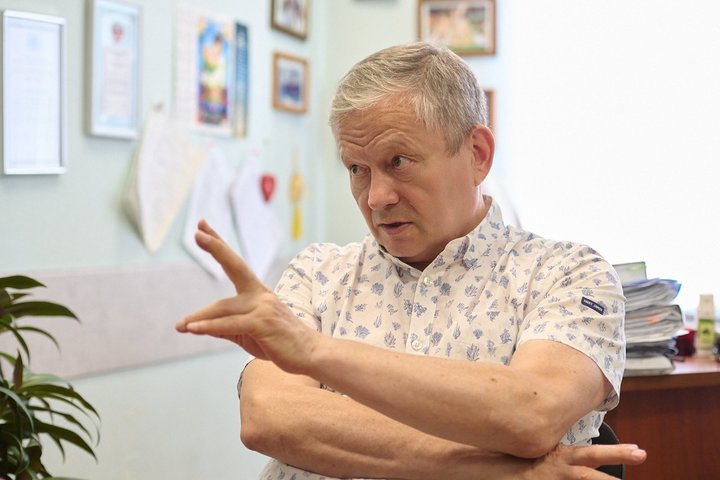
The Summer Universiade in Germany has come to an end, where Russian athletes competed under a neutral status. One of those who helped return our athletes to the international stage is Marat Bariev, deputy of the State Council of Tatarstan and president of the Gymnastics Federation of Tatarstan. In an exclusive interview with Realnoe Vremya, the former republic's sports minister talked in detail about the competition and where the Russians stood out.
“Apparently, the Germans overestimated their capabilities”
— Marat Mansurovich, how did you manage to break through the “iron curtain” and bring our athletes back to international competitions?
— Having known the FISU leadership since the time of preparations for the Kazan Universiade, including President Leonz Eder and his close team, we continued to stay in touch. In January, after the Winter Universiade in Italy concluded, there was a change in the leadership of the Russian Student Sports Union, now headed by Sergey Vladimirovich Kryukov. He visited Kazan, where we discussed prospects for returning Russian athletes to student competitions. After returning to Moscow, he spoke with the Russian Minister of Sports Mikhail Degtyarev. Mikhail Vladimirovich confirmed the leadership’s intention to resume international contacts.
Following this, on Degtyarev’s instructions, in April, Kryukov and I visited the FISU headquarters, and at the meeting with Eder, we heard they had no objections. The opposing side was Germany, the Universiade host. Nevertheless, we were allotted a quota for the number of participants, and the work began to form the team and agree on candidates for the quota — originally set at 260 people. But it turned out that the Germans somehow overestimated their capabilities and were ready to accept only 9,000 people instead of the announced 12,000. Then began a cutback, which primarily affected our delegation. In the end, only 48 athletes from Russia were admitted out of the 260.
To specify, ultimately there were no delegation members from Russia, including RCCC President Kryukov, and the minimal number of coaches who had to combine coaching duties with representation. Considering that the Universiade in Germany was not a local event like it was in Kazan or Belgrade but took place in five cities in the region, you can imagine the difficulties the Russians faced.
In total, our athletes won six gold and six silver medals, plus four bronze. Regarding Tatarstan, we should mention the gold medal in tennis won by Ilya Simakin in a duo with Yegor Agafonov from Tula. Both are students at the Volga Region University of Physical Culture. Also participating were Maria Taylakova, the winner in table tennis at the Kazan national championship this year, and judoka Khanmagomed Ramazanov, who was chosen as the flag bearer at the opening ceremony. The hero of the sports part of the Universiade was swimmer Alexander Stepanov, also from the Volga Region University of Physical Culture. He won two individual golds and a silver in the 4x200 meters freestyle relay.
“Kamil Shamilovich, how long will we have to travel to Chelny to watch football?”
— Recently Rubin announced that one of the Kazan metro stations will be called “Rubin Aviastroitel’naya” for the whole season. What was the level of involvement of the Tatarstan Ministry of Sports, focused on preparing Olympic athletes including Universiade participants, in professional teams during your time in charge?
— In 2001, when the Ministry of Sports of Tatarstan was formed and I was appointed its head, Kurban Berdyev started coaching Rubin. At that time, the ministry co-financed professional sports teams, but this funding decreased every year, and by the 1000th anniversary of Kazan, which is turning 20 years old this year, our financial support ceased. By then, the republic’s leadership had found reliable sponsors for all our sports giants. Regarding Rubin — that was the city administration led by Kamil Shamilovich Iskhakov. As for me, the greatest cooperation was with the hockey club Ak Bars.
By the way, I was a witness to when Kamil Shamilovich paid attention to Rubin. This event also marks an anniversary — 30 years. In 1995, a football tournament called the “President’s Cup” was held in Chelny, featuring the local Kamaz, Dinamo Minsk, Bulgarian Lokomotiv, and the Jordanian national team. All the republic’s and Kazan’s leadership were there. During one of the matches, President of Tatarstan Mintimer Sharipovich Shaimiev asked Iskhakov: “Kamil Shamilovich, how long will we keep traveling to Chelny to watch football?” Iskhakov, a man of old party convictions, understood the hint immediately.
— Since we are talking about anniversaries, let’s recall the 1000th anniversary of Kazan. Initially, there were about 60 planned events, but only three were sports-related: World Championships in bandy, Korash wrestling, and the Ministry of Internal Affairs fire-applied sports championship. Gradually, the celebration added more sports events — like the Znamensky brothers' athletic memorial, which, I suspect, was moved to Kazan on your initiative.
— At that time, I was part of the leadership of the Russian Athletics Federation, whose president Valentin Balakhnichev was among the honored guests of the first summer student Spartakiad held in Kazan in 2003. A year later, I learned that Moscow faced big difficulties organizing the Znamensky Memorial, and in Russia, only three stadiums were certified by the IAAF as it was called then: Tula, Cheboksary, and Kazan. We made a proposal ahead of everyone to hold the Memorial in Kazan, which became a big event for the city and a sporting contribution to the 1000th anniversary celebration, as a whole group of the world’s top athletics stars came here.
“National championships felt like the baton was being passed between Viner and Usmanov”
— At that time, the republic’s head coach Denis Kapustin recalled that the superstar of high jump Javier Sotomayor from Cuba, when asked about Kazan, replied “so-so," which can be interpreted as “not so great.”
— Unfortunately, I must say that recently the first coach of Kapustin, Gumer Abdrakhmanovich Mukhamedov, passed away. Regarding Sotomayor’s words, I suspect he was still mild in his evaluation, since Kazan in the early 2000s could hardly impress such a sophisticated guest. The other thing is that we were still developing, and already three years later, after the 1000th anniversary, we held the Russian Athletics Championship of 2008, which gained great significance as a qualifier for the Beijing Summer Olympics.
By the way, since we mentioned national championships, in 2005 we consecutively held two championships in “Basket Hall”: rhythmic gymnastics and fencing. It was initially agreed to hold the fencing championship as this sport has long traditions in the republic from Soviet times. As for rhythmic gymnastics, we reached an agreement with the president of the federation, Irina Viner. Irina Alexandrovna visited Kazan after Aline Kabayeva’s Olympic victory in Athens. We proposed hosting the national championship, and she supported the idea. Interestingly, shortly after, there was a leadership change in the fencing federation, headed by Alisher Usmanov. So in 2005, our national championships seemed like the spouses Irina Alexandrovna and Alisher Burkhanovich were passing the relay to each other.
— I remember it was planned that the absolute winner of the national championship Olga Kapranova would join the Tatarstan team.
— Aim higher, we had agreements for Alina Kabayeva to represent Tatarstan. She missed the championship in Kazan, seriously preparing for her third Olympics but got injured in spring 2008 and had to retire. However, we had our own athlete at the Olympics — Darya Shkurikhina, who won gold.
“In Kazan, Pavel Kolobkov and Alexander Pozdnyakov won their last gold medals”
— Alongside Nizhny Novgorod.
— That was the reality because Nizhny Novgorod was one of the strongest regions in group exercises, and the national team was formed based there. Consequently, Shkurikhina moved to Nizhny Novgorod to prepare for Beijing.
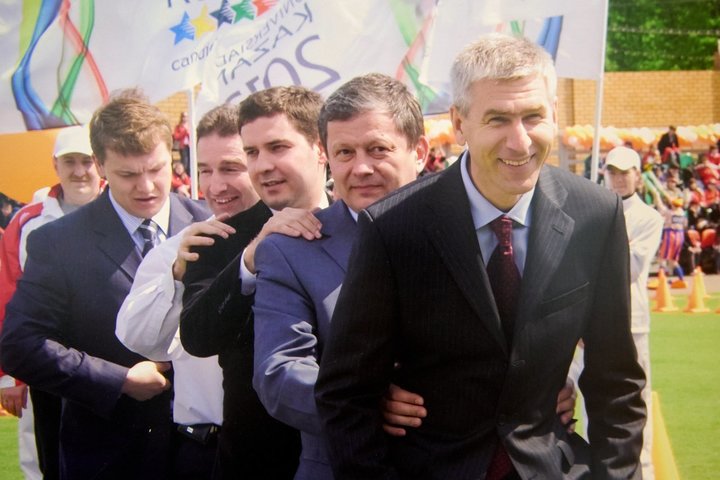
As for the Russian fencing championship, I have an interesting story. It was in Kazan where Pavel Kolobkov and Alexander Pozdnyakov won their last gold medals as athletes — future Minister of Sports and head of the Russian Olympic Committee respectively. Overall, these championships were a huge gift to the Tatarstan sports community, as earlier there had been a gap after the last USSR boxing championship held in winter 1991 at UNICS, where our Ayrat Khamatov was among the winners.
— I’ll add that in 1995 the Russian team chess championship was held in Kazan, where our men’s team took second place. This was thanks to chess enthusiast Nail Ibrahimov and the sponsors of the chess federation. Unfortunately, nowadays our men’s team did not even start at the national championship in the top league, but two leading grandmasters, Vladislav Artemiev and Artem Timofeev, became Russian champions as part of the CPRF team.
— I also recall the legendary tournament between the Teams of Tatarstan and Europe in 2001, again at the time I became Minister of Sports. I want to sincerely thank many sports enthusiasts of those years who stirred up sports officials and sponsors to engage them in organizing sporting events. Just think about those international professional boxing matches broadcast live on Channel One, the first of which took place in Kazan. This was thanks to another sports enthusiast Renat Yusupov and his team.
“The idea was born to hold a match meeting with the Hungarian team”
However, I myself was such a sports enthusiast vested with power. Now, finishing with the topic of anniversaries, the ongoing World Aquatics Championships in Singapore was supposed to mark the 10th anniversary of Kazan’s Aquatics and take place in Kazan. I came up with an idea, supported by the President of Tatarstan Rustam Minnikhanov and Minister of Sports Mikhail Degtyarev, to hold a kind of match meeting with the Hungarian team in all aquatic disciplines. Moreover, it would be at the status of not the main but student national teams.
Since you mentioned the chess CPRF team, note that in Soviet sports history, match competitions played a significant role in boxing and athletics between USSR and USA teams, and in diving with Americans and East German divers. In sports gymnastics, where I head the republican federation (which is a separate topic), we held a junior level match with Chinese athletes.
— Recently in freestyle wrestling, there was a showdown on the mat between Russian and US athletes.
— Exactly. Therefore, the idea of organizing a similar meeting with the Hungarians is under consideration. Hungary is a mighty force in aquatic sports. In swimming, we are on par, as in women’s water polo. In men’s water polo, Hungarians are stronger, and matches with them would greatly help our water polo players, as teams in team sports continue to be sidelined in international competitions. There are no political disagreements, as shown by last year’s short course swimming world championships, where Russians performed excellently — the first such event for years despite the international sports blockade.